Disability World
A bimonthly web-zine of international disability news and views, Issue no. 7 March-April 2001

table of contents - home page - text-only home page

Former U.S. President Jimmy Carter Critiques Florida Election Practices

By Kay Schriner (kays@uark.edu)

The United States is often looked to as a model of democracy by the rest of the world. But the 2000 presidential debacle has shed light on shoddy election practices.

The events of this election have raised serious questions about the way U.S. states conduct elections. In Florida, the infamous events of this fall's presidential contest have exposed the underside of American democracy. Some legally cast votes were not counted because of mechanical glitches. The absentee ballots of some military personnel were not counted because of failure to comply with complex rules governing how they are mailed to election officials. African Americans have complained that they were systematically denied their right to participate in the election.

Universal design experts have objected to the design of the 'butterfly ballot' because it is so difficult to use, and some disabled individuals have complained that they were kept from voting, or were treated unfairly by polling place workers.

Former U.S. President Jimmy Carter, whose Carter Center works with 65 nations on various democratization projects, said that he was "taken aback and embarrassed" by what happened in the Florida election. In a January 9, 2001 interview aired on National Public Radio's "Morning Edition," former President Carter said that, if the Carter Center had been asked to monitor the Florida election, it would have refused to participate. The Center will not take part in election monitoring when a country fails to follow certain procedures to guarantee the fairness and integrity of elections.

Former President Carter said that he "couldn't believe it" when he learned that Florida state election officials said they expected the error rate to be 3-4%. This is an "enormous" rate, he said.

Apparently, former President Carter is not the only prominent American who feels that this year's election indicates a need for changes in U.S. election practices.

Older equipment difficult for disabled voters to use David Broder, a political columnist writing in the Washington Post, said that state election officers are faced with budget constraints that keep them from making the changes they know are required to improve election practices. The punch card system, which Broder says is used by 31% of all U.S. voters, is part of the problem. Broder says "This is equipment that, from all we have learned, clearly is harder for voters to use than other kinds - especially if they are elderly or disabled - are harder for machines to count with precision."

Legislators are also taking notice. Senators Charles E. Schumer (Democrat-New York), Sam Brownback (Republican-Kansas), and Max Cleland (Democrat-Georgia, and the only U.S. Senator who uses a wheelchair) recently introduced a bill that would provide $10 million to the Federal Election Commission for a study of election practices.

Another bill, this one co-sponsored by Senators Mitch McConnell (Republican-Kentucky) and Robert G. Torricelli (Democract-New Jersey) would establish a bipartisan commission for the same purpose. Under this bill, $100 million would be set aside for grants to the states and localities to buy improved voting machinery.

Jim Dickson of the National Organization on Disability, who appeared with Senators McConnell and Torricelli at their press conference announcing the bill, endorsed the proposal, saying that as many as 17 million people voted in this election using "unreliable" methods.

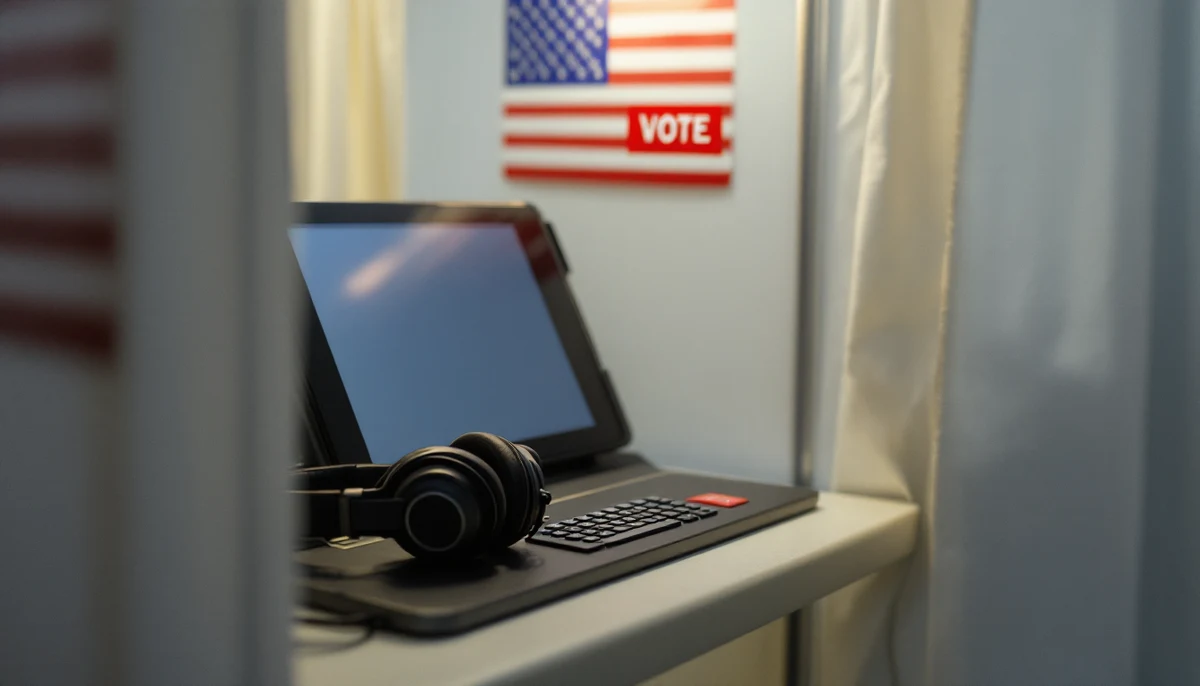
Technology to increase accessibility of voting Meanwhile, there have been significant technological developments that may help election officials make elections accessible to persons with disabilities. EZ Access Interface technology has been used to develop a voting "kiosk" that is accessible to people with a variety of impairments. This technology, developed by the Trace Research and Development Center, is an important advance in voting machinery. A picture of the kiosk can be seen on the Center for an Accessible Society website (www.accessiblesociety.org).

For more information, check out these resources:
The Center for an Accessible Society website (www.accessiblesociety.org), which contains several articles about voting rights, and the voting rates among people with disabilities.

The Trace Research and Development Center website (www.trace.wisc.edu/world/ez) for more information about the voting kiosk.

John Broder's article entitled "Senators Back Proposed Bills to Modernize U.S. Elections," appeared in the December 6, 2000 New York Times, www.nytimes.com

David Broder's column entitled "In Need of an Overhaul," appeared in the December 6, 2000 Washington Post, www.washingtonpost.com


table of contents - home page - text-only home page