
Disability World
A bimonthly web-zine of international disability news and views • Issue no. 12 January-March 2002


table of contents - home page - text-only home page

Accessible Cities Project in Ekaterinburg, Russia
By Lena Lyenteva; translated by Erin Trouth

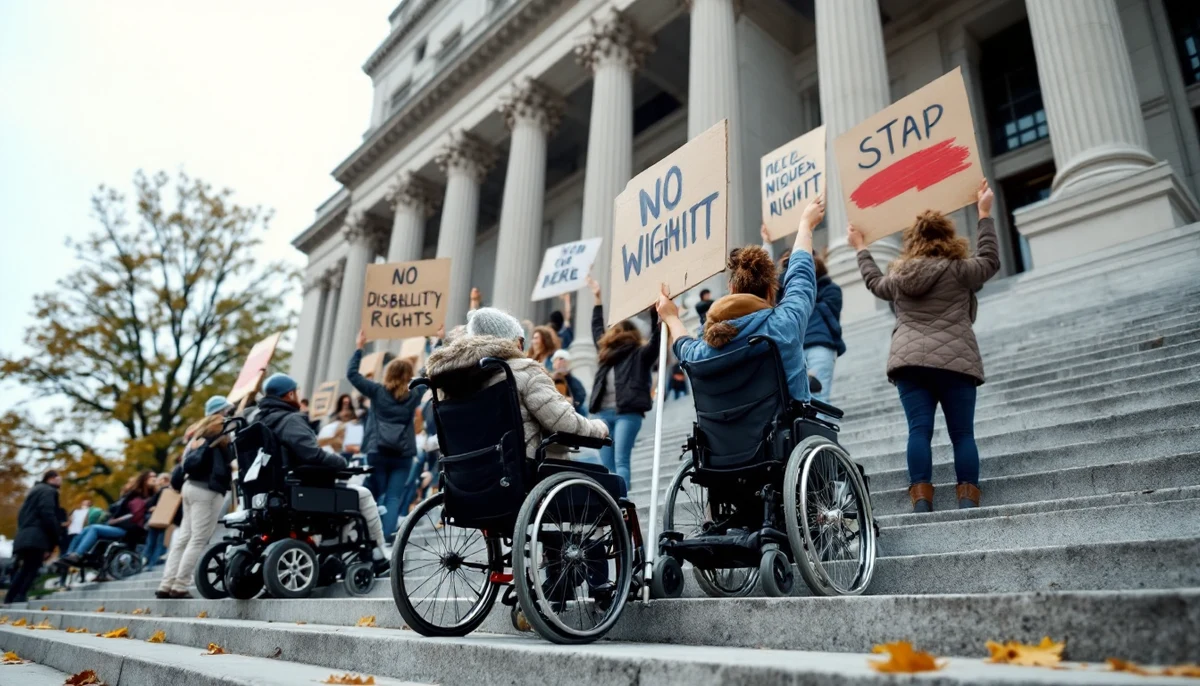
The "Accessible Cities" project is aimed at improving the quality of public buildings in the city of Ekaterinburg from the point of view of wheelchair users, organized by the Freedom of Movement Society of Wheelchair Users of the City of Ekaterinburg.

On January 1, 1999, the 15th article of the Russian federal law on the social protection of disabled people came into force. The article requires that disabled people have free access to public areas, public transportation, and other objects of infrastructure. In Ekaterinburg, the local government developed the "Disability" program, which included provisions for the introduction of accessible structures. As part of this program, "call buttons" appeared throughout the city. A person who cannot manage to get in to a certain building can push the call button to summon the help of personnel or security guards.

The original idea was to put these buttons in buildings that would be impossible to make accessible. But of course, call buttons soon became the norm, since the difference between putting in a call button and building a ramp is "like night and day." Nevertheless, some accessible infrastructure was created, but not without pressure from disabled people. And then a group of wheelchair users and people who walk with crutches (who would later become the core of the newly registered Freedom of Movement Society) went around the city to inspect the new structures. It turned out that most of what had been built was not actually accessible to disabled people. "Small" defects - the angle of ramps, the width of sidewalks, the lack of banisters or their height, the difficulty of opening doors, among other things - made the efforts of the activists and the government all in vain.

Winning respect for expertise
Freedom of Movement's first action was to draw up a list of places that were in the most urgent need of being made accessible. The city government supported this project, because they needed the advice of wheelchair users of where to begin. It was this list that first put Freedom of Movement in contact with the city government and earned it the government's respect. Thanks to the trust and authority that they had won, Freedom of Movement was easily able to ensure that some of its representatives were included on the commission for improving accessibility. They were given quite a bit of power: Freedom of Movement had to approve of any project the commission chose to undertake.

As the commission negotiated, a number of important facts came to light. The most important thing was that everyone realized that no one in the city government knew anything about building. Freedom of Movement came to the conclusion that they themselves should learn everything they could about construction and present their demands to the architects. The organization created a set of guidelines, and the architects accepted them eagerly - the guidelines laid everything out very clearly. In addition, they were very happy to receive hard-to-find technical literature from Freedom of Movement. They also took pictures of all of the objects they intended to restore. These photographs were a very clear illustration of what needed to be done and how to go about doing it so that the result would be both attractive and accessible.

300 projects under consideration
Since the beginning of Freedom of Movement's project, 110 buildings have been considered, and as a result some 300 construction projects have been suggested. Of these 300 potential projects, only places required for normal, everyday living and located on the first floor of former apartment buildings will actually be undertaken, because it is specifically in these places where it is especially difficult to ensure accessibility. Only eight of these 110 buildings are fully accessible to wheelchair users, and six are considered partially accessible - the ramps leading to their entrances are somewhat steeper than the norm, but they can be easily and safely used. The remaining buildings have nothing but call buttons.

But it must be noted that in none of these buildings is there a problem with banisters. Today all buildings are required to have convenient banisters corresponding to height requirements, even if there are only two or three steps. All new construction in the city must be built according to legal norms, and most new buildings are in fact accessible, especially to wheelchair users.

City is changing in front of our eyes
New construction is changing the city in front of our eyes. All new streets in Ekaterinburg are built with sidewalks lowered to make crosswalks accessible, parking spaces are set aside for disabled people, the city is beginning to build three underground crosswalks with gently sloping ramps, all new brick and stone buildings are built to be convenient for wheelchair users (including having accessible grounds), even office buildings must be accessible to disabled people. In these accessible buildings, but not in ordinary buildings, special attention is paid to the restrooms. For example, in the city center there is a public restroom with special stalls for disabled people.

Guidebook issued
The Dirigible Mall, the largest in the Urals, opened on March 6th, is the real pride of the Freedom of Movement Society. The mall provides all possible conveniences for disabled people, including restrooms with wheelchair accessible stalls and stalls with handrails for people who use crutches. Today renovations are being done on the city's main movie theater, two colleges and three high schools to make them accessible to wheelchair users. There is an agreement pending on a project to renovate all the city government buildings, and work has already begun on the mayor's office. At the present time a brand new guidebook for wheelchair users, Accessible Ekaterinburg, is ready for publication. The book lists all the city's accessible buildings and describes all the local attractions from the point of view of their convenience to disabled people.

The mayor assures us that this is how things will always be. At a meeting of the Mayor's Coordinating Council on the Affairs of Disabled People, of which several members are Freedom of Movement representatives, it was noted that in Ekaterinburg city administration and disability organizations had managed to form a partnership that has provided mutually beneficial results. For this reason programs proposed by disabled people were included in the city's "Disability" project, and will in the future continue to be financed from the city's budget.

Freedom of Movement Society
112-100 Bebelya St
Ekaterinburg, 620034
Tel. (3432) 45-3067.

table of contents - home page - text-only home page


Email this article to a friend!