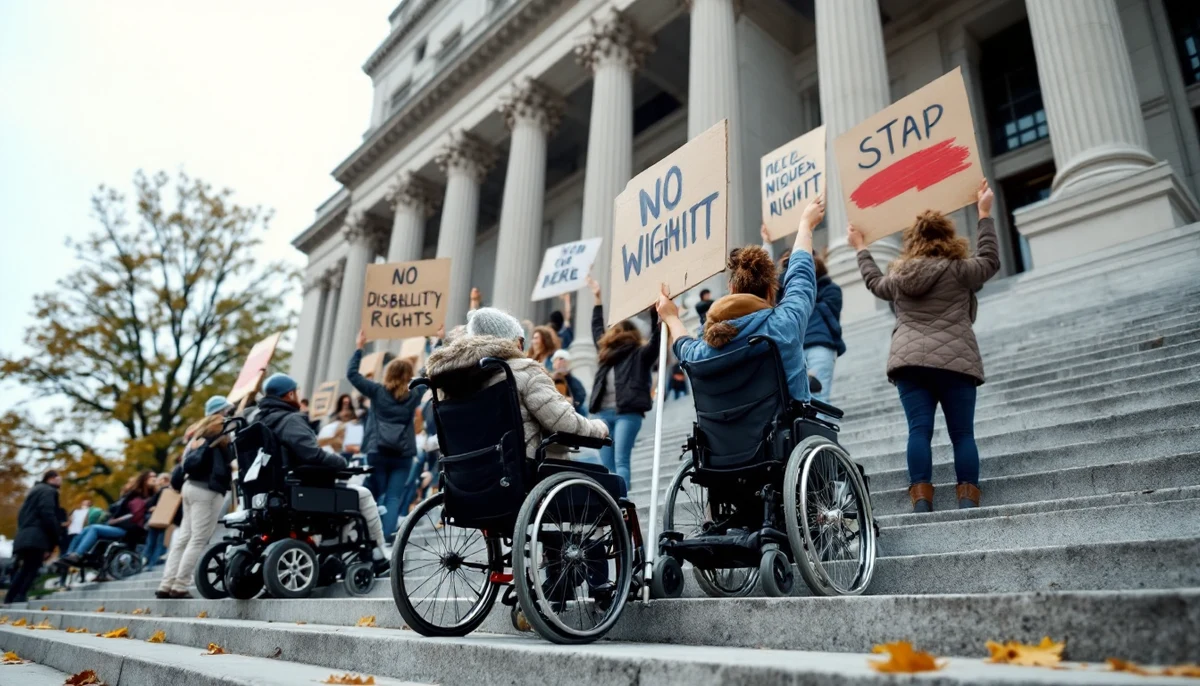
Image description: Disabled activists with placards and wheelchairs gathered on the steps of a government building, photographed from a low angle against an overcast sky.
Reading Time: 13 minutes
For most of the twentieth century, disability was treated as a medical misfortune to be managed by professionals and, very often, hidden away. Disabled people were patients, beneficiaries, and inmates — rarely citizens with rights. The modern disability rights movement is the story of how that frame was overturned: how a scattered set of self-help groups, parents’ associations, psychiatric survivors, and disabled veterans came to insist that the problem was not their bodies but a world built to exclude them. This is a primer on that history — the ideas, the protests, and the laws — from the institutions of the 1950s to the UN Convention on the Rights of Persons with Disabilities and the enforcement landscape mapped across our national regulations index.
The through-line is a single conceptual shift, repeated in different national keys: from charity to rights, from the medical model to the social model, from “care” delivered to passive recipients to self-determination claimed by an organised political community. The slogan that came to encapsulate it — “nothing about us without us” — was not a piece of branding. It was a demand that disabled people be the authors of the decisions, laws, and services that govern their lives.
The institutional baseline
To understand the movement, you have to understand what it pushed against. In the mid-twentieth century, the dominant response to significant disability in the industrialised world was segregation: residential institutions, “colonies,” asylums, and special schools that removed disabled people from ordinary community life. Conditions in many were grim, and the institutions were rarely accountable to the people inside them.
The darkest expression of the medical model was the Nazi “Aktion T4” programme, under which the German state systematically murdered disabled children and adults between 1939 and 1945 — people judged “lives unworthy of life.” The history is not a digression. It is the extreme endpoint of a logic that treated disabled existence as a problem to be solved by experts, and it shaped the post-war human-rights consciousness that the disability movement would later draw on. Disability arts and remembrance work — documentary film, memoir, the recovery of individual stories from the camps and the wards — has been central to keeping that history visible rather than buried.
By the 1960s, exposés of institutional conditions in the United States, the United Kingdom, and Scandinavia were prompting a reckoning. The principle of “normalisation”, articulated first in Scandinavian social policy, argued that people with intellectual disabilities were entitled to patterns of everyday life as close as possible to the mainstream. It became one of the intellectual seeds of deinstitutionalisation.
The independent living movement
The movement’s organisational breakthrough came from disabled people organising themselves. In the United States, the pivotal figure was Ed Roberts, who in 1962 fought his way into the University of California, Berkeley, despite an administration that doubted a man who used a wheelchair and an iron lung could study there. Roberts and a group of fellow disabled students — the “Rolling Quads” — built a campus support network, and in 1972 founded the Center for Independent Living (CIL) in Berkeley. The CIL model was radical in a simple way: services for disabled people should be designed and run by disabled people themselves, oriented not around cure or care but around the supports — personal assistance, accessible housing, transport, peer counselling — that make self-directed community life possible.
The independent living philosophy spread quickly to a network of centres across the United States and then internationally, and it reframed the entire policy conversation. The question was no longer “how do we care for disabled people?” but “what barriers prevent disabled people from living the lives they choose, and how do we remove them?” That reframing — barriers, not bodies — is the practical heart of the social model.
The social model of disability
If the independent living movement supplied the organising energy, British activists supplied the theory. In 1976 the Union of the Physically Impaired Against Segregation (UPIAS) published its Fundamental Principles of Disability, drawing a now-famous distinction between impairment (a feature of the body or mind) and disability (the disadvantage imposed by a society organised around non-disabled norms). The disabled academic Mike Oliver later named and systematised this as the social model of disability.
The social model did not deny impairment or pain. Its claim was about causation and responsibility: a wheelchair user is not disabled by their legs but by the staircase; a Deaf person is not disabled by deafness but by a hearing society’s refusal to provide sign language. That shift moved the obligation to act from the individual onto society — onto architects, employers, broadcasters, and lawmakers. It is the conceptual engine behind every accessibility statute that followed, and it underlies the modern compliance framework explained in our guide to how compliance, conformance and accessibility differ.
Three models, briefly
The medical model locates the problem in the disabled individual and seeks to cure, fix, or care for them. The social model locates the problem in disabling barriers — physical, attitudinal, and institutional — that society can choose to remove. The human-rights model, which the UN CRPD adopts, builds on the social model but adds that accessibility and inclusion are matters of enforceable right, not goodwill — and that disabled people are rights-holders entitled to remedies when those rights are breached.
The 504 sit-in and the American statutes
The United States produced the movement’s most iconic direct action. Section 504 of the Rehabilitation Act 1973 contained a single sentence prohibiting discrimination on the basis of disability by any programme receiving federal funds — the first US civil-rights protection for disabled people. But for four years successive administrations refused to sign the regulations that would give it force. In April 1977, disabled activists occupied the San Francisco federal building of the Department of Health, Education, and Welfare for 26 days — the longest occupation of a federal building in US history. Led by figures including Judy Heumann and supported by the Black Panther Party, who delivered hot meals to the protesters, the 504 sit-in forced the regulations to be signed unchanged.
The campaign culminated in the Americans with Disabilities Act (ADA) of 1990, the most comprehensive disability civil-rights statute of its era, banning discrimination in employment, public services, and places of public accommodation. The image that defined its passage was the “Capitol Crawl” of March 1990, when disabled activists abandoned their wheelchairs and mobility aids to haul themselves up the steps of the US Capitol, dramatising exactly the kind of barrier the bill was meant to abolish. The direct-action group ADAPT, which had spent the 1980s blocking inaccessible buses under the banner “We Will Ride,” was central to that pressure — a campaign we trace forward in our explainer on the accessibility of public transport. The ADA’s promise of access to public accommodations is also the legal ancestor of today’s web-accessibility litigation, covered in our ADA Title III guide.
Deinstitutionalisation and the survivor movement
In parallel, a movement of psychiatric survivors and people with intellectual disabilities challenged the institutions directly. The push for deinstitutionalisation — closing the large residential asylums and moving support into the community — was driven both by the normalisation principle and by litigation exposing abuse and neglect. The self-advocacy movement, organised internationally under the banner People First from the 1970s, asserted that people with learning disabilities could speak for themselves and make decisions about their own lives, against a system built on the assumption that they could not.
The legacy is double-edged and still contested. Deinstitutionalisation freed hundreds of thousands of people from custodial institutions, but where community supports were under-funded, some were left without the assistance they needed. The unfinished business — adequate community support, an end to coercive treatment, the right to legal capacity — runs directly into Article 12 (legal capacity) and Article 19 (living independently and being included in the community) of the modern CRPD.
The international turn: from declarations to a treaty
The United Nations moved in stages from soft aspiration to binding law. The General Assembly proclaimed 1981 the International Year of Disabled Persons, followed by the World Programme of Action concerning Disabled Persons (1982) and the Decade of Disabled Persons (1983–1992). In 1993 the General Assembly adopted the Standard Rules on the Equalization of Opportunities for Persons with Disabilities — influential, but not legally binding and without an enforcement body.
The decisive shift came in the 2000s. Disabled persons’ organisations, coordinated through the International Disability Alliance, pressed for a binding treaty, and the negotiations themselves became a demonstration of the movement’s central principle: disabled people and their organisations participated directly in drafting, to a degree unprecedented in UN treaty-making. The Convention on the Rights of Persons with Disabilities (CRPD) was adopted on 13 December 2006 and entered into force on 3 May 2008 — the fastest-negotiated human-rights treaty in UN history and now among the most widely ratified. Its enforcement architecture, two decades on, is the subject of our dedicated analysis of twenty years of the CRPD.
| Year | Milestone | Significance |
|---|---|---|
| 1972 | Berkeley Center for Independent Living founded | Services by and for disabled people |
| 1973 | US Rehabilitation Act, Section 504 | First US disability anti-discrimination provision |
| 1976 | UPIAS Fundamental Principles | Impairment/disability distinction |
| 1977 | 504 sit-in, San Francisco | Regulations signed under pressure |
| 1981 | UN International Year of Disabled Persons | Global visibility |
| 1990 | Americans with Disabilities Act | Comprehensive US civil-rights statute |
| 1995 | UK Disability Discrimination Act | First UK anti-discrimination law |
| 2006 | UN CRPD adopted | Binding human-rights treaty |
Beyond the Anglosphere
The narrative is often told as a US and UK story, but the movement was always plural. The United Kingdom’s Disability Discrimination Act 1995 followed years of direct action by the Disabled People’s Direct Action Network (DAN), including activists chaining themselves to inaccessible buses. Across continental Europe, statutory employment-quota systems — in Germany, France, Italy, Austria, and Poland — reflected a different, more corporatist tradition of disability policy, one we examine in our analysis of disability in the workplace. Japan and the wider Asia-Pacific region developed their own frameworks, and the post-2008 wave of CRPD ratifications drove new national statutes across Africa, Latin America, and the Middle East.
What unites these strands is the move from a politics of charity to a politics of rights — and the insistence, everywhere, that disabled people themselves lead it. The phrase “nothing about us without us”, popularised by the scholar-activist James Charlton in his 1998 book of that title, captured a principle that had been latent in the movement for decades and is now written into the CRPD’s consultation duties.
From the streets to the standards
The movement’s latest frontier is digital. The same logic that demanded curb cuts and ramps now demands accessible websites, apps, and public-sector digital services. The technical expression of the social model online is the Web Content Accessibility Guidelines (WCAG), and its legal expression includes the EU’s European Accessibility Act and the procurement standard EN 301 549. The barriers have changed shape — a missing alt attribute instead of a missing ramp — but the claim is identical: an environment that excludes disabled people is a problem the builders of that environment are obliged to fix. Organisations that want to find those barriers can begin with a free accessibility scan.
The history is not finished. Institutionalisation persists, legal capacity is still denied to many, the disability employment gap remains stubbornly wide, and enforcement of even the strongest statutes is uneven. But the conceptual victory is real and largely won: disability is now understood, in law and increasingly in culture, as a matter of rights and barriers rather than charity and defect. That shift was not granted. It was organised, argued, and occupied into being by disabled people — which is, in the end, the whole point of “nothing about us without us.” Continue with our wider 2026 reporting record and the national regulations index.