
Disability Buzz
The longest Oscar night in history is now over, with "A Beautiful Mind," the portrait of John Nash, a prominent scientist struggling with schizophrenia, capturing the Best Picture and three other awards. Several articles in this issue of Disability World focus on recent films with disability themes, including a view from culture reporter, Robyn Hunt of New Zealand, and a protest by Support Coalition International. The protest by mental health advocates claims that the producers of "A Beautiful Mind" had caved into the drug industry by scripting into the film that Nashıs condition improved when he "took newer drugs." In fact, Prof. Nash has released statements clarifying that his mental health improved over the years without reliance on drugs. The controversy got some serious coverage in The Los Angeles Times, but for the most part was obliterated by crossfire between film industry titans in the heated race for the awards.

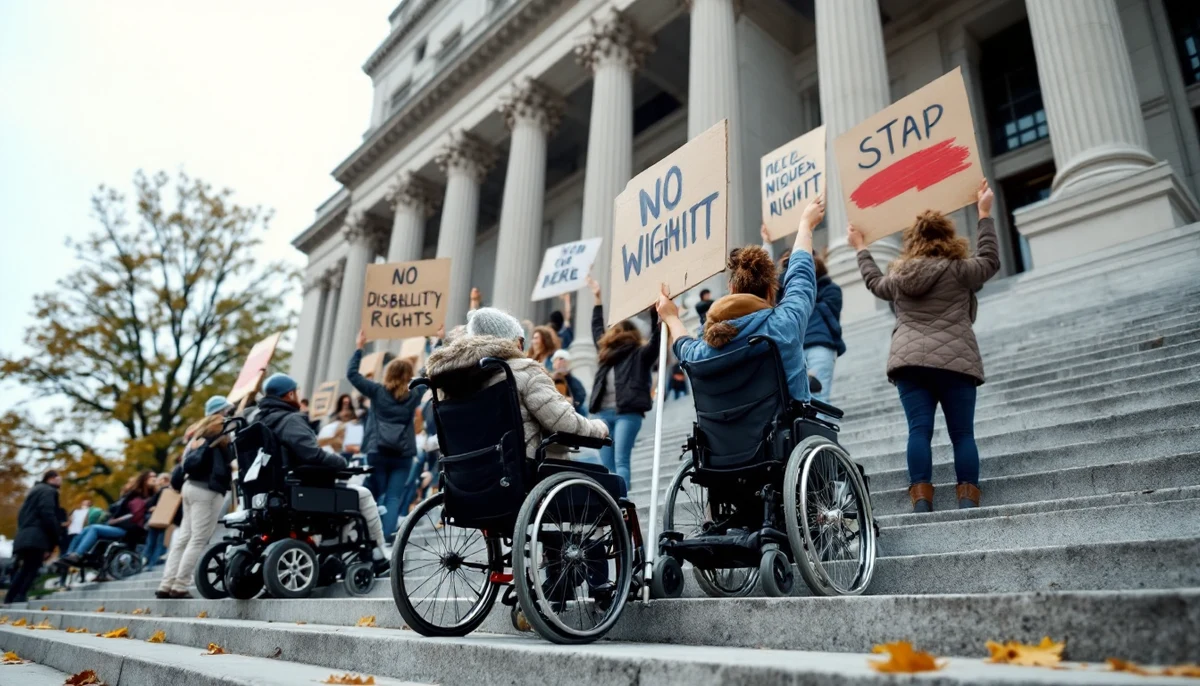
Two days before the Academy Awards, the U.S. disability issues radio program called "On a Roll," blasted the film industry for not making sure that the new Kodak facility, purpose-built to house the ceremony, was accessible. On a Roll guest Christopher Reeve, the film star and director who now uses a wheelchair, was clearly outraged by the oversight, and with his connections, the problems will probably be fixed. It is not, however, a good sign that in 2002, 12 years after the passage of the ADA, connections are still needed to achieve accessibility on "the street of dreams."
The Yellow-Brick Road to a UN Convention
Featured in this issue is a story by new Disability World reporter Mike Ervin about progress in the last couple months toward a United Nations Convention on disability rights. Representatives of the International Disability Alliance (IDA) met in New York during February with governmental participants in the annual review held by the UN Commission on Social Development. The discussions showed there is receptivity to the idea among many poor countries, but still a lot of work to be done to convince some of the wealthy countries.
The major change since the last issue of Disability World is that the European Union has decided to support the idea, now that the commissioned study on the need for such a convention (by lawyers Gerard Quinn of Ireland and Theresia Degener of Germany) has been released. That will be the next hurdle for the Convention: the annual progress and planning meeting of the UN Commission on Human Rights, taking place in April in Geneva. Representatives of the IDA will be meeting with representatives of the 40 countries with current membership on the Commission, and we will report the outcomes of these meetings in the next issue.
Meanwhile in Washington, D.C. in April the first of a series of meetings planned by the National Council on Disability to build U.S. support for the proposed UN Convention, will take place. This seminar will examine the strategic experiences and lessons of other recent UN human rights campaigns, such as banning landmines.
International Conferences
With this issue of Disability World, we introduce an expanded listing of international disability related conferences taking place in 2002. If we have overlooked yours, please let us know.
Harold Russell: in Memoriam
Following is a tribute to Harold Russell, most likely the first disabled actor to win an Academy Award. Trivia buffs will know it was the only time two Oscars were awarded for the same role: the first one was earned as Best Actor fair and square and the second was given as a "special award" because the Academy did not think he would win the first one.
Remembering Harold Russell
By Norman Acton (kenea@xtalwind.net)
We have lost a friend whose warm, crooked smile was known around the world, a man who instead of hands used hooks, and who combined the two -- the smile and the hooks -- with a generous heart to inspire whomever he met. Harold Russell passed away January 29th after a heart attack in a Massachusetts nursing home where he spent his last days.
Russell, serving as a paratrooper in World War II, lost both his hands in a training accident. After his rehabilitation, when he demonstrated great skill in using prosthetic hooks, he was cast in a training film that was seen by the Hollywood people who were casting a picture -- The Best Years of Our Lives -- that included a war disabled veteran and his problems. Russell took the part and his performance won two Oscar awards, one as best supporting actor and a special one for "bringing aid and comfort to disabled veterans through the medium of motion pictures." The image of the smile and the hooks was born.
While he subsequently played a few parts in movies and TV, the bulk of his life's attention was directed to activity related to veteran's affairs and disability issues. He served as national commander of the AMVETS (American Veterans of World War II and Korea) and was a founder and Board Member of the World Veterans Fund which provided U. S. support for the World Veterans Federation. He created and managed a consulting service to assist disabled people get employment.
In 1961, President John F. Kennedy appointed Russell Vice Chairman of the U. S. President's Committee on Employment of People with Disabilities and, in 1964, President Lyndon Johnson made him Chairman of the Committee. He held that post until 1968.
Russell was keenly interested in international affairs and frequently joined in the work of the World Veterans Federation. Here, as in his other doings, the combination of the smile and the hooks worked its magic. To cite one experience: during the 1960s, we presented to many of the world's leaders a WVF appeal to support the United Nations in the search for peace and respect for human rights. Harold joined us in a delegation received by Kwame Nkrumah, then the President of Ghana and a leading voice in the pan-African liberation movement.
After the formalities, the president summoned an equerry bearing a large tray of drinks in elegant crystal stemmed glasses. The man approached Harold. Nkrumah, probably fearing a problem with the hooks and the glasses, leapt to assist. But, by the time he arrived, Harold had with great dexterity plucked a glass from the tray and, gracious as a duke of the royal blood, raised it in toast to the president.
When it was time for us to leave, I looked around for Harold and found him with Nkrumah, jacket off, demonstrating at the president's request how the harness controlled the hooks.
The smile and the hooks. That's half the story. The second half came a few hours later when we were strolling through the Accra market. Missing Harold, I retraced our steps and found him in the midst of a dozen urchins, holding a paper cup of beer with all the grace he had applied to the presidential crystal. And then, with the same hyper charge of enthusiasm, demonstrating the harness.
Seeing me, Harold shouted, "The Best Years was here -- on TV. They've all seen it." And the kids, bubbling with excitement, singing "Ya -- ya ya", dancing in a circle, pointing at and touching their new friend.
I saw this repeated many times around the world. The Best Years of our Lives has had, and continues to have frequent exposure on TV and the big screen. When you see it, you easily understand that the audiences are not likely to forget the guy with the smile and the hooks.
The smile and the hooks. An image that many of us who had the privilege of knowing Harold Russell will not ever forget.
|