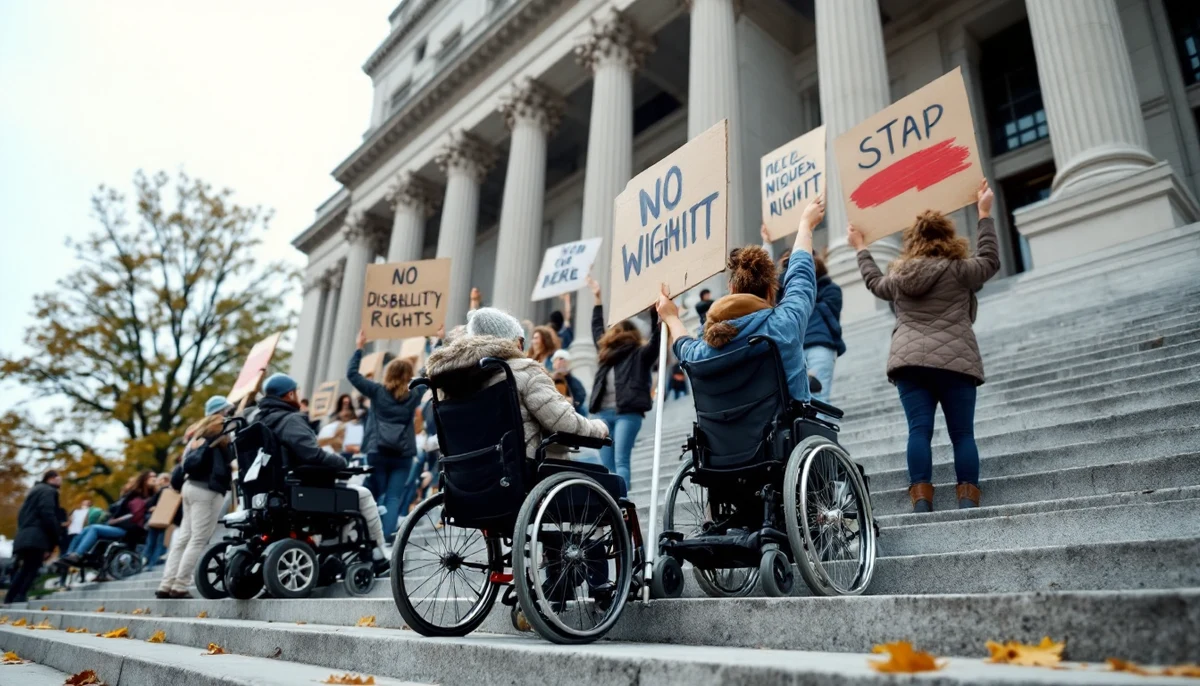

U.S. State Department Reports on Rights of Disabled People around the World
By Kay Schriner (kays@uark.edu)
Continuing its tradition of reporting on human rights conditions around the world, the U.S. State Department has just issued its latest country reports. As required by the Foreign Assistance Act and Trade Assistance Act, the reports will be used as "a resource for shaping policy, conducting diplomacy, and making assistance, training, and other resource allocations." They will also "serve as a basis for the U.S. Government's cooperation with private groups to promote the observance of internationally recognized human rights."
To prepare the reports, U.S. embassies interview individuals and organizations in each of the countries. Once they have prepared the report drafts, they are sent to Washington for review and editing. The "guiding principle," according to the State Department, is to ensure that the information is assessed for its objectivity, thoroughness, and fairness.
The reports focus on a full range of human rights issues, including political rights, press freedoms, women's and worker's rights, and religious persecution. Section 5 of each country report focuses on discrimination based on race, gender, religion, disability, or social status.
The reports always raise concerns among those who believe that the U.S. is overly critical of some nations. Also, some people complain that the U.S. takes a 'holier than thou' approach to human rights - quick to note the failings of other countries while overlooking our own human rights problems. No doubt there is some validity to these criticisms, but nonetheless the reports are of interest for identifying at least some of the developments in each nation.
Not all of the news in these reports is bad. It's worth noting a few promising developments:
-
Costa Rica has seen a 20 percent increase in special education services, and 116 special education centers have been created
-
Norway's government is given high marks for enforcing that country's mandate that public buildings be accessible to persons with disabilities
-
New regulations in the United Kingdom require all businesses to make "reasonable" modifications for individuals with disabilities by 2004
-
Mozambique's government enacted provisions providing for building accessibility and transportation for people with disabilities in its elections
Other developments are more troubling. For example, in Russia "being a child with disabilities still is a serious social stigma in the country..." and many disabled children are considered "uneducable." (See separate report on Disabled Children in Russian Institutions in this issue of DisabilityWorld.) In India, there are continuing complaints "relating to harassment, intolerance, and discrimination" against persons with disabilities.
The following excerpts are taken verbatim from the State Department's full country reports. We are reprinting below the "persons with disabilities" section from the reports of the ten countries - Columbia, Costa Rica, India, Japan, Vietnam, Norway, Russia, United Kingdom, South Africa, and Mozambique - that are the primary focus of DisabilityWorld reporting this year. Full reports can be found at the State Department's website at http://www.state.gov/g/drl/rls/hrrpt/2001/.
Colombia
The Constitution enumerates the fundamental social, economic, and cultural rights of the persons with physical disabilities; however, serious practical impediments exist that prevent the full participation of persons with disabilities in society. There is no legislation that specifically mandates access for persons with disabilities. (Most public buildings and public transport are not accessible to persons with disabilities.) According to the Constitutional Court, persons with physical disabilities must have access to, or if they so request, receive assistance at, voting stations. The Court also has ruled that the social security fund for public employees cannot refuse to provide services for the children of its members who have disabilities, regardless of the cost involved.
Costa Rica
The 1996 Equal Opportunity for Persons with Disabilities Law prohibits discrimination, provides for health care services, and mandates provision of access to buildings for persons with disabilities. This law is not enforced widely, and many buildings remain inaccessible to persons with disabilities. In July 2000, a government study concluded that only 35 percent of the law's stated goals had been implemented. Nonetheless, a number of public and private institutions have made individual efforts to improve access. In 1999 the PANI and the Ministry of Education published specific classroom guidelines for assisting children with hearing loss, motor difficulties, attention deficit disorder, and mental retardation. In October 2000, the Ministry reported that since 1998 there had been a 20 percent increase in special education services offered throughout the country, and that 116 special education centers had been created.
The Ministry of Education operates a Program for Persons with Disabilities, and in November President Rodriguez's wife received an award from Goodwill Industries for her efforts to support it. The program includes a national resource center that provides parents, students, and teachers with advanced counseling, training, and information services.
India
According to regional NGO's, there are over 50 million disabled persons in the country. According to the Blind Foundation for India, there are more than 2 million blind children in the country, and only 5 percent of them receive an education. According to Javed Abidi of the National Center for Promotion of Employment for Disabled People (NCPEDP), the census taken during the year failed to include categories of disability, thus making an accurate estimate of the needs of persons with disabilities impossible. Neither law nor regulations require accessibility for persons with disabilities. With the adoption of the Persons with Disability Act, a nascent disabled rights movement slowly is raising public awareness of the rights of the disabled. Although the act provides equal rights to all persons with disabilities, advocacy organizations admit that its practical effects so far have been minimal in part due to a clause that makes the implementation of programs dependent on the "economic capacity" of the Government. For example, government buildings, educational establishments, and public spaces in New Delhi have almost no provisions for wheelchair access. To a large degree, physical impediments still limit mobility, legislation prevents equality, and societal discrimination maintains the status quo of persons with disabilities.
The Disabled Division of the Ministry of Welfare had a budget of more than $50 million (2.3 billion Rs) for the 2000-01 fiscal year for a number of organizations and committees at the national, regional, and local levels. The Ministry delivers rehabilitation services to the rural population through 16 district centers. A national rehabilitation plan commits the Government to putting a rehabilitation center in each of more than 400 districts, but services still are concentrated in urban areas. Moreover, the impact of government programs has been limited. Significant funding is provided to a few government organizations such as the Artificial Limbs Manufacturing Corporation of India, the National Handicapped Finance and Development Corporation, and the Rehabilitation Council of India. Each entity provides specific services or training, including producing aids and prosthetics, promoting disabled-oriented economic development activities, offering training to health-care professionals and vocational instructors concerning disabled-related issues, and providing comprehensive rehabilitation services to the rural disabled.
Additional mini-grants are offered to NGO's that coordinate programs for the disabled to facilitate their physical, social, and psychological rehabilitation and integration into mainstream society. During 2000-01, $13 million (585 million Rs) was available. However, only half of this amount was allocated due to funding restrictions placed on each providing organization and the small number of them that exist.
Two significant programs to benefit the disabled are the National Project to Integrate Mentally Retarded in Family and Community and the National Institute for the Multiple Disabilities. The first project, launched in six states in 1998, primarily focuses on children from the economically weaker sectors and promotes awareness concerning the mentally disabled, their problems, and their rights. The second is the Ministry of Welfare, which provides rehabilitation services to the disabled and is fostering greater awareness among communities throughout the country. As a result of the passage of the Persons with Disability Act, there is a Disabilities Commissioner who oversees implementation of the act and its protections for persons with disabilities. In addition, the NHRC formed a group of seven experts in August to identify issues affecting persons with disabilities, to review government policies, and to protect the rights of persons with disabilities.
According to the Persons with Disability Act, 3 percent of positions in government offices and state-owned enterprises must be reserved for persons with visual, hearing, or orthopedic disabilities. The act mandates that 5 percent of employees in both the private and public sector eventually should consist of persons with disabilities. However, a survey conducted in 1999 by the NCPEDP indicated that in the public sector the figure was 0.54 percent and in the private sector 0.28 percent. The Government provides special railway fares, education allowances, scholarships, customs exemptions, budgetary funds from the Ministry of Rural Development, and rehabilitation training to assist the disabled. However, implementation of these entitlements is not comprehensive. Although the Government has taken significant steps toward improving the plight of the disabled, its involvement has been insufficient. The majority of responsibility for caring for disabled persons still lies with family members and voluntary groups.
The NHRC continues to receive complaints relating to harassment, intolerance, and discrimination against the disabled. It is gathering information on such cases and forwarding assessments to concerned NGO's and government entities. However, this process is slow, and its effects so far have been minimal.
The NHRC continued its efforts to improve conditions in mental hospitals and enhance awareness of the rights of persons with mental illness during the year. In a 1999 report, the NHRC stated that conditions at many mental hospitals throughout the country are unsatisfactory.
In July the NHRC coordinated with the All India Institute of Medical Sciences (AIIMS) for a medical student who had lost his sight just prior to his final exams. AIIMS initially informed the student that he could not sit for exams; however, after the case was filed under the Disability Act, he was allowed to do so. AIIMS also formulated a system to deal with any future cases of a similar nature.

The NHRC continue to use old concepts of mental health care and essentially function as custodial rather than therapeutic institutions. Overcrowded and serving as "dumping grounds" for desperate relatives, some mental hospitals lack even basic amenities and have poor medical facilities. Persons with mental retardation and mental illnesses often are housed together, leading to physical abuse of persons with mental retardation. Patients generally are ill-fed, denied adequate medical attention, and kept in poorly-ventilated halls with poor sanitary conditions. Most of the private mental hospitals are run by Muslim organizations, but there are Hindu and Christian-run mental hospitals as well. In August when 26 inmates at a private Muslim mental hospital in Erwadi, Tamil Nadu, died in a fire, the victims were chained to their beds, which apparently was a common practice in many such private institutions. Following the fire, the government of Tamil Nadu ordered the closure of all unlicensed medical asylums in the state. Many of the inmates were moved to public mental hospitals. According to Tamil Nadu state officials, 3,500 persons are confined in 130 private mental hospitals. Press reports described horrific conditions in many mental hospitals elsewhere in the country, including one where inmates were chained in a row on a stone floor in an ill-lit room during the daytime.


In August 1999, the NHRC reported that it had assumed the management of mental hospitals in Ranchi, Bihar, Agra, Uttar Pradesh, and Gwalior, Madhya Pradesh, at the direction of the Supreme Court. In February 2000, NHRC Chairman Justice J.S. Verma asked chief ministers of all the states and administrators of all the union territories "to issue clear directions to the inspector generals of prisons to ensure that mentally ill persons are not kept in jail under any circumstances." However, there was little follow-up to the NHRC direction. In January, the NHRC wrote to the chief ministers of all states to ask them to abide by recommendations to remove all persons with mental illness from ordinary jails; however, by year's end, the directive had not been implemented.
Japan
There are an estimated 2.9 million persons with physical disabilities and roughly 2 million persons with mental disabilities. Although not generally subject to overt discrimination in employment, education, or in the provision of other state services, persons with disabilities face limited access to public transportation, "mainstream" public education, and other facilities. The Deliberation Panel on the Employment of the Handicapped, which operates within the Ministry of Labor, mandated that private companies with 300 or more employees hire a fixed minimum proportion of persons with disabilities. The penalty for noncompliance was a fine. A 1998 cabinet directive ordered private companies to raise the proportion of persons with physical disabilities in their work force from 1.6 to 1.8 percent and raised the percentage of persons with disabilities among civil servants from 2 to 2.1 percent. Some prefectural governments provided subsidies to companies that employed persons who used wheelchairs. In June the Diet passed legislation amending 27 laws that previously had banned the blind, deaf and those with mental disabilities from working as doctors, dentists, nurses, and pharmacists. The Health, Labor, and Welfare Ministry started awarding licenses for these professions on a case-by-case basis in July.
The law does not mandate accessibility to buildings for persons with disabilities; however, the law on construction standards for public facilities allows operators of hospitals, theaters, hotels, and similar enterprises to receive low-interest loans and tax breaks if they build wider entrances and elevators to accommodate persons with disabilities. In 2000 the barrier-free transportation law took effect, requiring public transport systems to take measures to make their facilities more accessible to persons with disabilities as well as to the elderly.
The Law to Promote the Employment of the Handicapped includes those with mental disabilities. The law also loosened the licensing requirements for community support centers that promote employment for persons with disabilities, and it introduced government subsidies for the employment of persons with mental disabilities in part-time jobs.
The Headquarters for Promoting the Welfare of Disabled Persons, set up by the Prime Minister's Office, in previous years recommended that municipalities draw up formal plans for the care of citizens with disabilities. The Ministry of Health and Welfare also has instructed local governments to set numerical targets for the number of home help providers and care facilities allocated to the disabled. In 2000 74.9 percent of municipalities had formal care plans for citizens with disabilities. During the year, the Government abolished Medical Service Law provisions that had exempted mental hospitals from minimum staffing guidelines; however, reports of understaffing persisted.
Advocacy groups for women and persons with disabilities continued to press for a government investigation into sterilization cases that were carried out between 1949-92, a formal government apology, and compensation...
Vietnam
There is no official discrimination against persons with disabilities in employment, education, or in the provision of other state services. Government provision of services to assist persons with disabilities, however, is limited, and the Government provides little official protection or effective support to persons with disabilities. Government agencies responsible for services to persons with disabilities worked with domestic and foreign groups to provide protection, support, physical access, education, and employment. Implementation is hampered by limited budgets. The law requires the State to protect the rights and encourage the employment of the persons with disabilities. It includes provisions for preferential treatment of firms that recruit persons with disabilities for training or apprenticeship and a special levy on firms that do not employ workers with disabilities. The extent to which the Government enforces these provisions is unknown. The Government permitted international groups to assist persons disabled by war, by subsequent accidents involving unexploded ordnance, or other causes, and has developed indigenous prosthetics-manufacturing capabilities. There are no laws mandating physical access to buildings, but international groups are working with the Government to provide increased accessibility. International groups also are assisting the Government in implementing programs to increase access by persons with disabilities to education and employment.
Norway
There is no discrimination against persons with disabilities in employment, education, or in the provision of other state services. The law mandates access to public buildings for persons with disabilities, and the Government generally enforces these provisions in practice.
Russia
The Constitution does not address directly the issue of discrimination against persons with disabilities. Although laws exist that prohibit discrimination, the Government has not enforced these laws. The meager resources that the Government can devote to assisting persons with disabilities are provided to veterans of World War II and other conflicts.
The law requires that firms with more than 30 employees either reserve 3 percent of their positions for persons with disabilities or contribute to a government fund to create job opportunities for them. The law also removed language defining an "invalid" as a person unable to work; however, the Government has not implemented this law. Some persons with disabilities find work within factories run by the All-Russian Society for the Disabled; however, the majority are unable to find employment, frequently are discouraged from working, and are forced to subsist on social benefits.
Special institutions exist for children with various disabilities but do not serve their needs adequately due to a lack of finances. Being a child with disabilities still is a serious social stigma in the country, an attitude that profoundly influences how institutionalized children are treated. Many children with physical or mental disabilities are considered uneducable, even those with only minor birth defects. Parents wishing to enroll a child in an ordinary secondary school in Moscow must produce a medical certificate affirming that the child is in perfect health. Families with children with disabilities received extremely low state subsidies that have not changed to reflect inflation since the Soviet era. According to a 1998 Human Rights Watch report, many children with disabilities in institutions are confined to beds around the clock or to rooms that are lit, heated, and furnished inadequately. The children are given only minimal care by low-paid unskilled workers with no training in the care of the disabled. In November the President issued a decree designating several programs for children with disabilities. Reportedly the designation is an honorary one and does not affect those programs' budgets.
The Government does not mandate special access to buildings for persons with disabilities, and access to buildings was a problem.
The NGO Society for the Defense of Invalids continued to work to broaden public awareness and understanding of problems concerning persons with disabilities by conducting workshops, roundtables with public officials, and training programs for the disabled. On October 24, the Third Congress of the All-Russian Society of Invalids, which represents more than 2 million persons, called on the Government to devote more resources to help the more then 4 million persons with disabilities in the country.
United Kingdom
The Disability Discrimination Act (DDA) prohibits discrimination against persons with disabilities in the provision of access to public facilities by employers of more than 15 workers, service providers (apart from those providing education or running transport vehicles), and anyone selling or renting property. In addition all businesses are required to accommodate customers with disabilities. Adaptations must be "reasonable," bearing in mind the circumstances and size of the business. The Education Act requires local education authorities to make provision for the special educational needs of children with disabilities. However, one in seven persons in Britain has a disability, according to the Disability Rights Commission (DRC), which reported that approximately 8.5 million persons with disabilities faced discrimination in work, housing, health, and social care.
In March the Government responded to a disability rights task force report by announcing new measures to cover nearly 7 million jobs previously excluded from the DDA, such as police, firefighters, and prison officers. In May the Government passed the Special Educational Needs and Disability Act, which enhances civil rights for persons with disabilities in education.
The DRC provides a hot line for persons with disabilities and employers, legal advice and support for individuals, and policy advice to the Government. The DRC also has the power to conduct formal investigations, arrange conciliation, require persons to adopt action plans to ensure compliance with law, and apply for injunctions to prevent acts of unlawful discrimination.
Government regulations require that all new buildings meet the access requirements of all persons with impaired mobility and that all taxis be wheelchair accessible; similar regulations are in force for sensory-impaired persons. Access to many buildings, especially older buildings, including transportation centers, remains inadequate. New measures introduced in March require all businesses to make "reasonable" modifications for persons with disabilities by 2004.
South Africa
The Constitution prohibits discrimination on the basis of disability. Society is increasingly open to the concept of persons with disabilities as a minority whose civil rights must be protected. The Government attempts to ensure that all government-funded projects take account of the needs of citizens with disabilities. However, in practice Government and private sector discrimination against persons with disabilities in employment still exists. The law mandates access to buildings for persons with disabilities, but such regulations rarely are enforced, and public awareness of them remains minimal. The law requires employers with more than 50 workers to create an affirmative action plan with provisions for achieving employment equity for persons with disabilities. The National Environmental Accessibility Program, an NGO comprising consumers with disabilities as well as service providers, has established a presence in all nine provinces to lobby for compliance with the regulations and to sue offending property owners when necessary. In August the Public Service Commission reported to a parliamentary committee that persons with disabilities constitute only 0.02 percent of the public service workforce.
Mozambique
The Constitution states that "disabled citizens shall enjoy fully the rights" that it provides for; however, the Government provided few resources to implement this provision. Representatives of disabled groups and injured veterans frequently protested that societal discrimination continues against persons with disabilities. War veterans with disabilities are among the most politically organized citizens with disabilities. Approximately 1.9 percent of citizens have physical or mental disabilities.
The Government only provides four schools nationwide for the hearing and vision impaired and for persons with physical and mental disabilities. There are few job opportunities for persons with disabilities in the formal sector, although the 1997 census reported that 55 percent of such persons worked or held a job.
Social workers found that some parents of children with disabilities in several districts, including the towns of Gorongosa and Dondo, did not permit their children to leave their homes. Provincial Ministry of Women and Coordination of Social Action officials continued their educational campaign to reverse traditional attitudes toward children with disabilities. During the year, the Government provided scholarships for 615 children with disabilities in education facilities.
The Government continued to rely on NGO's to assist persons with disabilities. The Association of Disabled Mozambicans (ADEMO) addresses social and economic needs of persons with disabilities. ADEMO's effectiveness during the year was hindered by internal conflicts. Smaller NGO's also have formed, including the Association of Handicapped Military and Paramilitary Mozambicans, the Association of Blind and Visually Impaired Mozambicans (ACDVM), the Association of Mozambican Disabled Soldiers (ADEMIMO), the Association of Deaf Mozambicans (ASUMO), the Association of Demobilized War Veterans (AMODEC), and the Association of Disabled Divorced Women (AMODD). In 2000 ADEMO held a conference to address the rights of persons with disabilities.
Concerns of persons with disabilities include access to socioeconomic opportunities and employment, accessibility to buildings and transportation, and a lack of wheelchairs. The only provisions that the Government has enacted for accessibility to buildings and transportation for persons with disabilities were in the electoral law governing the country's first multiparty elections, which addressed the needs of voters with disabilities in the polling booths. Special access facilities are rare. In 1999 the Cabinet issued a resolution that approved the first national policy on persons with disabilities and laid out principles and strategies aimed at encouraging their active participation in the country's socio-economic development; the plan would address concerns of persons with disabilities, including access to public buildings and government infrastructure. However, the plan had not been implemented by year's end due to funding constraints.
|