
European Commissioner Highlights Goals of European Disability Year
By Anna Diamantopoulou, Commissioner responsible for Employment and Social Affairs, European Commission
Note: Anna Diamantopoulou is the Commissioner responsible for employment and social affairs of the European Commission, the executive body of the European Union. The following are her remarks at the official opening of the European Year of People with Disabilities 2003, held in Athens, Greece, on January 26, 2003.
I am extremely proud to be here with you to officially open the European Year of People with Disabilities. And I would like to begin by congratulating the Greek Presidency of the European Union for having organised such an impressive event to launch the European Year in style.
I am very happy, of course, that the launch is taking place here in Athens. It is a strong sign of the commitment of Greece to taking further positive steps to include all citizens in society.
Attitudes, barriers & rights
The European Commission sees the Year as the start of an exciting wide programme to achieve clear, concrete and tangible results:
- by changing attitudes with respect to disability and disabled people
- by drawing attention to all the many barriers that continue to exist for people with disabilities. Identifying ways to overcome those barriers
- by recognising and protecting the rights of people with disabilities, and
- by recognising that the benefits not just to people with disabilities, but to society as a whole.
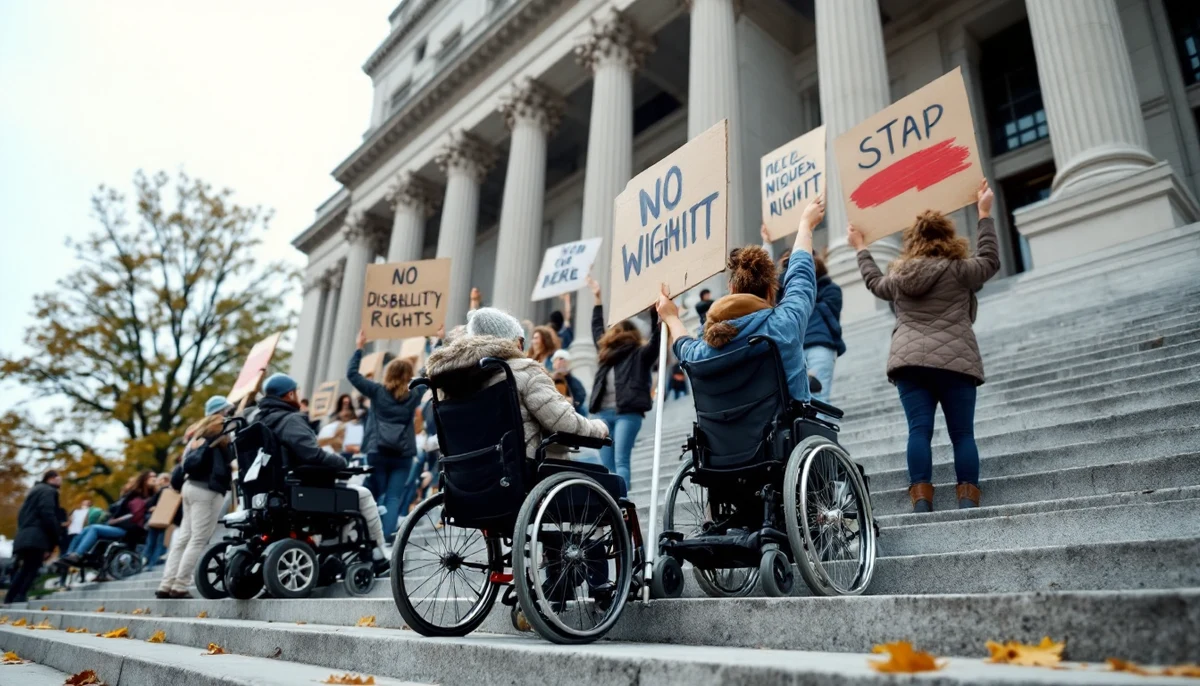
This year is about making a move forward in disability policies, about equal rights, empowerment and the full citizenship of people with disabilities.
Get on board
Thousands of activities are being planned across the Union. To encourage participation, we are organising a march across Europe, which is supported by the EU bus that you saw outside today. We need all sections of our society to get on board this campaign.
People with disabilities must be involved equally at all levels. Including people with disabilities in the mainstream political process itself, is the key to successful policies and action. We need to work closely with employers. To promote responsible business in Europe. To undertake actions promoting equal employment. And we need to build on a strong alliance. Of non-governmental organisations. Public administrations. And corporate support. It will give a strong impetus for governments, at all levels. To set up long term goals. Sustain them for the future. And bring in new and workable policies.

Employment focus
The choice to work must be available - and achievable - for people with disabilities who have the capacity, skill and ability to do so. Developing mainstreaming has both social and economic advantages for society in general. So far, open co-operation with the Member States on employment has worked very well . Now we are reviewing this strategy. Making the right offer to the right person at the right time will certainly be our guiding principle to meet individual needs. The European Social Fund and, in particular, the (community initiative) Equal, ensure that across the European Union this process is sustained.
In 2003, we have the opportunity to put into practice the new directive on employment and occupation that is currently being implemented into national laws. Providing us with a very clear legal framework to protect disabled job applicants, or employees from unfair treatment. To guarantee people with disabilities their fundamental human and social rights.
Throughout the year, the European Commission will act as facilitator, lending support. But, more crucially we will produce a policy communication by the end of 2003 on what should be done to follow up on the Year, and how best to address new challenges.
Improving access to assistive technology
Improving access to assistive technology is one area we intend to develop. It is estimated that in Europe this market is worth 10 billion Euro and growing. Assistive technology plays a key role to including people with disabilities in our society. The Commission will publish a report in 2003 with recommendations.
And we must improve accessibility, particularly with respect to buildings. Just like the new metro here in Athens, we need to ensure that all of our citizens have access where needed. I have set up an independent expert group to examine current legislation and to make recommendations for action.
I am well aware that some of you here today would like the Commission to propose a new disability-specific directive. I fully understand your concerns. But I have to consider whether such a directive could succeed at this time. We need to achieve the full implementation of existing legislation, before launching a new process.


Support for UN Convention
In this context, I am pleased to see that there is now a serious prospect of establishing a UN 'Legally binding instrument' on Human Rights of People with Disabilities. As a rights-based initiative, it is very much in line with one of the key objectives of the European Year of People with Disabilities 2003. The Commission will contribute to the development of such an instrument and has issued a Communication spelling out our support and our views of what it should contain.
I am confident this Year will act as a catalyst. Encouraging everybody to discuss and develop possible future actions. For achieving equal opportunities of people with disabilities. For improving quality of life. And for creating a truly inclusive society.
A society based on a strong social model, which achieves the social economic goals that the European Union set itself in 2000. And I hope that tonight's event will reinforce our objectives and that when you return home, you will take with you the key messages of the European Year.
|