
Gaining Access to the Policy Agenda on Development Cooperation
By Andrew Freeway (Andrew_Freeway@yahoo.com) (with thanks to DCDD)
The Problem
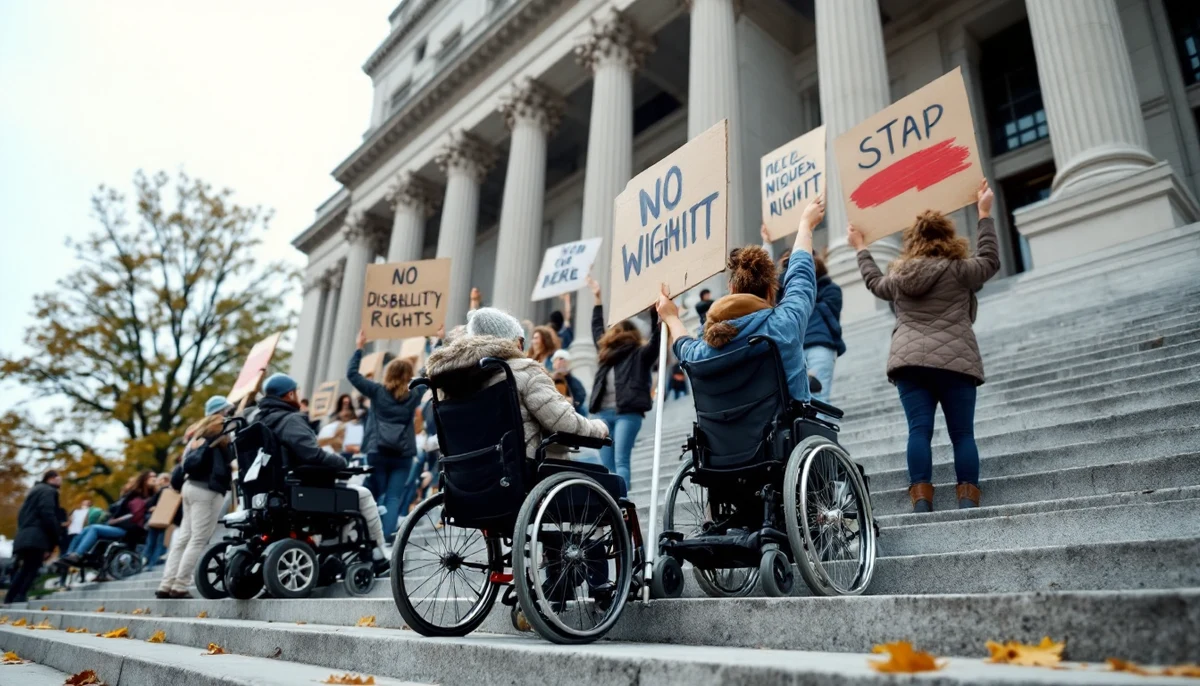
Exclusion. Powerlessness. Poverty. That is the fate of the great majority of people with a disability in most countries we have labeled as developmental areas or countries in transit. Social exclusion because disabled people are not accepted, powerlessness and poverty due to the isolation. Often poverty is not the result of disabilities but their cause. Bad health, virtually no access to proper education, little chance of paid work, no opportunities for making a living, no prospects of a better future - that, all too often, is the sad reality.
The scale of exclusion due to disabilities is dramatic. Approximately 98% of all children with disabilities receive no formal education, according to Rebecca Yeo in her presentation at the Development Studies Association conference in Manchester, September 2001(www.id21.org
enter Yeo). One hundred million people have disabilities that could have been prevented, because these disabilities are the result form malnutrition, inadequate sanitary facilities and inadequate health care. For example, 70% of all cases of blindness in children and 50% of all hearing impairments from birth in Africa and Asia can, in principle, be prevented or treated.

Violence is another important cause of disabilities. As The Sowetan stated in April 1990: a situation of conflict resulting in one death causes three disabilities, on average. And the Landmine Victim Assistance (www.handicap-international.org) reported in 2001 that every 20 minutes someone somewhere treads on a landmine!

In the field of development cooperation, most governments do not pay attention structurally, as a part of their policy, to disability from the perspective of human rights, while co-financing organizations have shown decreasing interest disability since the late 1980s. Organizations of disabled people all over the world wish to remedy this situation, because disability deserves a place on the political policy agenda.

A different approach
Currently the leadership to place disability on the political policy agenda comes from the Nordic countries. In these countries, for some ten years now, disability is given due attention in development co-operation. In the year 2000 the Nordic ministers for development co-operation gave out a joint declaration stating that their countries will regard disability from the human rights perspective as a matter of policy (www.disability.dk, search for 'Nordic disability conference'). In all Nordic countries interest groups of persons with disabilities exist which carry out projects and programmes in developing countries with substantial government support.
For instance in Norway the Atlas Alliance, a federation of NGOs, co-operates with persons with disabilities, and their organizations, in developing countries. The Atlas Alliance's budget was about 8 million Euros in 2001 and approximately 85% of this was furnished by the Norwegian government. In January of this year the Norwegian Directorate for Development Co-operation published a policy document (www.norad.no/norsk/files/InklusionOfDisability.doc) containing guidelines for government bodies and Norwegian NGOs regarding integration of the disability dimension in development policy and implementation. Norwegian embassies now have to report on disability.
And DSI, the Danish umbrella organization of disabled persons' interest groups, receives some 3 million Euros annually for development co-operation. This money is spent by 14 of the 29 DSI members on projects in over 20 developing countries; projects by, for and with persons with disabilities (www.disability.dk
search for 'Charity to inclusion')
In a joint parliamentary assembly of the ACP/EU countries a unanimous resolution was passed last year concerning the rights of the elderly and of persons with disabilities in ACP countries (www.europarl.eu.int/intcoop/acp/bru2001/pdf/res_011_en.pdf). The European Commission has already taken action on this matter. Replying to questions from members of the European Parliament, the European Commission proposed BY MOUTH OF Mr. Poul Nielson to incorporate disability in development co-operation. In the course of this year (2002) the European Commission will draft a policy document on how to integrate the disability perspective in the European Union development policy. The European Commission regards disability, like gender and poverty, as an important crosscutting development issue.
But there is also so much to learn from developing countries. From Uganda, for example, where a strong democratic movement arose in 1986, after many years of civil war, which was sensitive to the disability movement. Uganda now stands as an example of integration of persons with disabilities. Five seats in Parliament are reserved for persons with disabilities, one of whom serves as Minister for Disability and Elderly Affairs. In total, 47,000 persons with disabilities serve on governing bodies in Uganda's 45 administrative districts.
Unrestricted policy
The publication of the Standard Rules on the Equalization of Opportunities for Persons with Disabilities (www.un.org/esa/socdev/enable/dissre00.htm) was a milestone in thinking about the rights of persons with disabilities. As a sequel to the adoption of the Standard Rules a UN convention is to be held (www.un.org/esa/socdev/csd/2002disabilityres(A).htm).
But this is not all. For example, the UN Millennium Declaration (September 2000) states that the number of people living on less than a dollar a day must be halved by 2015. All children must have access to elementary education by 2015, including children with disabilities. In 1989 the Convention on the Rights of the Child was concluded in New York; 191 countries have ratified this convention. Article 23 of the Convention states that the States Parties "recognize the right of the disabled child to special care" and "recognize that a mentally or physically disabled child should enjoy a full and decent life, in conditions which ensure dignity, promote self-reliance and facilitate the child's active participation in the community" (www.defenceforchildren.nl). At the last-held Child Summit in New York the need for special attention for disability and children was re-emphasized, in particular with regard to integration of children with disabilities in education.
Many national governments have drafted policy papers on the issue of Civil Societies or Poverty Reduction. In practice, however, little is known about the extent of discrimination and obstacles experienced by persons with disabilities by these governments. One reason is that persons with disabilities are rarely involved in policy development. The time has arrived for structural co-operation in this field with disabled people's organizations (DPOs). It is of particular importance that policymakers think inclusively, integrating the disability dimension in overall policy for poverty reduction.
Disability, like gender, deserves structural and pro-active attention from governments. If we really want to reduce poverty by half by the year 2015, it is essential that persons with disabilities and their organizations be fully involved in all strategies for combating poverty. Development co-operation can only be credible and effective if disability receives specific, structural attention.
|