
Disability World
A bimonthly web-zine of international disability news and views • Issue no. 8 May-June 2001


table of contents - home page - text-only home page

Disability March: 1500 Costa Ricans demand equal oportunity
By Luis Fernando Astorga Gatjens (lferag@racsa.co.cr)

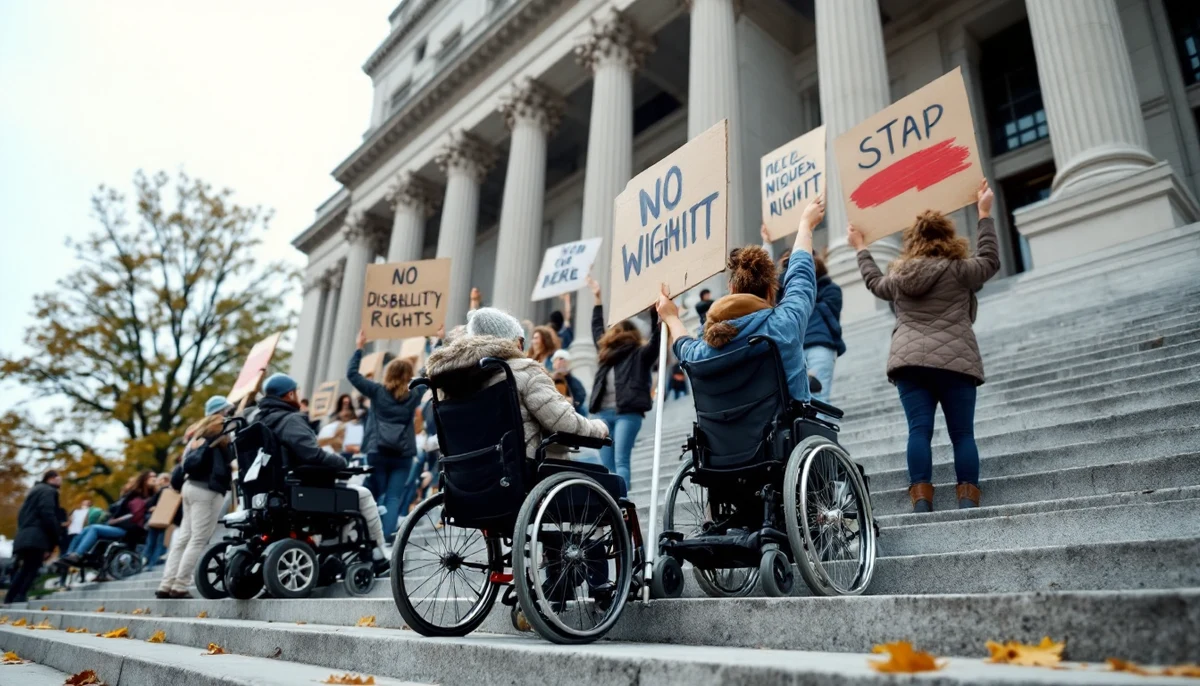
On Friday 1 June 2001, nearly 1,500 people with disabilities marched on Second Avenue in San Jose, Costa Rica. Our demand: equal opportunity.

The wide Avenue was filled with a picturesque group of people that moved on wheelchairs, walked on crutches or using white canes, or were guided by dogs, or had someone translate what was heard into sign language.
The successful and enthusiastic demostration was organized by FORO POR LOS DERECHOS HUMANOS DE LAS PERSONAS CON DISCAPACIDAD, the Human Rights Forum for People with Disabilities. The main goal of the demostration was to celebrate the five-year anniversary of Law 7600, the law on equal opportunity for people with disabilities, passed by the Costa Rican congress in 1996.

Moreover the march wanted to show Costa Rican society that people with disabilities movement had the will to pursue its rights and remind Costa Ricans that law 7600 had not been enforced.

And five years later enforcement is still mostly nonexistent. There have been gains. But they have lacked depth. They are reversible and have not any impact upon the lives of 400,000 people with disabilities. As the Bureau of Civil Rights says, we are still the most excluded population in the country.

Underestimating & Overprotecting
Costa Rican society has two dominating traits: it underestimates and overprotects. In the daily lives of people with disabilities, this translates into exclusion and passive discrimination.

Hundreds of people from different parts of the country answered the call of the Human Rights Forum for People with Disabilities, convinced that real change demands active participation not only from people with disabilities, but from all social groups seeking equal opportunities for all.

This socially and politically significant effort made itself heard through hundreds of voices and boards, all screaming slogans such as

"Law 7600: Enforce it"
"Equal opportunity for all people, for all ages"
"Woman with disability, twice discriminated"
"Costa Rica listen, we are risen"
"Baruch, you're not a Liberal, then liberate our money" (Baruch is Minister of Finance)

One slogan, however, was taken up in chorus by the vibrant crowd. It became the official slogan for the March for Equal Opportunity:

"If Costa Rica is not accessible, democracy is impossible"

The diverse and hopeful crowd gathered at the Merced Park. The group walked for a mile under a scorching afternoon sun and stopped opposite the Legislature Building, chanting its demands for justice. There the Majority Whip, Ovidio Pacheco, listened to the Open Letter to Costa Rica (see annex)

The March finale was full of songs. Violeta Parra's "Gracias a la vida" ("Thanks, Life") was the closing point of the March. Its optimistic message rekindled hope, and like an electric current, it went from one end of the crowd to the other, forever imprinting on it the seal of justice and hope.

Open letter to Costa Rica
From the Organizations of People with Disabilities

To the People of Costa Rica:

On 29 May 1996, the Official Gazzette published Law 7600 of Equal Opportunity for People with Disabilities. The main goal of the Law is to serve as a tool for People with Disabilities to reach their full potential, achieve full social participation, and exercise their human rights as per the Costa Rican Constitution and international treaties.

A group of organizations that belong to the movement for people with disabilities decided to commemorate with a march the fifth anniversary of Law 7600. The occasion presents a good opportunity to reflect upon the enforcement of this law. The degree of enforcement offers no consolation. According to the Annual Report of the Bureau of Civil Rights, people with disabilities are among the most excluded social groups in Costa Rica.

We still hope to attend a school that is near our home. We still hope to use public transportation, just like our friends and family. We still hope to obtain a decent job, one at the level of our training and talent. We still hope to enjoy health and rehabilitation services according to our needs. All this, nonetheless, is as precious to us as it is distant. Enforcement of Law 7600 is in its infancy, is painfully slow, is inconsistent, and is reversible.

It is imperative that the government, public institutions and Costa Rican civic society at large truly commit to the effort of strengthening the living conditions of people with disabilities.

On account of the above, we declare:
  • To our legislators: We demand deep changes in regulations so as to secure equal opportunities for people with disabilities. Currently a bill is being reviewed, the General Collective Transportation Law, that clearly represents a setback to accessibility in buses, which are used not only by people with disabilities, but by other people with mobility problems such as pregnant women, senior citizens, children, obese individuals, small people, and so forth. We ask that the bill be modified to comply with the principles of Universal Accessibility in public services.
  • To the President: We demand that measures be taken to fully insure the human rights of people with disabilties. This means strategies, policies, programs and services should subscribe to the principles of equal opportunity and accessibility. Furthermore, financial resources should be asigned to them to secure their satisfactory implementation.
  • To the authorities: We demand a watchful attitude, so that the Law of Equal Opportunity for People with Disabilities is fully enforced. To this effect we believe it is indispensable that the officers who enforce the law are trained to clearly and correctly interpret it in accordance with the needs of people with disabilities.
  • To those who want to become our leaders: We demand real political will to improve living conditions for people with disabilties. Disability should be an issue of state and it should not be left to the agenda of the First Lady or philanthropical associations. This would limit the issue to a problem for social assistance, which in turn would strengthen prejudice that restricts the full appreciation of people's true value.
  • To the media: we request that you air a positive and dignified image of the people with disabilties that helps eliminate stereotypes that make us the recipients of pity and charity. These two are obstacles to our social, cultural, political, and economic growth.
Five years have gone by since the signing of Law 7600 and its level of enforcement does not give us high expectations for the people with disabilities in Costa Rica. We want a country with equal oportunities for all with no distinction of any kind. This is the fight we will never give up.

"If Costa Rica is not accessible, democracy is impossible"

San José, Costa Rica. Friday, 1 June 2001


table of contents - home page - text-only home page


Email this article to a friend!