
Disability World
A bimonthly web-zine of international disability news and views • Issue no. 14 June-August 2002


table of contents - home page - text-only home page

Chile: limited participation of persons with disabilities
Summary of research study by María Soledad Cisternas

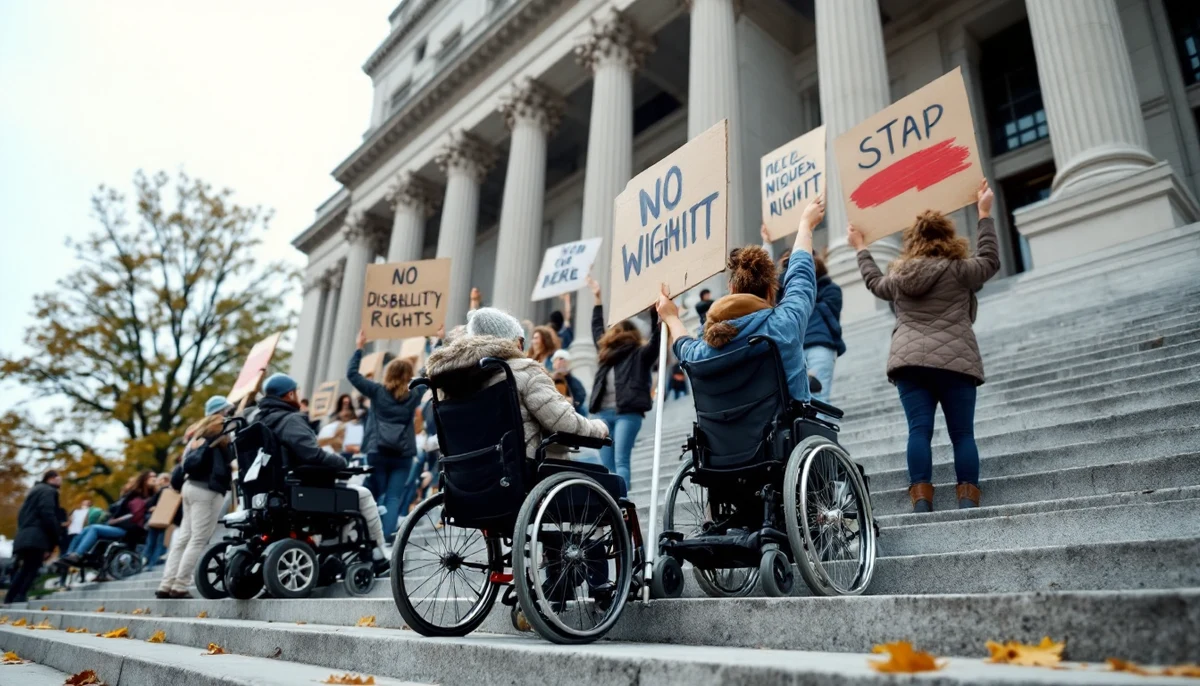
An investigation conducted by María Soledad Cisternas Reyes, a Chilean lawyer who is blind and the Director of the Disability Program of Diego Portales University, reveals how many potential voters with disabilities in Chile, are prevented from voting or at least are not motivated to participate in electoral processes because of existing social and physical barriers.

Her study, published at the end of 2001 in The Chilean Jurist, examines the ways in which the lack of accessibility to voting and related services of this democratic right, prevent or limit persons with disability from full citizenship in her country.

Estimates of prospective voters with disability
Since last June María Soledad Cisternas has served as an advisor to the National Disability Fund (Fondo Nacional de la Discapacidad (FONADIS). Interviewed about her study, she stated, "Though in Chile there are no specific statistics regarding the number of voters presenting a disability, for our purposes we may say that 65% of the population is older than 18 years of age and legally capable to vote. On the other hand, according to World Health Organization estimates, 10% of the population of Chile presents a disability, or about 1,500,000. When we apply these figures to the number of potential voters, there will be about 1,001,127 persons with disabilities of voting age. But, then 9% must be subtracted which corresponds to the percentage of persons with mental disabilities, as defined by the National Social and Economical Profile Study (Encuesta de Caracterización Socioeconómica Nacional CASEN 2000). Consequently, our first results indicate that there are around 929,868 potential voters with disabilities.

Different barriers, common difficulties
This investigation was performed, among other purposes, to present the difficulties that voters with disabilities face in Chile during election times. According to Cisternas: "There is a significant group of persons with disabilities who do not register at the National Electoral Registry, or are registered but end up not voting--to avoid the lack of adequate electoral information or just not bother with the lack of accessibility during the electoral acts-- in a higher proportion than the non disabled voters."

Though many times willing to vote, people with disabilities have accessibility problems that prevent them from this form of political participation: "The lack of accessibility affects all groups of the disability sector, we must undertake the necessary legislative actions to provide for the needs of these vulnerable groups. The right to vote is not a discretionary decision on the part of the Electoral Authorities, on the contrary, the whole electoral system must be accommodated so everyone is able and will vote. The proposed changes will eliminate violations to the human rights of persons with physical and sensory disabilities."

Situation of deaf voters
When studying the situation of deaf voters, the investigation indicates: "deaf persons in general experience isolation, because they do not have the same access to information as the rest of the population, they lack provisions to understand the electoral programs or the debates that are held before the elections. On the other hand, the barrier of lacking ways to communicate with the hearing world, coupled with a tendency to avoid adversity, translates into insufficient information available to deaf voters at the voting tables and insufficient orientation of persons in charge of the voting centers and the security custodians near the voting booths."

Visual disabilities
As for the situation of voters with visual disabilities, though the Chilean legislation includes dispositions for the exercise of the rights to vote, the associations of persons with visual disabilities indicate the following deficiencies to accessibility within the electoral process:
"a.- The information about the candidates is generally provided in graphic and ink printed material, so persons who are blind cannot read its contents. There is little to no electoral information either in Braille system or in audio tapes destined to benefit persons with visual disabilities."

"b.- The voting ballot designed by law is not helpful to persons who are blind. This is because the grooved cross marks do not orient the voter to express her or his decision for the corresponding candidate. For example, in our last election we had six candidates on the first round. Blind voters had to really have good memories to recall the order of the candidates. The situation becomes irrationally more confusing when blind voters have to use the Voting Ballot for the Members of Congress or the Candidates to the Municipalities, which contained even more numbers and names in the lists to be matched."
Physical disabilities
On the other hand, persons with physical disabilities confront other difficulties: "The major difficulties perceived by this sector pertain to the lack of accessibility to physical space, the lack of access to public transportation that they need to get to the voting centers."

There are other difficulties: "For those who have movement difficulties in their hands and other types of physical difficulties making it difficult or impossible for them to write, they find similar difficulties as persons who are blind, and they require to be assisted by another person in their trust, to hold the materials for them and even mark in the corresponding spaces of the Voting Ballot", but the law does not contemplate provisions to address the needs of persons with these types of disabilities.

Conclusions and proposed solutions
The researcher concludes that "considering disability as a variable", between what is stated in the Chilean electoral legislation and what happens in practice, there is the clear need to improve our democratic system, to make it completely inclusive and with full participation for all. The right to vote is very meaningful in the political lives of persons with disabilities, it should be fostered and must be respected.

With the objective of correcting the present situation of serious disadvantage to present and future voters with disabilities, Cisternas Reyes, indicates that there is "a need to fulfill the empty spaces and to include the modifications to the Law of Elections and Popular Consultations (Ley de Votaciones Populares y Escrutinios, Nž 18.700), so that the constitutional mandates that oblige the State to ensure the right to equal opportunities in the national life, particularly in participation in collective decisions, will become a reality and not just a mere aspiration."

Her research concludes with proposed corrections and modifications to the existing electoral legislation of Chile, covering the needs of the major disability groups. She states the need to "consider the situation of deaf persons. This requires inclusion of closed captioning in all propaganda spots and televised political programs, and to add sign language interpretation at public political gatherings and meetings. These and many other achievements can be made by the legal recognition of sign language as "the official instrument of communication of deaf persons in all the national territory."

With respect to the situation of blind persons, her investigation indicates that: "political parties, national and regional candidates, and parties involved in public consultations, should add Braille versions of their presentations, including educational material and propaganda. They also should complement their information efforts with sound tapes for this population."

She also proposes the making of Braille Printed Ballots for blind voters, which must include the indications of the lists, the numbers and the names of each candidate all in Braille system."

"The alternative of having a person of trust come into the voting booth when it is requested by the voter with disabilities, must be regulated by the law."

With respect to the situation encountered by persons with physical disabilities, this investigation recommends: "in those voting centers that do not have sufficient accessibility conditions, such as ramps or elevators for the upper floors where the voting table designated for a voter with physical disability is found" legal dispositions must provide for Electoral Authorities to come down to assist this voter to be able to exercise his or her right to vote.

As for voters with movement disabilities in their upper limbs (amputees, paralysis or Parkinson's Disease, who are not able to mark, close, seal, and deposit the used ballot into the corresponding box, there must be a legal disposition so that these persons "may be added by a person of their trust, including the possibility of allowing the assisting person to be able to enter the voting booth."

At the end of her investigation, lawyer Cisternas Reyes expresses that "... all of these considerations are only a specification of constitutional rights that the Fundamental Charter already recognizes for every person in Chile, pursuant to the special needs that they may have, such as: the right to access to information (Art. 19 No. 12), the right to free circulation of persons (Art. 19 No. 7), political rights (Art. 13 Part 2), and in general, the right of each citizen to participate in equal conditions in national issues (Art. 1 Part 4)."

She culminates her investigation with an evaluation of the proposed changes: "These changes should improve conditions to ensure the participation of persons with disabilities in the electoral processes. They constitute not just an advance to our legislation, making it at least theoretically more democratic, but contributing to the inclusion of this sector into the political life of the nation. There will provide an increase in the number of voters for the Electoral Registry, and will reduce the percentage of abstention. The participation of voters will be increased by these additional efforts of providing due and complete information."

table of contents - home page - text-only home page


Email this article to a friend!