
Johnny Crescendo, British balladeer for disability rights
By Mike Ervin (Mervin4241@aol.com)
Alan Holdsworth became Johnny Crescendo basically as a joke.
"It was during the punk era," he says. He was reading poetry and doing stand up comedy in clubs in Britain and one day he gave himself a stage name. "It was a piss take of the working class Latin lover singing 'My Way' in a dive with too much reverb. Suddenly I was getting loads of gigs and the name stuck. I was almost Sammy Scrabble or Tony Monopoly."

By either name, Johnny Crescendo is one of the strongest British voices for disability rights in both spoken words and music. At the gatherings of the hard core direct action disability rights groups, ADAPT in America and Direct Action Network (DAN) in Britain, he can often be seen up front playing his guitar and singing his homemade songs. His long repertoire of disability-themed songs includes sad ballads of people trapped in institutions, satires of the charity mentality and proud anthems of empowerment.
Though Johnny works by day as a policy advisor to the city council of his hometown of Birmingham, the action of street-level activism suits his passionate personality best. He claims to have been arrested over 100 times for civil disobedience, once was when DAN members blocked traffic outside Buckingham Palace. "Don't mess with the Queenie!" At night at ADAPT actions, when work is done, he can often be found in the hotel bar, smoking, drinking and laughing it up.
Growing up
Johnny's shoulders are broad and his arms are muscular. He gets around by pushing a manual wheelchair. He was born in 1952 in the town of Salford in the Northwest of England "There's a song called 'Dirty Old Town' about it. We were poor. My father was an electrician, my mom a secretary. My father died of cancer when I was 10 and we got poorer."
He went into the hospital when he was nine months old for cleft palate surgery. "I got polio, caught it in hospital but we couldn't sue. Suing is a rich person's privilege in Britain. If you lose the case you pay the costs which meant losing everything my parents had."
But the attitude of his family toward his disability, he says, was "pretty good considering the time. I went to a mainstream school throughout. When I was about 11, I went to senior school and I was bullied and started truanting. I left school at 16. I was bright but hardly a good student. Not being at school meant I began to self teach at an early age.
Published at 14
"I have always sung since I can remember. I started writing poetry when I was 12 and was published when I was 14. I really enjoyed it. I started writing lyrics for a friend who played guitar, then I learned how to play on my own from a book. I did my first gig about four months later with two songs: 'Colors' by Donovan and 'I Had a Dream' by John Sebastian."
The early songs Johnny wrote were mostly about racism, poverty or love. It took him 15 years before he wrote anything directly about disability." "First I just wrote a couple of humorous poems. One was called: 'Where dya Get that Leg?'. The other, 'Taxi Driver's Treat,' is an anti-charity poem."
His musical evolution coincided with disability revelations that would send him toward his political activism. "I was working in Chesterfield in the north of England as a youth worker and one of my workers, Izzy, challenged me to work with people with learning difficulties. I was reluctant but after about a month I realized that these people had just as many issues to deal with as the black young people I had been working with. We set up independent living for over 200 people in the next three years. That small first group of young people remains my reference point to this day".
Birth of DAN
He was there when DAN was born in 1992. It all began informally two years earlier when over 1,000 activists turned out to protest a British television telethon that was the same in its patronizing, degrading tone as the Jerry Lewis telethon in the U.S. After an even bigger protest the next year, the telethon was discontinued.
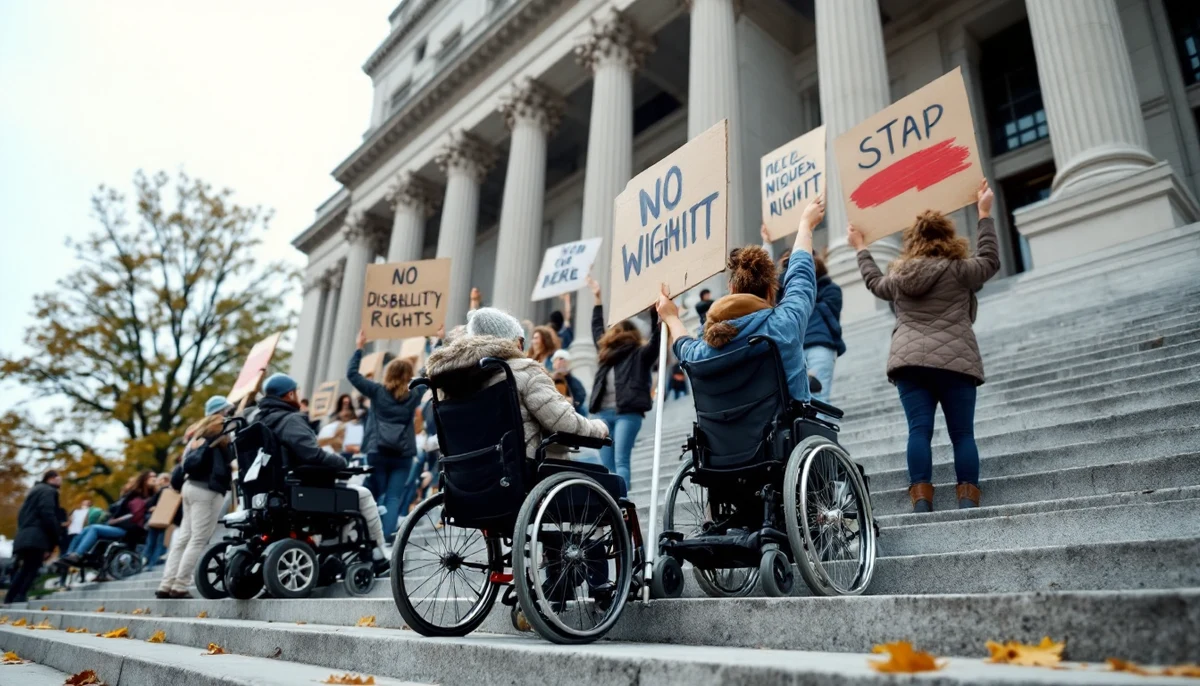
Building on the momentum, DAN was formed and the first national campaign was called WE WILL RIDE, with the goal of making all public transit accessible. Johnny and company chained themselves to trains, blocked buses and tried to crawl into Parliament. They had a barbecue in the lobby of a government office building, burning a government document calling for limited transit access instead of charcoal. "I guess we really are fire risks!" Johnny says.
But the tactics worked. "DAN was getting very high profile publicity and disabled people's issues were moving off the charity pages and into the political pages." Though there is no formal legislation requiring it, Johnny says, all new public buses are now wheelchair accessible. He's also sure all the publicity DAN generated led to the passage of the Disability Discrimination Act in 1995, which he describes as "a watered down version of the ADA."
Learning strategies
So DAN launched its current national campaign in 1999. The goal of FREE OUR PEOPLE is to create enough services and supports so every person with a disability can live in their community rather than an institution. Johnny says, " We'd been campaigning for five years already on WE WILL RIDE and we'd learned many lessons. Not least we learned that even with direct action, it can take time. Also, you have to break up your demands into achievable chunks and finally, unfortunately, you have to go to meetings. WE WILL RIDE was a simple campaign with simple demands that everyone could understand. FREE OUR PEOPLE was going to prove more complex and I believe that without WE WILL RIDE, we wouldn't have been experienced or sophisticated enough to even attempt FREE OUR PEOPLE."
The new campaign has had some successes too with the creation of some new independent living centers and support systems. But Johnny knows it will be a long haul. "FREE OUR PEOPLE will not be won in a single action or in a year. We are still learning how to be most effective and how to use direct action strategically. We won accessible transport and we will free our people."
Johnny's main partner in organizing DAN and in life these days is his second wife, Cassie James. Cassie was once a leader of the Philadelphia ADAPT chapter. Johnny and Cassie are such hard core ADAPTers that they even got married at the conclusion of the 1999 national ADAPT action in Columbus, Ohio. In July 2000, Cassie gave birth to Johnny's second daughter. They named her Danielle. Johnny says the pun in the name is intended-- DAN-YELL.
|