
|
South Africa: From Human Rights Lawyer to Librarian
William Rowland (Rowland@sancb.org.za) interviews Johan Roos
In an unusual career move, Johan Roos, a human rights lawyer by profession, has become head librarian to the blind community in South Africa. Visiting Johan at his Grahamstown office in the Eastern Cape, I found a softly spoken man passionate about his new work and clear about one thing: access to information is a democratic right.
You became Director of the SA Library for the Blind in February 2003. What did you find when you got here?
To begin with, the library had just gone through fairly difficult circumstances. The previous director had resigned unexpectedly and it took some time to find me as his replacement, and it fell to the current management team to manage the library through that difficult period, which they did quite well, if I may say so. So, when I arrived I took over, essentially, a stable ship.
Up to that point the library had been developed very well by my predecessor, Nic Snyman, who I think, in the wider scheme of things, must go down in the history of this library as an extremely able librarian, who worked very hard to turn the library's collection into a respectable one and who worked very hard to design the current premises occupied by the library. Nic turned this library into a modern creature which complies very well with the standards set by overseas institutions of a similar nature.
And someone else who deserves a mention as far as the history of the collection is concerned is Sheila Eichhoff, now the Chief Librarian. She was mainly responsible for the audio collection and she did a lot over the past decade or so to ensure that the collection met the standards that serious readers would have expected of it. So what I inherited was a collection of about 22 000 books - 12 000 braille and 10 000 audio - which the library has good cause to be proud of.
The path that leads from being a library to being a fully-fledged information service: how far along that path are we?
I don't think we are as far along that path as we would like to be. The difficulty is that the library has to be many things to many people, and over the next couple of years we will need to find out precisely what demands the users are likely to make of us and what demands, in fact, the users should be encouraged to make of the library. Blind people do not have the same degree of access to libraries that sighted people have. Blind people need to explore what they can realistically or legitimately expect from a library. In my opinion, therefore, we should first and foremost remain a library and make sure that we are a good library.

Alongside that, we are very poor as far as our collection of African language materials is concerned. We need to beef up the production side to be able to deliver to black communities according to their needs. And in the process, I imagine that we would also have to beef up on the library side itself to be able to serve the communities for whom we are producing books in languages other than Afrikaans and English.
Maybe I should add here that it is not as if the library does not have any books at all in African languages. Our Xhosa collection especially is good, and we do have braille books in some of the other African languages, but on the audio side a lot needs to be done.
You have spoken about collection development, and the need to expand holdings in the African languages. Are there any other challenges that have to be met?
There are two challenges that need to be added. One is the transfer from audio cassettes to digital audio format. The other has to do with the library's work in relation to braille code development and standard setting. These are major challenges that I have identified and that will require almost fulltime attention.
Our delivery system for braille and audio materials is very fragmented. It includes the SA Library for the Blind, Tape Aids for the Blind, Braille Services, and Pioneer Printers. Do you see any of this changing?
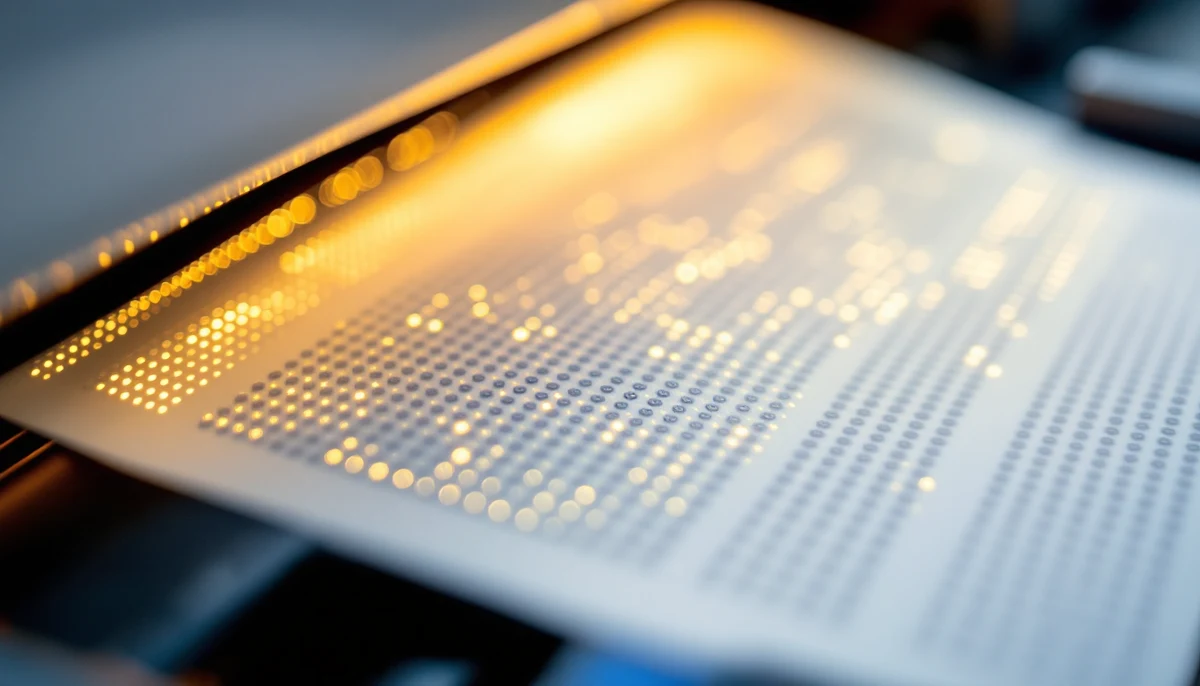
The delivery system will become even more fragmented. The ability to produce braille with the assistance of computer equipment and braille embossers, together with the demands that are made of teachers by the system of outcomes-based education, is likely to see more and more schools producing braille in-house. And I imagine that other institutions may do the same thing. If anything, therefore, the delivery system for braille is likely to become more fragmented, and this raises the question of standards. It also raises the question of training. The library, with other production houses, bears a responsibility to future generations to ensure that the new stage of braille production doesn't spell anarchy as far as standards of production are concerned, particularly so that quality can be guaranteed to the end-user.
Coming to the library has meant a mid-life change of career. Previously you worked as a lawyer, could you tell us about that time, what you did and where?
My career as a lawyer spans three distinct stages. The first of those I spent as an academic, teaching law at the University of Cape Town, the second as a practitioner in private commercial litigation, and the third as a human rights lawyer, working for the Legal Resources Centre as Director of their Grahamstown office.
The human rights portion of that career was interesting, mainly because I started doing work with poor communities. And I was able to use a skill that I acquired in a commercial setting for the benefit of poor people, so to speak, and in a way that was a natural precursor to the work I'm doing now, because it occurred to me, after a few years doing that kind of work, that I was working with all sorts of communities except with the blind community, which was really the community closest to my heart, for personal reasons.
The progression, therefore, from lawyer to librarian was not as unnatural as it might seem from the outside. Given especially the fact that I do have quite a well-developed academic background, I think it now will stand me in very good stead as far as managing this particular library is concerned.
Your legal work was extremely varied, and sometimes contentious. It included land claims, didn't it?
I was involved in two types of work: land claims and litigation in the area of social welfare, disability grants in particular.
The land claims were interesting because in all the cases we acted on behalf of communities who had been dispossessed under apartheid, usually for reasons that served the cause of spatial apartheid and, in one particular instance, simply because they were black and occupied land on which the state wanted to exploit diamonds. The history of each and every claim had to be researched in considerable detail, going back, in one case, for more than a hundred years. It brought me into contact with the affected groups of people themselves, with historic research, with anthropological expertise, and with legal principles that were really being developed as we went along. In other words, it was new law in South African terms, sometimes almost obscure history and anthropology, all of which raised very interesting issues in their own right. The opportunity to work in an area where I could blend all of those disciplines into one enterprise was an extraordinary privilege, and not something many lawyers are ever able to do.
In the area of social welfare litigation, I was part of the team that spearheaded the first class action in South African constitutional law. We represented in excess of 50,000 former disability grant recipients in the Eastern Cape. Their grants had been cancelled because the provincial government needed to rationalize the various disability grant systems it had inherited from the separate homelands that now comprise the province. The challenge was too big for the state, and at some point it was decided simply to terminate all grants in order to redesign the entire system from the stream of fresh applications, which of course was very unfair to people who were really in dire need. Simply to gather the evidence required to challenge that practice was one of the most mammoth tasks I ever undertook. Again, the experience of having been at the cutting edge of the development of constitutional law in this country, and the experience of working for such a vast number of disabled people, was, I would say, one of the highlights of my professional career.
Is there a human rights dimension to a library service?
I believe so. The issue here is one of access to information. It's become almost commonplace to say that access to information is a cornerstone of participation in the democratic process, but that is literally what it is about. It literally is about enabling disabled people to participate as fully as possible in the democratic process by having information which will enable them to form opinions and which will enable them to make inputs at whatever level they think best and in whatever way they think best. In addition, access to literature and information promotes personal development. There is no greater good in any society than the personal development of the people it comprises.
We're privileged to have a well-developed national library in our country. Elsewhere in Africa blind people are often poorly served. Is there a role to be played by our library in this regard?
I think there is a role for the library to play and the reason I say this is that the library does not only have books. It also has expertise relating to collection development and it has credibility in the informational library community and, I would dare to suggest, it has credibility in the South African blind community. Whatever might be needed out there, the library should either be able to provide a service or to facilitate a process whereby the expectation can be met. In other words, we can provide books or we can provide information or we can provide contacts.
Here again, it's worth noting that the process has already started. It's not only the SA Library for the Blind that is interested in assisting in Africa. I've discovered an immense amount of goodwill towards the needs of blind people in Africa in overseas organizations, from funders to actual library institutions. I'm specifically referring to people in France and Canada who are interested in assisting Francophone Africa and people in Britain and the Netherlands who are interested in assisting Anglophone Africa. This is not something the library has to start from scratch, but something in which the library is able to play a key role because of its geographic location, because it is in Africa, and because of its expertise.
Tell us about Johan Roos the person when he is relaxing. What are the things you like to do?
What I like to do most is to read. Right now, though, I have two little children at home who occupy my attention almost on a fulltime basis. The way I spend my free time these days over weekends is that I don't relax at all. I try to play with my children as much as I can and at night I read, thinking that that's what I would have liked to do all day, which is no doubt just a fantasy.
What do you like to read?
It varies; at the moment I'm reading moral philosophy, but, every now and then, when the diet becomes too rich for me, I break away and read novels. I've rediscovered John Le Carré, for example, as a temporary diversion. When I'm not reading John Le Carré or something equally low or middle brow, I read philosophy. I went through a history patch too; history and philosophy are the two disciplines I love most.
You're one of those blind people who like to surf the internet. Do you find any useful sources of information? And does it have any relevance for your library work?
The internet is a vast source of useful information. The trouble is that it is not an ordered terrain, so that the major challenge to somebody who has access to the internet is to be able to systematize one's reading. In other words, it doesn't seem to me useful to have access to more information than one can manage, if one does not have the means of coping with all that information. I have found the access to unlimited quantities of information is a bigger challenge than I ever expected. I am ambivalent about the internet in the sense that I can make use of it now, but that at an earlier stage of my life all of this information served as such an immense distraction that it could have derailed me, had I not managed to recover my balance.
Do you have a favourite website?
I have one favourite website which I can recommend to all serious blind readers. Its called Arts and Letters Daily and the URL is www.aldaily.com. It is the best effort on the internet in gathering together all the sources of literary and philosophical information that any serious reader might want to access.
|