
Disability World
A bimonthly web-zine of international disability news and views • Issue no. 19 June-August 2003


home page - text-only home page

Costa Rica: Promising Negotiations by Persons with Disabilities and the Government
By Luis Fernando Astorga Gatjens (lferag@racsa.co.cr)

As an immediate result of the 1000 persons protest, conducted by the organizations of persons with disabilities in Costa Rica, the government was quick to respond by initiating a negotiation process with representatives of these organization. The objective was to provide effective solutions to the 10 point petition presented by the disability community.

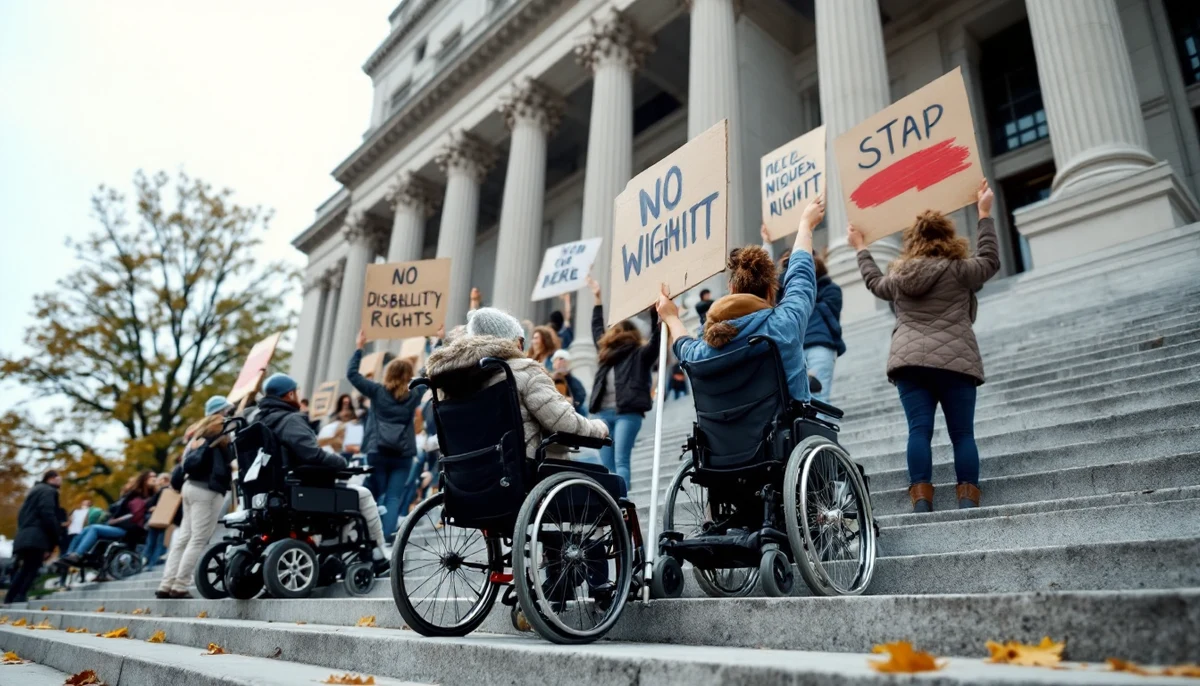
After a march, the demonstrators gather in front of the Presidential House, on May 29, in Zapote, San José, the capital of Costa Rica. This public event was also held as a way to celebrate the seventh anniversary of the approval by Congress of the Costa Rican Equal Opportunities Law for Persons with Disabilities (Law 7600), which became part of our legislation on May 29, 1996.

The demonstration
The demonstrators included Costa Rican Ombusdman José Manuel Echandi and Members of Congress Rodrigo Alberto Carazo of the Citizen Actino Party (Partido Acción Ciudadana, PAC) and Federico Vargas of the Social Christian Unity Party (Partido Unidad Socialcristiana /PUSC).

While shouting their slogans, the gathering crowd demanded justice and respect for the human rights of persons with disabilities, after marching from a near by radio station to the Costa Rican Presidential House. They all expressed the urgent need for compliance of Law 7600 with slogans like: "Without an accessible nation, democracy is impossible."
The Petition
In the middle of March, at a General Assembly of Organization of Persons with Disabilities, the Costa Rican Forum for Human Rights of Persons with Disabilities (Foro por los Derechos Humanos de las Personas con Discapacidad) presented a 10 point Petition for the Government of Costa Rica. The General Assembly approved the Petition, emphasizing the need to deliver it to government authorities.

The Petition addresses unmet demands in the following areas: education, technical training, protected employment and sheltered workshops, small business, the promotion of work and hiring, and strengthening the Costa Rican Council of Rehabilitation and Special Education, to improve its functions as the government agency responsible for disability issues in the country.

After the unanimous approval of the Petition, it was hand delivered to the then acting President Lineth Saborío, on April 11. The Petition provided the government with a one month period for due answer. But the government did not respond.

Because the government did not respond, the disability community decided to organize the demonstration, making the 7 Anniversary of Law 7600, an occasion to demand compliance with the law and a concrete answer to our Petition. (The Petition is found at the end of this article).

The Delegation for the Negotiation
During the demonstration of May 29, pressed by the determination of the protestors assembled in front of the Presidential House, Vice President Lineth Saborío decided to receive a delegation of four representatives of the organizations of persons with disabilities. The group appointed four persons with disabilities which have been very active in this new negotiation process: Catalina Devandas Aguilar and Luis Fernando Astorga Gatjens, Vice President and President, respectively of the Forum for Human Rights of Persons with Disabilities, Francisco Villalta Montes, President of the Association of Sheltered Workshops, and Jesús Hernández Hernández, member of the Information Committee of the Organizations of Persons with Disabilities. They met on the same day for three hours with Vice President Saborío and other government authorities. The two Members of the Congress mentioned and Master Bárbara Holst, Executive Director of the Council of Rehabilitation, served as facilitators.

Negotiations moving
Thanks to the open and constructive attitude of Vice President Saborío, who is president of the Social Council, the negotiations had a good start. She was very receptive to the arguments we expressed regarding the difficult situation of discrimination and disadvantage against persons with disabilities in our country.

We also indicated that, because on this seventh anniversary of the Law there is still not practical implementation of its articles, the organizations of persons with disabilities may be forced to present law suits and other demands at the Costa Rican Constitutional Court (Sala Constitucional) and the Regulations Authority of Public Services (Autoridad Reguladora de los Servicios Públicos, ARESEP).The lawsuits would address specific areas of unmet needs, for example public transportation, thus creating a difficult situation for the government.

We explained that the spirit of the organization and their representatives was constructive and that we only wanted concrete short and long term solutions to improve the quality of life of persons with disabilities and their families. This need for action is contained in the 10 point Petition presented to the government more than a month ago.

Then Mrs. Saborío examined each point of the Petition and there was a general agreement and a strong commitment from the Vice President that they must be translated into concrete actions for each request. At the end of the meeting Vice President Saborío told us that there must be a second meeting with the representatives of the institutions mentioned in the 10 point Petition: The Ministry of Public Works and Transportation, Combined Institute of Social Assistance, the National Institute on Learning, the Ministry of Labor and Social Security, and the Ministry of Public Education.

During this first meeting Federico Vargas, Member of Congress, was very critical with respect to the ineffective way that the government has complied with Law 7600: "That is why I have participated in this demonstration with the organizations." He expressed his willingness to contribute with support from the legislature regarding reforms and projects.

The Second Meeting
The second meeting to continue with the definition of solutions for the the 10 point Petition, was held from 2 to 5 pm, on June 3, with the Vice President Saborío and high officers from the institutions mentioned on the text presented to the government.

The other authorities present in this second meeting were: Wilfredo Blanco, Vice Minister of Education, Carlos Monge, Vice Minister of Labor and Social Security, Karla González , Vice Minister of Public Works and Transportation, and Roger Carvajal, Executive President of the National Learning Institute, Raúl González, Technical Secretary of the Social Council, Luis Madrigal, Legal Advisor of the Vice President and Ivonne Jiménez, Press Secretary, and representing the organization of persons with disabilities: Catalina Devandas, Francisco Villalta, Jesús Hernández, Luis Fernando Astorga and, Barbara Holst, the facilitator from the Council of Rehabilitation and Special Education. The two Members of the Congress, Vargas and Carazo did not come to this meeting.

This meeting began with reading a letter from the four representatives of the organizations of persons with disabilities, where we recognized the open and constructive attitude of Vice President Saborío and her commitment towards the concrete points of the Petition. Then, we all worked with the corresponding government authorities of the education, transportation, labor, and technical training areas, defining for each, as stated on the Law 7600, the unmet demands. Emphasis was made on how this situation becomes harder and greatly affects persons with disabilities from low income families, which are the majority of this sector of our national population.

Methodology for the negotiations
This second meeting also served to define a more precise working methodology to conduct this important process of negotiation.

a. General Meeting with the Vice President
The First Meeting with Vice President Saborío on May 29. At this meeting the following progress was made:
  1. A general assessment was made regarding the conditions of discrimination and exclusion that persons with disabilities are confronting and the lack of compliance with Law 7600.
  2. Each point of the petition was examined and the corresponding solutions were commented on (actions and measures).
  3. The Vice President made a commitment to address the demands included on the Petition, by working with the pertinent government authorities.
  4. The Vice President perfectly understood the our demands cannot be treated as "help" but as social and economical strengthening for a sector of the population in search of justice and whose urgent situation is a matter of human rights and social inclusion.
  5. A second meeting was scheduled for May 3 with the purpose of conducting a more detailed assessment with the pertinent government officials and us.
b. Second Meeting with Vice President and officers of the pertinent institutions and us
The institutions represented at this Second Meeting: Ministry of Education, the Ministry of Public Works and Transportation, Ministry of Labor and Social Security, and the National Learning Institute, with the persons mentioned above.

The following progress was made:
  1. Each representative of the corresponding institutions expressed their concerns with respect to our demands of urgent improvements in the areas of education, work, public transportation, and technical training.
  2. Without exhausting the topics, concrete measures were defined with respect to the 10 point Petition.
  3. The Vice President assumed the role of orienting and guaranteeing the fulfillment of the measures to be undertaken by each government institution with respect to the Law 7600 and the 10 point Petition.
  4. The representatives of the government institutions expressed their commitment to meet with the Negotiating team in order to defined the corresponding institutional policies, programs, projects, and actions.
  5. The participation of the Executive President of the Combined Institute of Social Assistance was schedule for the Third Meeting with the Negotiation Team.
c. Meeting of Working groups with the representatives of government institutions
These meetings must be held within the next two weeks to effectively address the following tasks:
  1. Based on each of the 10 point Petition and the specific commitment of the Vice President Saborío, concrete commitments will be established regarding the actions of each institutions. These commitments must include objectives and goals, financial and human resources, and a time estimate to conduct the assumed obligations with respect to the demands in the Petition.
  2. This work will be written on a brief yet concrete two page document including the actions to be performed by each participating government institution.
  3. The work plan must include a meeting with the government officer who was present at the June 3 meeting; other officers may participate, so long as all contributions are practical and advancing the process.
d. A meeting to consolidate the agreements with the Vice President of the Republic
At this closing meeting of the negotiation process, the following actions will be performed:
  1. Each institution involved will present its contributions for the process. There will not be too much discussion, except for some specific clarifications.
  2. We, representatives of the organizations of persons with disabilities would collect the agreements and prepare a general document where the Vice President, representing the government, warrants the full compliance to all obligations found satisfactory for persons with disabilities.
  3. The remaining issues of the process (things requiring legislative intervention or longer time, such as the political and economical strengthening of the Council of Rehabilitation and Special Education) will be conducted pursuant to a plan to be drawn and approved by participants as part of this process, including the corresponding commitment and time for execution.
  4. The results of this negotiation process will be made know at the moments of concluding the negotiations. The press will then be informed (there is the possibility for the Vice President to organize a ceremony to conclude this important event) and the organizations of persons with disabilities may hold a General Assembly for this purpose.
Petition
-Concerned about the constant violations on the part of many public institutions and private public service entities of the regulation of the Equal Opportunities Law for Persons with Disabilities, Law 7600.

-Convinced that the immense majority of the almost 400 thousand persons with disabilities of Costa Rica cannot achieve our desired development, unless there is sustained progress in making services accessible and eliminating all forms of discrimination and the exclusion that still prevails in our society.

And inspired by the cause of human rights and the struggle for better living conditions of the population with disabilities, we present to you this petition with urgent requests which are necessary for our social development.
  1. The Ministry of Public Education must warrant access to education at both public and private centers to all persons with disabilities and to eliminate any discrimination based on disability when entering any educational facility.
  2. That the National Learning Institute (Instituto Nacional de Aprendizaje, INA) must, from this year 2003 on, open special course for the technical job training, within a joint participation program involving private companies wanting to hire persons with disabilities.
  3. The Executive Power must present and sponsor at the legislation, to protect and to regulate protected employment , with technical and financial support for the organizations working in this area, which is now benefiting hundreds of persons with disabilities.
  4. The executive Power must create a National Credit Fund for Small Business and Microenterprises for Persons with disabilities and their families in the amount of 500 million colones, operating within the Costa Rican Bank System. This fund will provide low interest credit and with accessible terms for persons with disability, plus training and small business management components for applicants. This training will be provided by the National Institute of Learning (Instituto Nacional de Aprendizaje, INA).
  5. That the Ministry of Labor and Social Security (Ministerio de Trabajo y Seguridad Social, MTSS) be provided with the adequate budget as it needs to develop a policy to foster work for persons with disabilities at both, the private and the public sector. This policy must include well defined annual job placement goals.
  6. That the Ministry of Public Works and Transportation ensure that in this year of 2003, the transportation companies must adapt at least two buses to ensure accessibility for persons with disabilities, including persons using wheelchairs.
  7. That the Ministry of Public Works demand from its concessionaries and permit bears in the area of public transportation, their obligation to provide accessibility at terminals. Also, the government must oblige the National Transportation Council (Consejo Nacional de Vialidad, CONAVI), to build access platforms at bus stops, to allow free and safe access for persons with disabilities at schedule bus routes.
  8. The institutions of the housing sector must ensure persons with disabilities and their families full compliance with the law, including the one and a half housing bonus and related support for them to achieve a decent and accessible house.
  9. The Combined Institute of Social Assistance (Instituto Mixto de Ayuda Social, IMAS), must establish more adequate and fair criteria to deal with poverty associated with disability.
  10. In order to strengthen the directive role of the Costa Rican Council of Rehabilitation and Special Education (Consejo Nacional de Rehabilitación y Educación Especial, CNREE) and to ensure the that this entity will comply with its obligations under the law, the Executive Power will increase the budget of this institution by 25% and will appoint representatives with sufficient powers to make decisions. Furthermore, the Executive Power will present the Legislative Assembly a project to modify the Law 7600 only with respect to the percentage of representatives of organizations of persons with disabilities, so that 50% of the members of the Board of Directors will be representatives of these organizations.
Mr. President, the Social Movement of persons with disabilities and their families that our reasonable petitions will be positively accepted, so that the activity we have organized for next May 29, to commemorate the seventh anniversary of the approval of the Law 7600, will be an expression of democratic celebration in a nation which is not yet accessible.

Issued at La Valencia de Heredia, March 15, 2003

home page - text-only home page


Email this article to a friend!