
Protection of Disabled People's Rights in Georgia: Highlights 1988-2004
By George Kokhreidze, former Member of Parliment, Tbilisi, Georgia (parl635@yahoo.com)
The breakup of the former Soviet Union, internal military conflicts, and disruption of the social environment in the 1990's caused quite a significant increase in the number of disabled people in Georgia. Experiments, carried out in the governing of the country's political and economical life, created after-effects, such as corruption, and lack of organization. Most of all, these negative consequences have greatly affected the unprotected population of disabled people.
During these years the necessity of protecting the rights of disabled people became clear and nongovernmental organizations of disabled people were founded and became active. The creation of disability NGOs, supported by international organizations, has played a significant role in protecting the legal rights of disabled (and not only disabled) people.
Growth of NGOs
The first NGO of disabled people in Georgia, the "Association of Disabled People" was founded in 1988. Then the Sports Federation of Disabled People was set up in 1990 and attracted many active participants due to its specific focus, and because sport is considered to be one of the best means of rehabilitation for disabled people. With the help of the Sports Federation, some disabled persons while participating in different programs abroad, gained experience and became knowledgeable about programs and laws protecting human rights and started fighting for the rights of disabled Georgians. In the beginning, although there were only a few activists, they managed to take disabled people out of their houses and encourage them to participate in different competitions (arm-wrestling, chess, draughts, backgammon, table tennis, marathons, water skiing, mountain climbing, etc). In addition, they developed cultural events in the communities and educational programs on TV. All of these activities were carried out with great enthusiasm and were based on personal interests.
In 1995 the "St. Queen Tamar Order of Veterans and Handicaps" and the "League of Disabled People" successfully lobbied for legislation on the social protection of disabled people. The sponsors of this legislation, with financing from the British organization, "Oxfam", traveled throughout Georgia and held a congress nine days before the adoption of the legislation. On 14 June 1995, Parliament adopted the legislation on social protection of the disabled people and in October Parliament also adopted legislation on the social protection of veterans. Organizations of the blind and organizations of the deaf became active. After the adoption of these laws, the number of disability NGOs increased more than the activity of the disabled people. Privileges that were contained in these laws were also conferred on other unmotivated groups through different resolutions, decrees and instructions through an over-use of political lobbying, thereby resulting in the abuse of these privileges. Therefore after six months, all of the above-mentioned legislation, including the law about disabled people, was cancelled. The cancellation of these laws lasted 18 months and those disability organizations that truly represented and united disabled people really suffered a lot.
In 1995-1996 the League of Disabled People, with the help of foreign partners, created many new jobs for disabled people. According to the assessment of international organizations, it proved to be the most active disability NGO in the Caucasus region during those years.
The successful programs of the League of Disabled People resulted in a Presidential decree, which ordered all State Departments to enforce each clause of the law about social protection of disabled people within its competence. Unfortunately the President's instructions were not fulfilled and therefore the necessity of uniting the efforts of all disability NGOs became apparent, since everyone understood that together they could achieve more.
Successful civil actions result in new law
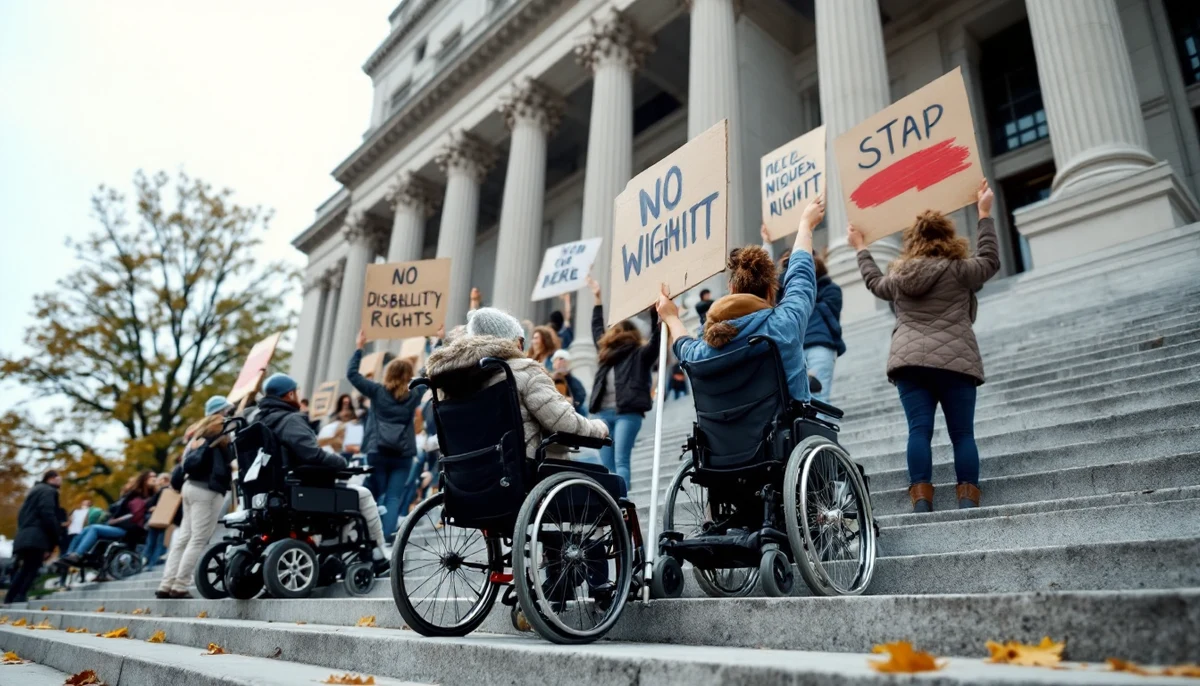
On 14 December 1996 the Coordinating Council was founded, which consolidated the work of 22 disability organizations in a well-defined campaign for their rights. On the same day representatives of the League of Disabled People started a hunger-strike, which after 3 days, resulted in an agreement between Parliament and the Coordinating Council that the rights of disabled people would be considered in approval of the Federal Budget. In June 1997, the Coordinating Council had to organize another hunger strike, since the government was not fulfilling its obligations. After two years of struggle, in 1998 a State Budget law was adopted with language declaring that any disabled person who wishes to live an active life can integrate into society.
From 1998-1999, while operating under constant unfavorable conditions from State functionaries, the law more or less worked for eight months. In July 1998, when State structures started stealing money from the accounts of disabled people, the Coordinating Council again had to conduct another hunger strike to focus the attention of the society and government. That action was only partly successful with some of the money being returned to the disability organizations and legal efforts continuing to demand the return of all the money.
Accomplishments while State Budget Law was active
In support of an active life for disabled persons program; the roads in six districts of Tbilisi were adapted for accessibility; 15 adapted buses were imported; a production shop of wheelchairs and subsidiaries were created where disabled people were employed and about 1000 wheelchairs produced. Approximately 100 wheelchairs were imported from abroad. Using active-type wheelchairs and with the help of local and foreign instructors, 100 persons received two-weeks of mobility training, 15 of them received certificates as "active life" instructors. Regional organizations were established and some State finances were assigned to them.
New services, businesses & access to assistive technology
Nowadays, these organizations have become quite strong lobbies to the local authorities. Disabled persons with hemophilia have been provided with the necessary medical supplies. Approximately 20,000 walking-sticks and crutches have been imported. Seven teams of amputee football players were founded and the national team has won 4 th place in Manchester, England. Three wheelchair volleyball teams of wheelchair disabled people were created; and two world champions emerged in arm- wrestling (Cairo). In addition: two integrated nurseries were founded; about 50 conferences and seminars were held on different topics, two Special Olympic games were organized with various educational programs for the parents of disabled children; three integrated art schools have been launched; construction standards have been prepared for creating an accessible environment; educational literature for disabled people has been translated and printed; two studios have been established, where disabled children learn art; directory address computer software has been created, in which disabled people were involved and these software programs are now being used by official organizations and private persons; three businesses for the blind and two businesses for the deaf have started operating, three businesses for people with mixed disabilities have been established; two Charity concerts have been held; for blind children audio educational material has been made; 200 disabled children have received computer literacy courses; and 200 deaf children have received hearing aid equipment.
Improving access to governance, democracy & education
In addition, representatives of the Coordinating Council have visited across the civil war conflict zone and established working relationships and provided assistance to local disability NGOs. Compared with the 1995 elections, 55% more disabled people took part in the 1999 election. Since 1999, disabled people do not have any problem in continuing their studies at high schools and a de-institutionalization program for disabled children has been started.
Increased access to medical rehabilitation and assistance
Some 15 surgical operations at an approximate cost of $ 25,000 have been carried out abroad and more than 200 operations have been carried out in Georgia. Ten inexpensive (approximately $2000) surgical operations were conducted in Yerevan, Armenia and 20 persons were sent to the Crimea for rehabilitation. At least 40,000 children in eastern and western Georgia received free medical screening and 40 of those children received urgent operations. More than 15,000 disabled persons received some financial help.
Lack of public awareness makes progress vulnerable
Unfortunately the Georgian public was not informed about these successes in the lives of disabled persons. This lack of public awareness in our society was exploited by a group of people who were interested in abolishing the law, and they successfully conducted a public relations effort to restrict the activities of disabled people's NGOs.
By the year 2000, the economic tools of the Federal Budget law, which were used to create many programs for disabled people, were abolished. However, because Disabled Persons had their own representative in the Parliament, they continued to have the right to initiate new legislation. A representative of disabled people's organizations was managing the subcommittee of Georgian parliament responsible for the affairs of disabled people. Even with a disabled representative in Parliament during the year 2000, none of the proposed legislative initiatives was successfully brought to the floor from the committee meetings. A draft Disability law, which was signed by 178 deputies, was not even debated in the open Parliament session.
The majority from the ruling government party has ignored the law on "protection of social rights of disabled people" and unfortunately this situation continues today. It is nothing but the discrimination of disabled people. Parliament has to discuss these matters, since it is a democratic institution and to have democracy and discrimination together is impossible. "If one country has both, discrimination and democracy at the same time - it is discriminated democracy..." (From Parliament session, 2000)
Some inroads made in spite of setbacks
Despite the successes and failures, 1998-1999 were very important years in the life of disabled people in Georgia and many disabled persons became active in this period. Additionally, part of the unmotivated public has started thinking about the problems of disabled people, sometimes due to the economic hardships, sometimes with sincere compassion. This is a real breakthrough in Georgian mentality. Disabled people could be seen in the streets, in transport, cafes, theatres and cinemas, stadiums and other gathering places. Disability organizations have gained important experience and quite expanded intellectual resources. As a result they have been quite successful in their activities, even though there was no support in the year 2000 and very little support in 2001-2003 from the State. During these three years using their own resources and sometimes with the help of international organizations, they have adapted 10 secondary schools, carried out integrated and inclusive studies and created an integrated swimming pool. The Coordinating Council member organizations have participated in 30 international seminars and conferences. One more integrated nursery was established and the remaining materials from the wheelchair production activity have been used to create 50 wheelchairs. Some 10 sporting events have been held and 250 children have undergone computer training, including special training for 25 blind children. For the children with limited hearing, a school of enunciation has been founded and teachers are undergoing training in Croatia.
Due to the activity of the NGO sector and with our lobbying efforts during the Budget process of 2001, a micro-projects competition for the employment of disabled people resulted in the funding of 40 programs with small grants (each GEL 25,000). Many previously unknown and inactive disabled people have participated within those programs.
Founding of Coordinating Council, new laws & resolutions
In 2001, thru the initiative of NGO organizations of disabled people, Parliament adopted a resolution to establish a Coordinating Council under the President within two months. The aim of establishing this Coordinating Council was to have a consulting body to the President, which would encourage the government to carry out its policy towards disabled people based on the recommendations of the active disabled population. However, it took more than one year for the government to fulfill this resolution and on 8 May 2002, the Coordinating Council was founded. Since then, it has played an important role in establishing anti-discriminatory policy on the basis of disability. In 2003, four anti-discriminatory laws and the President's five resolutions have been adopted.
In June 2001 after eight months of discussions, the legal term "invalid" was changed to "disabled person". The reason for the change of legal term was that people with disabilities need equal opportunities and despite our economic hardships, the international laws on human rights have no exceptions for any country. The law of social protection of disabled people unifies similar principles. During the same Parliament session clause 32, which was abolished in 1997, was reestablished and the new version was better than previous one!
On 7 December 2001, Parliament adopted the law concerning medical and social appraisal. According to this law, restrictions on the employment of persons with disabilities have to be defined not only from the medical point of view, but also from equal opportunities. The new law has eradicated the legal terminology, "incapable of work". Therefore many employment restrictions, where incapability for work was the reason to fire person, have been abolished. This was very important. With this advance in the right to employment for persons with disabilities we can think about various types of insurance, such as insurance against disability.
Coalition for Independent Life formed
According to the Parliament's resolution of 2001, on 8 May 2002, the national coordinating council under the State Secretary was founded. In the summer of 2002, the coalition of non-governmental organizations of disabled people and veterans (Coalition for Independent Life) was founded, which aims at supporting independence and welfare of disabled people and veterans in Georgian society.
Main activities of the Coalition:
- Support of disability organizations whose activities are directed towards protection of the legal rights and opportunities of disabled people.
- Destroy stereotypes about disability and disabled people and to establish positive public opinion through public awareness campaigns.
- Support the integration of disabled people and their family members into the country's political, economic, social and cultural life, and their participation in the policy decisions regarding disabled people.
The philosophy of independent life, which is the basis of the coalition, directs disabled people to set the policies and activities of the coalition for themselves.
Independent life - it means to make independent choices, to take risks, make mistakes and make decisions. Independent life - it is the person's right to be an integral part of active social life and participate in their country's social, political and economic processes. To have the free choice and option to use residential and municipal buildings, transport, communications, insurance, employment and education. To become really independent, a disabled person has to overcome many difficulties. These difficulties could be visible (e.g. architectural surroundings) or invisible (people's attitudes). If we eradicate these difficulties, it will be possible to make the first step, to live a life of full value, to work and have a family, to raise children, to participate in sports or politics etc.
On 14 November 2002, the Coalition organized a legislative forum where a package of anti-discriminatory draft laws and anticorruption ideas were presented to the invited government representatives. It was for those that disabled persons would participate in anticorruption and anti-smuggling activities, which would help save the State hundreds of millions of GEL. During the second forum held on 2 May 2003, the government expressed its readiness for the execution of the project.
Change of government in 2003
After the peaceful overthrow of the government in December 2003, called the "Rose Revolution," new government officials have assumed control and this project has temporarily stopped.
As a result of the Coalition's activity, the State budget of 2003 implemented several disability integration programs with the direct participation of disability organizations.
New projects
State program of 2003
Today the Coalition, within the State program of 2003, entitled "Support to social adaptation of disabled people", carries out six different projects:
- "Informing society about the matters of disabled people";
- "Supporting integrated education";
- "Supporting independent life of disabled people";
- "Supporting participation of disabled people in cultural and creative activities";
- "Supporting participation of disabled people in sports events".
- "Social rehabilitation of disabled people and veterans and the prevention of disability".
As a result of the Coalition's activities, a President's resolution announced June 14 as a day of protection of the rights of disabled people. On that day a concert sponsored by the coalition served as a background for the activities celebrating the event. Anti-discriminatory supplements to the criminal code and administrative code, which entered into force on 1 December 2003, are also credited to the disability NGOs. At the same time supplements to the law on building construction have been adopted, mandating that construction carried out for accessibility is free from taxation. These developments have improved disabled people's legal conditions.
New emphasis on accessible democracy
In summer 2003, the Parliament adopted changes in the election code in order for blind persons to be as independent as possible while voting. Election materials were made accessible to them by being printed in Braille. For deaf persons a public campaign is to be carried out by special translation. For persons using wheelchairs, the law requires easy access at electoral districts:
...If within electoral district there are disabled people, who are using wheelchair and they have addressed election committee not later than 25 days before voting day, the committee is obliged to provide temporary, easy access for them (Clause 50, Article 2)
...If within electoral district there are blind people and the information about them is given to election committee not later than 45 days before voting day, committee is obliged to prepare part of ballot-paper with special technology, that allows voters to fill them independently (Clause 51, Article 2).
...While broadcasting information about election campaigning, State TV companies are obliged to give the above sound information using special technologies for the people with limited hearing (Clause 66, Article 4).
printer-friendly format |