
How Children Are Learing about Disability
By Barbara Kolucki (bakoluck@aol.com)
We know that in many countries today, children with disabilities are included in more mainstream classes than ever before. How are non-disabled children being prepared for these experiences? How are they learning about their peers? Are they learning in ways that prejudice them or in ways that keep them open-minded for perhaps their first first-hand interaction?
This is the first in a series about a variety of ways school-aged children around the world are learning about disability today. We will present actual projects taking place, associated educational products such as new disabled dolls and appliances, guides on how children can critically analyze books, contests for teenagers, etc. We encourage readers from around the world to write in with their examples and suggestions.
The Berkeley Pioneer Disability Rights History Curriculum
Berkeley, California has been at the forefront of just about every aspect of the disability rights movement. They have continued this trend with a project that was piloted in November and December 2000. The target audience was fifth and sixth grade classes who also happened to be learning about civil rights history as part of their curricula. The project was run by the Disability Rights Education and Defense Fund (DREDF) in Berkeley and funded by California's Department of Rehabilitation. The project coordinator was Kenneth Stein, who was an early staff member of the Berkeley Center for Independent Living. Kathy Martinez, Deputy Director of the World Institute on Disability (WID), and Gerald Baptiste, Associate Director, Berkeley Center for Independent Living, were co-instructors for the classes.
In November of 2000, a letter was sent to the parents, guardians and caregivers of all children in the fifth and sixth grade classes at Jefferson and Martin Luther King Middle Schools. The letter explained the project and how disability rights would be part of the larger "rights movement" that was being studied in school. Parents were briefed on various assignments for the class and asked for permission to take and use photographs from the project for DREDF publications and website.

One of the instructors, Kathy Martinez, was no stranger in teaching children about disability. Ten years ago, she worked on a project called "Keys to Introducing Disability into Society", also known as the KIDS Project. Here children learned about both similarities and differences. A number of people with disabilities were invited into the classrooms over the six week project, and the disabilities ranged from those visible, such as blindness or cerebral palsy to invisible ones, such as learning disabilities. During the final week of the KIDS project, audiocassettes were made where children talked about what they learned and how they felt. They also had to experiment with inventing something that would help a person with a disability in an activity of daily living. And they were asked to write and/or draw something based on this experience. Ms. Martinez's personal experience as a blind person and her professional experience teaching about disability were central to this 2000 DREDF project.

The Book: Cornerstones of Freedom: The Disability Rights Movement
All students participating in the project were asked to read a 1996 publication by Deborah Kent called Cornerstones of Freedom: The Disability Rights Movement (Children's Press, A Division of Grolier Publishing, New York). The book is written for children with about a Grade Three/Four reading level. It includes numerous photos of children and adults who are disabled.
The book tells the story of Ed Roberts and Judy Heumann, two of the first pioneers in the disability rights movement. It also informs readers that disabled people have been Presidents, composers, poets, as well as and millions of ordinary human beings. Historically, discrimination kept them from school, work, play and basic communication opportunities. It covers the birth of the first Independent Living Centers and the first organizations formed to bring about political change to improve the lives of people with disability.
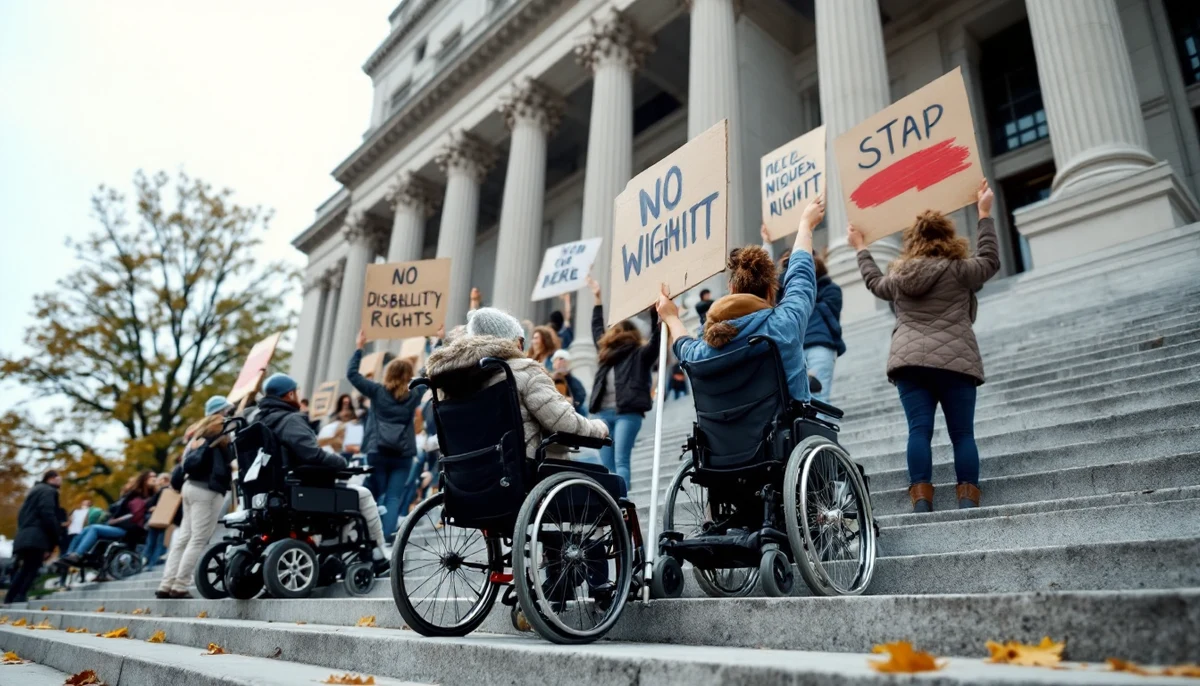
The actions of the first disability rights advocates were similar to those who fought for change in the civil rights struggle in the USA. These included peaceful demonstrations, sit-ins, demands for new non-discriminatory legislation and, plenty of press coverage. And as was also the case in the civil rights struggle, the attitudinal barriers were as powerful and damaging as those that denied access to buildings or schools.
The book details the key laws passed since the 1970s in the USA. It also highlights some of the strides that have been made with regard to mainstream/inclusive education, physical accessibility in communities and new disabled leaders in the field. The appointment of I.King Jordan, the first deaf president of Gallaudet University (the world famous university for deaf students in the USA) was a landmark event - and one that again, was brought about after a mass protest and shutdown of the University in 1988.
I personally think that this book is a welcome addition to the literature about the disability rights movement and similar struggles. However, educators and authors of books for children have learned a great deal about several principles and guidelines that can enhance the potential of such books with readers. I would have liked to see the book be more interactive and encourage critical thinking skills in the readers. I would have liked the book to include a section on how other types of discrimination can affect all of us. I would also have preferred if there were some first person stories where the person who is disabled speaks directly to the reader. Perhaps there will be a revised version or second part on this important topic!
Work with the students
After students had read the book, the presenters spent time with them discussing civil rights struggles in general as well as the relationship between the disability rights and civil rights movements. They viewed a video on laws passed in the disability field. The two presenters with a disability provided personal stories as well as a discussion of their daily lives and any adaptive aids they used. Sessions were interactive and students were encouraged to ask as many questions as they wished. Each of the three presenters were activists themselves in the disability rights struggle and so they could put a human face on what students read in the book.
Each student was then asked to interview a person with a disability. Interviewees were pre-selected and they welcomed a phone call or visit from the student. In some cases, students interviewed parents of children with a disability. Sample questions were provided but each student was encouraged to be open and ask what was "on their own mind". Students and presenters discussed these interviews. And finally the students were asked to write a letter about what they learned from this experience.
Project Report and Next Steps
A final report has been written by Ken Stein of DREDF. It is available at the DREDF website (http://www.dredf.org). The report highlights how much the students both enjoyed and learned from this pilot project. There are a few specific examples from this project and report that are fundamental to the true understanding of Disability Rights. These include:
-
"Although the independent living/disability rights movement sprang directly out of the experience and lessons learned from the struggles of other minority groups (in the USA) and is at its heart a civil rights movement, the passage of the ADA (Americans with Disabilities Act) and other disability civil rights laws were accompanied by no such public education or media awareness; neither of the history of discrimination against people with disabilities, nor the wrongs being righted by the passage of these laws. As a consequence, the laws protecting disability civil rights continue to operate in a traditional cultural and attitudinal context of charity and pity, and in a mass media context of "helpless cripple" and "inspirational super-crip". This view of persons with disabilities persists, inspite of the fact that the disability rights movement was based on an entirely different perspective, that is, on the disabled person's right to full and equal participation in society, and a recognition that the primary barriers to societal participation are discriminatory attitudes and architectural barriers".
-
"About 25 years ago, I began working at an organization called the Center for Independent Living. I know that many of you (the students) have seen the movie 'Pay It Forward', the movie with the boy who starred in 'The Sixth Sense'. What happens in that movie is that the teacher gives his class the assignment of doing something 'to change the world'. When I started working at the Center for Independent Living, I had no idea at the time that this was an organization that was literally going to change the world: it would change the way that people had thought about people with disabilities for centuries; and it would change the way that people with disabilities thought about themselves. What we're going to be talking about this week and next (with the students in the project) is what happened here in this city (Berkeley, California) back then, that literally changed the world.
These two quotes illustrate points that should be part of any project or activity aimed at educating children (or adults) about disability. First, we see the similarity between disability rights and the struggles of other groups confronting prejudice and discrimination - this is often a prerequisite for moving toward understanding and accepting others as equals. Second, we see that even laws are not enough. The public needs to be sensitized and educated if true implementation of the law is to occur. And third, we need to see what we can do to make a change in this world. We need to be challenged to make a positive difference in the lives of others.
The report provides an overview of what happened in each session with the children. The descriptions and details are clear and could definitely be adapted to other countries' efforts to bring disability rights education to children.
In the project evaluation, feedback was both positive and constructive. From a curricula standpoint, adaptations might need to be made with regard to developmental appropriateness (especially for Class Five students) as well as use of media (books and videos) that were of greater interest to this age group. There are numerous books for children (from preschool to teens) that are creative, sensitive and educational. Recent issues of DisabilityWorld include a review and listing of many of them. Many can serve as examples for adaptation and production elsewhere in the world.
Reactions from the Children
What follows are some quotes from children who participated in the project. Of course, we can see their honestly, practical suggestions and humor:
"I'm glad the ADA program came to our 6th grade class. I enjoyed learning about disability rights. I'm glad I got the change to be the first class to meet Mr. Stein and Ms. Kathy Martinez! My favorite part of the program was calling a disabled person. I called Suzanne .... a very nice, enjoyable, likeable woman. For me, the movie we saw about disability rights was an interesting movie, but a little slow. Slow, for children, I mean. I think the part about disabled men and women going to a sit-in was the most interesting part in the movie. I still think you could use that particular video, but most kids will like a different one. Me included. Thanks for coming to our class, and teaching us about disability right".
Olivia
"I think a fun activity (for us kids) would be to write braille. Maybe a few sentences per person".
Julia
"I like the way those gadgets (braille watch et al) worked".
Marc
"My auntie might get her left cut off so she can't walk. The reason why she can't walk is she had surgery three times. I was going to give her advice about disabled people but I didn't know about anything. Now you taught me stuff about disabled people and I can give all the advice I learned. Thank you.
Anthony
"I learned a lot from your class like that disabled people can survive on their own, and that the movement helped them. Speaking of movement, I learned that there was a movement. I used to think that people with disabilities were helpless (I know, I know, I was pretty stupid) but now I know how wrong I was".
Gabrielle
"I much enjoyed those two disability rights classes! I must say, some of the kids who usually never were intrigued or elated about any kind of work were interested in participating! I felt prized to be able to learn about an important subject that is rarely brought up! You may (for future references) want to have some sort of activity or game to get kids excited, if you unfortunately are asked to teach a class with lack of manners and listening skills. Besides that, I liked having you here to present an important subject that hardly any people (children and adults) are exposed to deeply understanding".
Catalina
The students also expressed a wish to be introduced to people with other types of disability. Their comments reflect interest, candor but also the fact that this one event is just a beginning. Some of the students continue to concentrate on "the people that are not disabled need to help disabled people" and "people with disabilities have it hard". Others were able to see both the obstacles but also the resilience and creativity that are part of the lives of disabled people and their families.
The Future
It is hoped that this pilot will serve as a model for the inclusion of disability rights history as part of the overall curriculum on human rights struggles in other schools. In addition, DREDF hopes to use this pilot as a springboard for a broad media awareness campaign to introduce children (and adults) to the issues, key players and legislation in the disability rights movement.
Will children someday know the names of Heumann and Roberts in the same way they know about Martin Luther King? Will they remember Ms. Martinez and Mr. Baptiste as the first persons they met who taught them that people with disabilities are talented, intelligent, contributing and "awesome" members of society? Will they meet a new student with a disability or an adult in the community and feel comfortable speaking with them and learning from them? Will they understand that persons who are disabled vary in the same ways as all human beings?
This project is one example of how children can come closer to learning about and integrating these attitudes into their daily lives. I hope that it is one among several models designed to integrate disability rights as an integral part of human rights history.
Questions from an 8 year old nephew
Ms. Martinez knows that projects like this one are extremely important. And she also knows that it is the daily interactions and responses individual to individual that make a difference as well. And reaching children is the best way of making a difference for the future.
The DREDF project was aimed at children in fifth and sixth grade. I personally think that although this is a good place to integrate disability rights history into their existing curriculum, it is too late in some cases to begin to educate about people with disability. The preschool years are when children's attitudes are formed and when they begin to learn about similarities and differences. The first grades in school are when they often begin to act in a way that might discriminate. Yet it is also the time when they will show extraordinary kindness, ingenuity and bravery.
Ms. Martinez was recently asked by her eight-year-old nephew if he could "interview" her. Of course she said yes. And how she responded to Kyle's questions will not only impact him but also his teacher and other school friends who might read and learn about his interview. Here are a few excerpt from Kyle's interview:
"Thank you Kyle for considering the subject of disability for your interview. I would like to give you some information about disability:
-
In the USA there are approximately 54 million people with disabilities - this is about 20% of the population.
-
Before, people usually died if they had a severe or moderate disability. Now they are living longer because of the advances in medical treatment and technology. Now they are out in public and participating as active members in their community.
-
In the past 30 years, there have been many laws passed to both protect the rights of disabled people as well as to make society more "accessible". This means that if the government or business wants to build a new building, for example, they have to construct it so that people in wheelchairs can get around, so that blind people can read the elevators and they have the proper equipment in order to communicate with deaf people.
Question: Do you wish you could see?
Answer: Because I was born blind, being blind is normal to me. I have never been able to see so I don't miss it. Sometimes it's hard being blind when I can't read something or I don't know how to get somewhere. Mostly it's not hard.
Question: Are you treated differently because you are blind?
Answer: Sometimes I am treated differently because I am blind. Mostly it's when people don't understand that blind people want to be treated like everyone else. Sometime people don't know what to do - if I need help or how to help. This just means that they haven't been around blind people and that they're not sure how to act.
Question: What has helped you to be successful?
Answer: The thing that has most helped me to be successful is the confidence given to me by my family when I was young. Grandma and Grandpa and your mom and others treated Peggy and me (Ms. Martinez's sister who is also blind) like regular kids. We had to clean up, wash dishes, do our homework and participate in all the household activities. Another thing is that we were both lucky because when we ere your age, we had teachers who wanted us to succeed in our education. We had access to braille, we learned to type on a regular typewriter when we were about eight years old and we had lots of friends who were very honest with us about how we acted and presented ourselves.
Question: Who are the biggest influences in your life?
Answer: Many people have been major influences in my life. My parents and brothers and sisters come first. There have been a number of teachers and also many mentors in the disability rights movement who have taught me a lot about being proud of who I am. You and Sarah have played a very important role too. Like when we go to San Francisco and you want to help guide me. That's a big deal, because it means that you are comfortable having a blind aunt."
I particularly love the last answer. Ms. Martinez demonstrates a sensitive knowledge about children when she helps Kyle understand that kids can be influential too! I would bet that Kyle passes on this knowledge and ease to his friends. Yes, it is important for us to teach the masses. The media can be particularly effective here. But it is also the individual "Each One, Teach One" that gives us confidence to pass on what we learn to another.
|