
Disability World
A bimonthly web-zine of international disability news and views • Issue no. 15 September-October 2002


table of contents - home page - text-only home page

The Art of Ergonomics
By Andrew Freeway (Andrew_Freeway@yahoo.com)

High tech or low tech, state of the art or as old as Methuselah, ultimately it is the proper use and fit to the person that makes the difference. The relation between the body, the personality, the profile or biography of a person with a disability and the 'thing' he or she is going to use is perhaps even more important than the appliance or state of the art developments in that specific area. Ergonomics is becoming more and more important in the life of people with a disability.

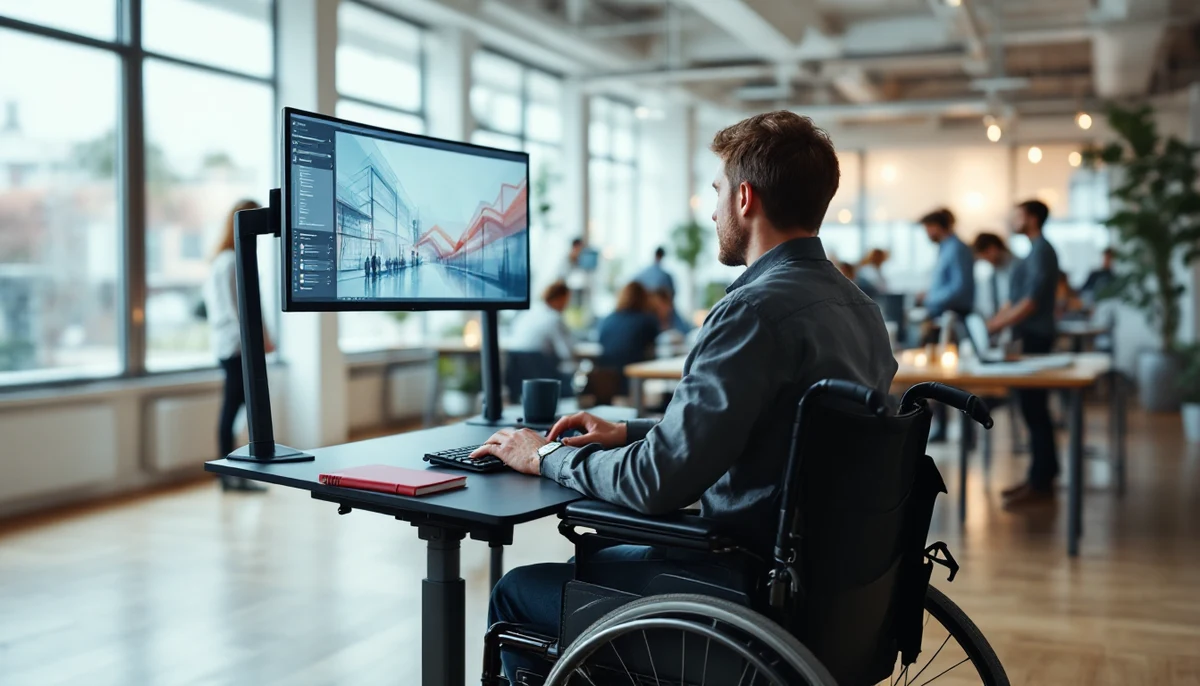
Joanna Jones did not like to use her wheelchair on the street; she was afraid to topple or keel over with her wheelchair, which had happened several times before. Badly injured and, what was even worse, afraid to go outside on her own anymore she either stayed in or asked someone else to push her wheelchair.

This situation is rather common if people are using a non-fitting wheelchair. But let's take a closer look at Joanna's situation. Joanna is quite a big young lady with short heavy legs. Therefore her center of gravity lies forward in the wheelchair. Joanna does not have a standard wheelchair; hers has been specially designed and build to meet her standards. But during that process the ergonomics have been overlooked. The wheelbase - the distance between the point where the front wheels and back wheels hit the ground - was too short. And in combination with her forward centered gravity a dangerous situation was created.

But perhaps an every day experience can explain this situation in more easily recognizable terms. Imagine a fully packed supermarket-shopping cart being pushed against a raised curve. What will happen? The shopping cart halts and at worst you are hit by frustration. But what if the front wheels of the cart were much more further back, closer to the back wheels? The cart would not halt, but would keel over and launches its content on the street. And this is exactly what happened with Joanna in her current wheelchair. Who would not be afraid in such a situation!


But apart from the ever present threat of toppling or keeling over, there is another big disadvantage of Joanna's current wheelchair situation. Because there is a lot of pressure on Joanna's front wheels these small wheels have to cope with a high rolling resistance. The smaller front wheels obviously have a lot more rolling resistance then the larger back wheels. And combined with the forward centered gravity of Joanna's situation, an unacceptable combination was created.

Maneuvering with ease was not possible; making short turns is out of the question. Joanna admits that she is the first one to ask her husband to give her a push instead of wheeling on her own. Not due to her weight or her condition, but due to the wrongly divided gravity she is confronted with too heavy a task.

So here we are: a state of the art specially designed wheelchair only offering Joanna a launching platform, which is too heavy to operate! What a waste of energy, of money, of hard work. What a frustration and what a disabling situation!

In Joanna's case, the only way out is going for a new wheelchair. The current one could not be modified to shift the forward gravity or to relieve the rolling resistance on the front wheels. It is impossible to move the back wheels forward and even if it were possible, this would only make the wheelbase shorter! The new wheelchair had to be designed in such a way that Joanna was more or less sitting behind the back wheels and the wheelbase had to be long enough to prevent any new launching! An important lesson was learned: not only the person's dimensions but also his or her weight, the forward gravity, the way the wheelchair was going to be operated, in short the relation between the person and the device should be mapped out before any decision is made on what kind of device will function best.

Increasing practice-based research in the area of technical aids for people with a disability, incorporating the experiences of people with a disability is a necessity. And applying the outcome of this research might create situations where launching will only be seen as a metaphor instead of the hard reality.

Andrew Freeway (source: Support)

table of contents - home page - text-only home page


Email this article to a friend!