
Disability World
A bimonthly web-zine of international disability news and views • Issue no. 25 September-November 2004


home page - text-only home page

A View from Holland: "The Land of May"

© Marja Morskieft, July 2004, English translation: Hanneke Meulenbroek, October 2004

"Interested? It's about mobility", my spouse says, dropping a pack of papers on the table. Ever since my mobility has been dramatically restricted by the budget cuts for special transport facilities for the disabled I have developed a keen interest in all things concerning the topic, even when it is about labour mobility, which happens to be the case with this package. I tend to have problems with this too. The document describes, at great length, the 'mobility roadmap’ my partner will soon be facing. It is about phased plans and procedures, measures and facilities and, here we go again, a lot of 'may' guidelines, which simply means that your employer may make arrangements with you but that he is not obliged to do so. He may offer you the proposed facilities, but that does not mean to say that you are entitled to them. Rights do not come into it. You are subject to his benevolence, that's what it all boils down to.

How familiar! After all, I have been living in the 'Land of May' for quite some time now.

One may get surgery for one's hip, but one needs to go to Germany for the replacement, where, as an eighty-year old, one cannot communicate with anyone since one doesn't speak the lingo. Where they have a different insulin protocol causing you to have one hypo after another, thus extending your stay at the hospital with two weeks.

You may get home care but only if you've been diagnosed with one or preferably more of the ailments about which the prevailing medical advisory boards have reached consensus. If not, you're basically left to fend for yourself.

You may, of course, appeal against a decision that cuts your personal home care budget by 50% and consequently substantially reduces your quality of life. However, due to the host of counteractions of the defending party, this procedure will probably drag on for about 5 years, driving the judge out of his wits and leaving you without any means to pay for extra care.

You may look for another oncologist when you don't see eye to eye with your present specialist. After all, it is a matter of life and death, where you need a doctor who can relieve you of your panic by discussing everything with you, openly and truthfully. But what if he is also the one who has to write the referral and starts cautioning his colleagues about you, portraying you as a difficult patient and a hypochondriac to boot?

You may try to do some paid work in spite of your uncooperative body, but don't count on them making any allowances for your restrictions or fluctuating energy levels; deviations from the norm are bothersome and regulations are there to be ignored.

You may go to the exhibition you have been dreaming of for some time. But if you want to go today, because it is one of your good days, it is likely to remain just that, a vision: the public transport providers cannot take you there because a) your wheelchair is too big, b) the station is not accessible for wheelchair users, c) the train is already fully booked and, besides, d) you have not applied for any assistance 3 hours in advance. Mobility is unquestionably part of this 'land of may': you may but you can't.


You may try to save some of your monthly disability allowance for a rainy day, but each month a new curb is adopted that, in sum, leaves you with even less money to spare: the compensation threshold for your medication and care expenses is raised, special transport funds are cut, the budget for the implementation of the Disabled Facilities Act has been taken to the cleaner's. Apparently, those rainy days have already arrived.

You may try to keep your head above water and to not lose your self-esteem, your nerve; to not let it bother you when you hear the barely veiled contempt in the voices of the health and welfare minister and his undersecretary when they discuss and rule on people like yourself, the ones with a limitation. You may try to not let it affect you when those in need of special care are so easily labelled as manipulative individuals and marginal or problem cases.

You may try to ignore it, this view -supported by one of our coalition parties- that is constantly being aired: that disabled persons should be compelled more to take on socially relevant jobs. As if their current contributions to society are not valuable already. It sure takes some self-esteem to be able to ignore this!

You may try to not regard yourself as a citizen who is not to be taken seriously when you read in the proposed legislation on 'Care in the Community' that it is your future to become dependent on charity and the goodwill of relatives and neighbours now that 'the right to care and support' is the new taboo. As is the right to participation, for that matter.

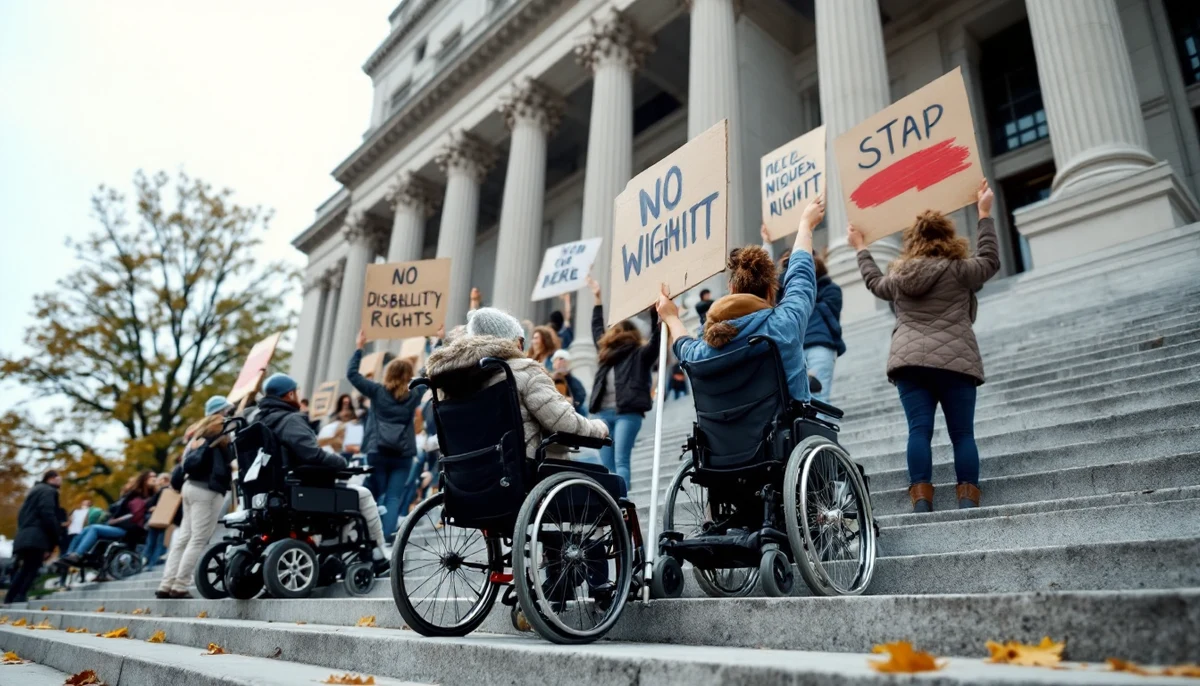
You may try to keep your courage up and to keep on thinking that human rights also apply to disabled people even if it would be more advisable to start reserving some money for a test case against discrimination and exclusion.

So many 'mays', they make me giddy.

Why should I think that I have limited possibilities? Everything is possible, right? In Never-Never Land.

graphic of printer printer-friendly format

home page - text-only home page


Email this article to a friend!