
Disability Buzz
Looking Back at 2001
This issue features two articles reviewing the top 10 disability stories of 2001, largely from the North American point of view. Inspired by these articles, Rosangela Berman Bieler and Barbara Duncan, the co-editors of Disability World, took a look back and selected the following five stories from 2001 that we believe will have a long range impact on the international disability community:
-
The December adoption by the United Nations of a Resolution calling for the immediate exploration of a UN Convention on the Rights of Disabled People. As reported in the last issue of Disability World, the resolution was put forward by the Mexican government and shortly attracted the co-sponsorship of more than a dozen developing countries, then gained the backing of the UN's Third Committee on November 30. Finally, it sailed through the General Assembly without a vote during its final 2001 session in mid-December. Developments will follow rapidly in early 2002, as the commissioned report of lawyers Gerard Quinn of Ireland and Theresia Degener of Germany concerning the need for such a Convention is now being submitted to the UN High Commissioner for Human Rights. At the same time the government and disability community of Mexico have begun plans for international consultative meetings about the proposed convention. The road to a UN Convention can be a long one, but a firm foundation was laid in 2001. The full text of the Resolution can be read at www.disability-rapporteur.org/panel.shtm


-
The African Decade of Disabled Persons (2000-2009) began to attract funding from the international development community. There is still a long way to go before this initiative has the stature and level of support provided to the Asia-Pacific Decade of Disabled Persons (1993-2002), but positive signs emerged last year. Disabled People's International and the Pan African Federation of Disabled Persons (PAFOD) are two of the leading non-governmental organizations involved in this project. One of the more challenging tasks is to demonstrate the Decade's importance to funders that are overwhelmed by the impact of AIDS/HIV on the African continent.
-
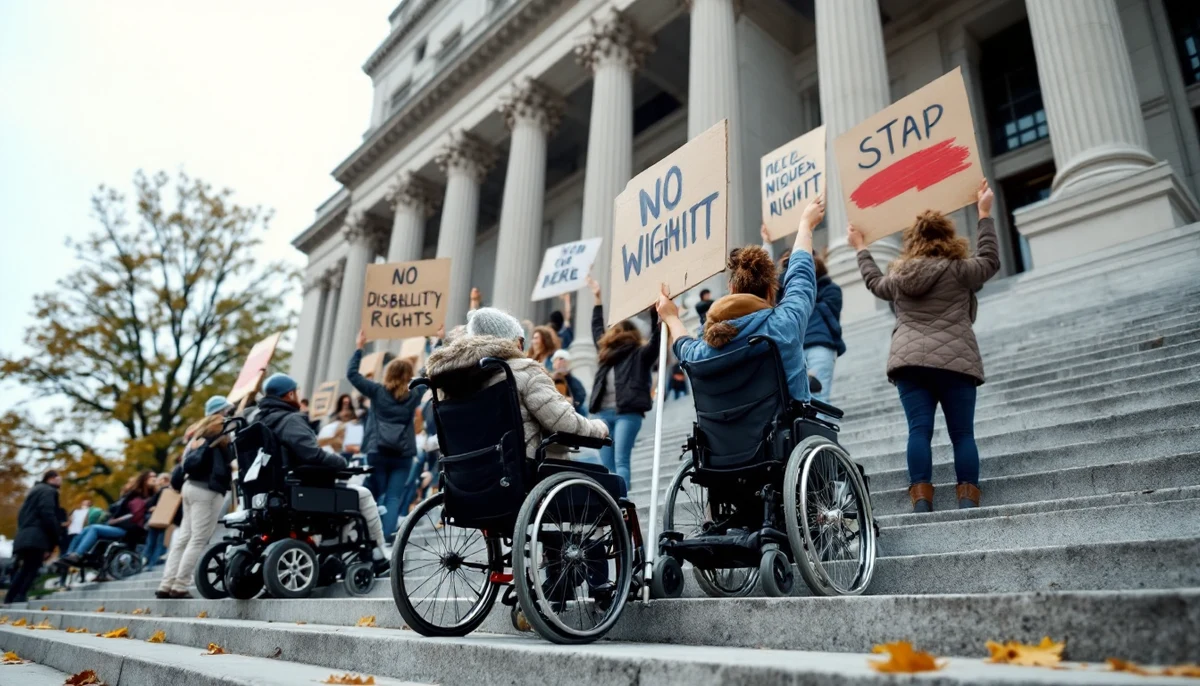
A significant increase in the number and size of disability rights demonstrations in developing or resource-poor countries around the world was evident in 2001. Once a strategy used almost exclusively in the wealthiest countries where accessible transport and funding enables large groups to assemble, 2001 saw major demonstrations in Thailand, South Africa and Bangladesh (reported in this issue), and in Russia, Argentina and Costa Rica (reported in earlier issues). As we post this issue of Disability World, hundreds of disabled Israelis enter their 28th day of sit-ins at a government building in Jerusalem, pressing for increased benefits. Details appear on the web: www.jpost.com/Editions/2002/01/14/News/News.41602.html
-
In Latin America, the biggest story of 2001 was the increasing number of governments that ratified the Organization of American States (OAS) Convention on the Rights of Disabled Persons, combined with the increased visibility given to disability issues by the Inter-American Development Bank (IDB). Berman-Bieler pointed out that the raised consciousness of Latin American governments and disability NGOs gained through the OAS Convention and their participation in the IDB disability consultations held in Chile last March, is surely the main reason so many Latin American governments readily came forward to sponsor the Mexican Resolution about the need for a UN Convention.
-
In Europe, the clearest achievement of 2001was the effective collaboration among the European Union disability NGOs to gain official EU recognition and funding of the European Year of Disabled Persons 2003. A myriad of actions, activities and research will go forward under the aegis of the Year, many of which will be aimed at achieving national and EU level policies and/or legislation outlawing discrimination in sectors such as employment, transportation and communication.
In this issue
This issue of Disability World welcomes new reporters from Mozambique and South Africa. Francisco Manuel Tembe is a disability rights leader based in Maputo and William Rowland of the South African Council of the Blind, represents the World Blind Union on the UN's Panel of Experts on Disability. Don't miss their insightful analyses of the challenges the disability community faces in their countries.
Also in this issue is the encouraging news that: Afghan women leaders are including the needs of disabled women as plans unfold for the rebuilding of that nation; an accessible subway is now open in Tokyo; a serious campaign to integrate the schools is finally underway in Britain; International Disability Day was celebrated in substantive ways throughout Latin America; in the USA the long awaited Olmstead Report has been released by the Bush Administration, indicating policies to increase support for community-based living as opposed to nursing homes; and there are no fewer than four disability film festivals planned in Moscow, London, Chicago & Berkeley for 2002.
In Closing
In 2001 the Nobel Peace Prize was awarded to Kofi Annan for his yeoman efforts as Secretary General of the United Nations. At the end of 2001, he made the following observations:
"This has been an extraordinary year - for the United Nations, for New York, for the United States and for much of the world. When I said in my Nobel Lecture last week that we have entered the third millennium through a gate of fire, I was of course thinking of September 11. But for Afghans, or Israelis or Palestinians or many other people suffering from conflict and poverty, my statement would have a different meaning. And there are many people in the world for whom it may have no particular meaning, because 2001 was not different from 2000 or 1999 - just another year of living with HIV/AIDS or in a refugee camp, or under repressive rule, or with crushing poverty, or watching crops dwindle and children go hungry as the global environment comes under greater threat. Those are the realities we have to remember, even as we find new inspiration in the honor conferred on us by the Nobel Committee."
|