
All means all!
Key-note speech by Bengt Lindqvist, UN Special Rapporteur on Disability, former Cabinet Minister
Osaka Forum, Japan, October 2002
Distinguished Participants,
May I first of all thank the organisers for giving me the opportunity to address this important Forum.
The theme of this Forum is "Partnership for Disability Rights". It is a good theme and it is very timely chosen. A number of exciting opportunities are just now available and we must work together to make the most of them. How can we mobilise all good forces in the struggle for disability rights? On what values can we build this partnership, to get as many as possible involved? The answer is obvious: In all we do to strengthen our rights, we must be guided by the values of the Universal Declaration of Human Rights, adopted by the United Nations in 1948.
"All human beings are born free and equal in rights and dignity". These are the first and most important words of this Declaration. When the UN celebrated the 50th anniversary of the adoption of this Declaration, the theme "all rights are for all" was chosen.
Do we mean all or is this just rhetoric?
In the human rights context we often meet the important word "all". Is this just rhetoric and a habit? Do we really mean all, when we say all? And if we do, are we ready to face the consequences of this position?
All means all! There is no other possible answer. Who would want to stand up and point at some of us and say: In my opinion you should be excluded from enjoying the human rights announced in the Universal Declaration.
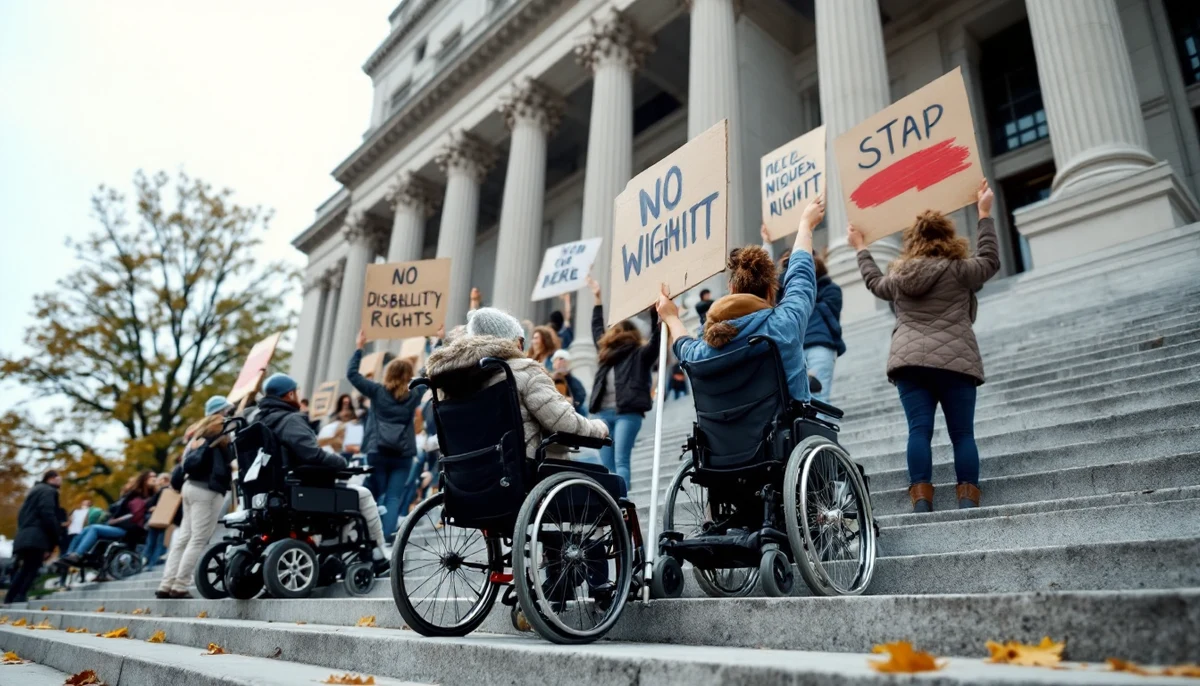
All means all! This is the profound meaning of the Universal Declaration and of real democracy. As you know, humanity has a very long way to go to make this the reality for all human beings. In this context, disability-related infringements of human rights are among the most challenging. In many countries there are still cases of gross violations, which indicate that people with disabilities are viewed as inferior citizens, invalid, to use a term which seems to be difficult to eradicate. However, just now there is a real opportunity for us to make progress. For a long time we have been fighting for this break-through in human rights. We must use this opportunity effectively. But there is a risk that we, in our eagerness to achieve results, will reach for the obvious, the nearest and the simplest? This would be a serious mistake. We ourselves must never forget those among us, who for various reasons will not be at the negotiation table and speak for themselves, be it due to their severe disabilities, because they are paralysed by extreme poverty or because they have been trapped in large institutions without any contact with the outside world. All means all and may we ourselves never forget this!

Partnerships for disability rights
What should be the content of our partnership for disability rights? During the time since the International Year of Disabled Persons we have experienced nothing less than a paradigm shift in our thinking. Those of us who happen to live with a disability, do not accept to be viewed as objects of care and services. We are citizens of our countries, entitled to full participation and equal rights. This way of thinking must penetrate all our actions, both nationally and internationally. As the situation and the level of development is different in our countries, our actions will have to differ from country to country. As for the international arena, I together with the Panel of Experts, monitoring the UN Standard Rules, have elaborated an agenda for action, which contains the most burning issues just now. There are four items and we want to apply a "multi-track approach", because all these four issues are interdependent. The four items are as follows:
- The UN Standard Rules have now been in force for nine years. During my time as Special Rapporteur, I have visited some 60 countries. Through our surveys we have obtained information from about 130 countries. Based on our information, we can say that the Rules have been and are being widely used in all regions of the world, both by governments and by disability organisations. They are used for advocacy, public policy-making, legislation and evaluation. There is no doubt that the Standard Rules have paved the way for the new paradigm of rights. Recently they have been recognised by the UN Commission on Human Rights as a yard-stick for development of human rights in the disability field.
The Economic and Social Council of the UN has decided that the monitoring mechanism attached to the Standard Rules shall continue. As I am retiring from my function as Special Rapporteur at the end of this year, it is necessary for the UN Secretary-General to recruit a new Special Rapporteur as soon as possible and to alert Member States to the need for continued financial support for the monitoring mechanism. I hope you will assist us in getting this done by the UN.
- The Standard Rules need to be developed in certain areas. Commissioned by the UN Commission for Social Development, I, together with the Panel of Experts, have drafted a Supplement to the Rules, which will now be circulated to Member States and the NGO community for views. Some of the contents will need explanation and advocacy to be accepted by some Member States. We, of course, hope that you will involve your organisations and agencies in this consultation process, in order to make a useful and future-oriented supplement.
- With the support of the UN Commission on Human Rights, we now have the opportunity to develop a disability dimension in the monitoring of the six major UN human rights conventions. The recently published study by professors Quinn and Degener ("Human Rights are for all. A study of the current use and future potential of the UN human rights instruments in the context of disability. Febr 2002") contains a number of concrete proposals for strengthening the monitoring of the rights of persons with disabilities. These proposals should be implemented within the UN human rights system, and again, it is important to make governments interested in the implementation of these measures. We already have the support of the Office of the High Commissioner for Human Rights.
- Finally we arrive at the great issue of a convention on the rights of persons with disabilities. Many of the disability organisations have been working hard to obtain a UN decision to draft a new convention. The initiative in the UN general assembly by the Mexican government last year means that this process has started. However, there seems to be a considerable number of countries which are hesitant or against a disability convention. I hope you will help us in convincing reluctant Governments in this matter and I will therefore give you three good reasons in support of a convention:
- The existing conventions were elaborated without taking any disability needs into account. A new convention should tailor the human rights norms and standards to the situation of persons with disabilities.
- A special convention will give status and visibility to the disability rights, which cannot be given by any other measures. We know this from the experiences in connection with both the gender and the child rights conventions.
- A special convention is probably the only way to obtain an effective monitoring mechanism for disability rights.
Before the next meeting of the Ad Hoc Committee, established to work with the convention issue, the Secretary-General of the UN is requested to seek the views of Governments in this matter. This is the first important opportunity for you to get involved. I wish you success in that task.
The four issues indicated by me and the Panel of Experts are concrete tasks ahead of us. They are also reasonable. Still, we know that we will need a strong partnership to get them implemented. We need a strong partnership in the disability movement. We must mobilise the professional organisations in the disability field, human rights organisations and institutions, political parties, individual politicians and media people. We need you all and the time is now! The next few months are crucial for the development of these matters. Indeed, we need you all and we count on you! I want to end my presentation with one of my favourite poems, written by Berndt Rosengren, underlining the crucial role that we as individuals can play in the development of things. It was written in Swedish and it goes like this with my translation:
Only by closing our eyes can we believe
that freedom exists and that peace prevails,
Only by not closing our eyes can we make sure
that freedom will exist and that peace will prevail.
There is a necessary kind of madness,
to believe that you can change the world,
madness, which is close to brilliance,
and at the same time is simple common sense.
You can do it and you do it together with others.
Only by closing our eyes can we believe
that freedom exists and that peace prevails.
Only by not closing our eyes can we make sure
that freedom will exist and that peace will prevail.
|