
Disability World
A bimonthly web-zine of international disability news and views • Issue no. 26 December 2004 - February 2005


home page - text-only home page

Governance & Legislation Briefly

Compiled by Jennifer Geagan (jennifer@wid.org), World Institute on Disability

Disability Policy Website Launched in Canada

The E-Democracy theme of the Dis-IT Research Alliance, in collaboration with many of Canada's national disability advocacy organizations, is launching a website called Disability-Related Policy in Canada on February 1, 2005. Visit the site at http://www.disabilitypolicy.ca. If you have any comments or suggestions, please contact Lindsey Troschuk.

National Council on Disability seeks legislation to restore 'original intent' of the Americans with Disabilities Act

An independent federal agency wants President Bush to propose changes in the nation's landmark disability act, citing Supreme Court decisions it says have reduced the status of disabled people "to that of second-class citizens." The National Council on Disability, which advises Congress and the president, said in a report to be released tomorrow that legislation is needed to restore the original intent of the 1990 Americans with Disabilities Act. The council proposed an ADA Restoration Act, which it likened to the Civil Rights Restoration Act of 1987, passed by Congress to broaden the civil rights law enacted two decades earlier. Read the AP report online.
Towards a National Policy for Indians with Disabilities

Union Minister for Social Justice and Empowerment Meira Kumar today said the government would soon bring out a national policy for the disabled to look into their needs and grievances. Speaking at a function of the National Commission for Women to mark the "International Day of Disable Persons," the Minister invited input from the NCW to help formulate the policy. Read the article online.

NOD Survey Shows People with Disabilities Gave Unprecedented Support to President Bush

A National Organization on Disability survey found a dramatic shift in support toward a Republican presidential candidate, a clear majority of voters with disabilities choosing George W. Bush over Sen. John Kerry in the US national election. According to a survey conducted by telephone between October 29 and November 1, 2004 by Harris Interactive®, likely voters with disabilities preferred President George W. Bush over Senator John Kerry by 52.5 percent to 46 percent. One percent of likely voters with disabilities preferred Ralph Nader. For details, visit http://www.nod.org/content.cfm?id=1585 .

Living Independently in Los Angeles (LILA) Conducts Voter Preference Survey

After the recent national election, many in our community have said that the disability vote either "determined the outcome" of the contest for President, or that "we failed to get our message out." We have decided to take that discourse one step further and try to understand how significant disability issues really were to the choices made by members of our community when they cast their votes for the next President of the United States. We are looking for honest answers, whether politically "correct" or not. If you didn't vote, please let us know that too and, briefly, why not. ALL SURVEY RESPONSES ARE PRIVATE AND ANONYMOUS. To get as wide a response as possible, we would really appreciate it if you would share this survey with anyone you know who either has a disability him/herself, has family members or close friends with disabilities, or who works closely with our community. LILA will publish the results of the survey early next year. Take the survey online.

In ATMs, Not Votes, We Trust

When the ATM asks whether I want a receipt, I usually say no. When a Web site wants my credit card number, I usually say yes. When I pay bills online, there is no paper record of the transaction. In my failure to demand physical evidence when money changes hands, I am not very unusual. Most Americans now conduct at least some of their financial transactions without paper, or at least sleep happily knowing that others do. Yet when it comes to voting -- a far simpler and more straightforward activity than electronic bank transfers -- we suddenly become positively 19th century in our need for a physical record. Read Anne Applebaum's piece in the Washington Post.

One Vote Could Change Montana House Leadership

The provisional vote of a mentally handicapped elector who works at a sheltered workshop in Ronan could change the results of Tuesday's House District 12 race, where Constitution Party candidate Rick Jore now leads Democrat Jeanne Windham by a mere one vote. The leadership of the House of Representatives hangs in the balance. If Windham ultimately wins, the House would be split 50-50 between Democrats and Republicans, allowing the newly elected Democratic governor to name the House speaker. If Jore hangs on to his win, the House leadership will remain Republican. ...The competency of the mentally handicapped elector was challenged by an election judge when the man went to vote. He was unable to sign the registration card legibly himself, so a sheltered workshop case manager did so for him. Read the entire article from the Missoulian.

First disabled person included in Namibian political party's parliamentary list

The National Federation of People with Disabilities' secretary general, Gerson Mutendere, recently resigned from the position he has held since 2000, following his nomination on the Congress of Democrats' parliamentary list and presented to court and the Electoral Commission of Namibia. Mutendere is the 11th on the Congress of Democrats' list of 72 aspirants to the National Assembly and the first disabled person to be included in a political party list. To read an article online, please visit http://allafrica.com/stories/200410200195.html.

Namibia Provides Special Ballot for Visually Impaired

The Electoral Commission of Namibia is providing Braille ballot papers to enable blind Namibians to cast their votes for the first time without any assistance from poll officials in the upcoming parliamentary and presidential elections planned for November. Until now, blind voters had to depend on their relatives or close friends to assist them to cast their votes. With the compilation of special ballot papers in Braille, visually impaired Namibians can exercise their democratic right to vote in secrecy. The Electoral Act of 1992, Act No. 24 states that every individual Namibian has the right to cast their votes in secret. Those who cannot read Braille may still bring along a friend or a relative to assist them in casting their votes. To read an article online, please visit http://allafrica.com/stories/200410190196.html.

AAPD leads drive to register disabled voters in the US

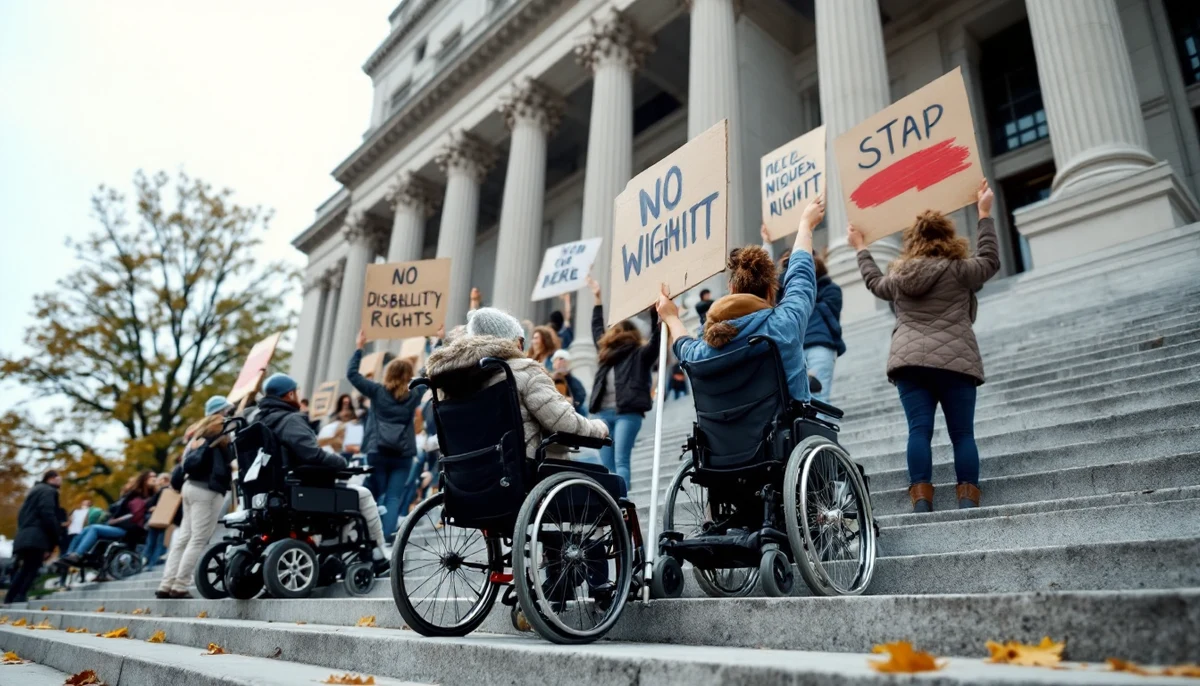
Throughout the U.S., organizations are registering new voters, arranging candidates' forums and working to make polling places accessible. Approximately 20 percent of the US population is disabled, and Washington-based American Association of People with Disabilities is coordinating an effort to increase Election Day turnout by 1 million new disabled voters. Disabled citizens are15 percent less likely to vote, according to a 1999 Bureau of Economic Research study, and 14 years after the Americans with Disabilities Act, many polling places and ballots remain inaccessible. Many visually impaired voters have never been able to vote in secret. Mobility impaired voters face flights of steps and inaccessible voting booths. In a 2001, a Government Accountability Office survey of more than 500 U.S. polling places during the 2000 general election found only 16 percent were completely accessible. Read the Chicago Tribune article online.

Armenian NGOs and Election Administrators Discuss Improving Elections Access for Disabled Citizens

IFES-Armenia and Armenian NGOs, Lusastgh and Paros, convened a round table discussion to improve access for disabled voters to the country's electoral processes and further develop the recommendations regarding the Electoral Code and other legal procedures with representatives from the Armenian National Assembly, the Central Electoral Commission, territorial electoral commissions, local government officials, and international and local NGOs. Armenia's current electoral code guarantees equal electoral rights of all citizens who have the right to vote, including citizens with disabilities, and the officials agreed to address the needs of disabled voters in legislative changes. To read more, please visit http://www.ifes.am/news/july%2004/story1.html.

New Philippine Governor Upsets Dynasty

Grace Padaca, a 40-year old woman who uses crutches as a result of childhood polio, was elected governor of Isabela province in May, upsetting Gov. Faustino Dy Jr., the third successive member of the powerful Dy family to run the province over the last 35 years. Padaca, who had championed the causes of the poor for 14 years as a local radio commentator, campaigned day and night in poor villages throughout Isabela with a few volunteers. The power of the Dy family made many supporters afraid to be seen with her in public, fearing they could lose their jobs, and the Catholic Church deployed about 3,000 parishioners to help guard the ballot boxes, fearing widespread vote fraud by the Dys. Read the Washington Post article about Padaca online.

Play the ADA Game

The ADA Game simulates how advocacy can promote positive changes in communities. Players take on the role of advocates for disability rights in one of eight virtual communities and work together to improve compliance with the Americans with Disabilities Act (ADA) in program access, public accommodations, transportation, employment, and communication. The ADA Game is free and available for anyone to play at any time online and can serve as a training and advocacy tool for anyone interested in disability policy, personal advocacy, or community leadership.  Play the ADA Game at http://www.adagame.org.

The US Department of Justice releases polling accessibility guide

Earlier this year, the US Department of Justice released "The ADA Checklist for Polling Places" to ensure that all polling locations in the US are in compliance with the Americans with Disabilities Act. The ADA requires state and local governments to ensure that people with disabilities have a equal opportunity to cast their ballots on election day, and this online guide is designed to assist local election officials in understanding and implementing these requirements before the upcoming election in November. The guide covers a variety of access issues including parking and passenger drop-off, walkways, corridors and building entrances, as well as the voting space and assists officials in assessing and solving problems that may occur simply and efficiently at the wide range of facilities used as polling places throughout the country. The guide is available online at http://www.ada.gov/votingck.htm.

Supreme Court decides on free education for disabled people in Nepal

The Nepalese Supreme Court recently ordered the government to provide free education to all disabled people throughout the country. The Supreme Court also directed the Ministry of Education and Sports, The Education Department, The Higher Education Department, The Special Education Council, The Tribhuwan University, The Purbanchal University and the Kathmandu University to Provide Free education for disabled people. The Nepal Disabled Human Rights Center, which has been lobbying for access to free education for disabled people, will continue to keep up the pressure on the government and the various agencies, on NGOs, INGOs, UN Agencies, Human Rights Organizations, and the general public to ensure the full implementation of this landmark Supreme Court decision. (From the Disability Tribune, a publication of Disability Awareness in Action, December 2003/January 2004).

Disabled people appointed to Bangladesh Government

Disabled people in Bangladesh welcomed the appointment of four disabled men to the Social Services Directorate. Persons with disabilities in Bangladesh are hopeful that this milestone event will send a clear message that disabled people are valuable members of their communities and that they have the right to contribute to policy development and the decision making process. (From the Disability Tribune, a publication of Disability Awareness in Action, December 2003/January 2004).

New Disability Rights Manifesto in Northern Ireland

1 in 5 people in Northern Ireland are disabled. Disability Action, the local DPO, produced The Northern Ireland Manifesto and hopes that it will work towards challenging the disadvantage and discrimination faced by disabled people in that region. The Manifesto covers all the key areas including the right of disabled people to be recognized as human beings, the right to education, the right to employment, housing and information. Disability Action wants the Manifesto to be used by individuals and organizations to lobby government departments, political parties and all public representatives. To obtain a copy of the Manifesto, e-mail Disability Action at hq@disabilityaction.org . (From the Disability Tribune , a publication of Disability Awareness in Action, December 2003/January 2004.

Disabled voters in Wales launch campaign to improve voter access

The BBC reported in April that the Wales Disability Reference Group has launched a campaign to improve access to voting stations for Wales' 400,000 disabled voters. A 2003 survey revealed that 77% of polling booths were inaccessible to some, and the group said with some planning these obstacles could be avoided. Representatives from the group met members of all the main political parties. One of the points raised was for politicians to ensure that all the forms for voting are available in alternative formats such as Braille. The Wales Disability Reference Group believes that it is in the parties' own interest to maximize potential voters' chances of casting their ballot in the June local and European elections. Read the entire BBC article online.

graphic of printer printer-friendly format

home page - text-only home page


Email this article to a friend!