
Book Announcement from South Africa: Nothing About Us Without Us
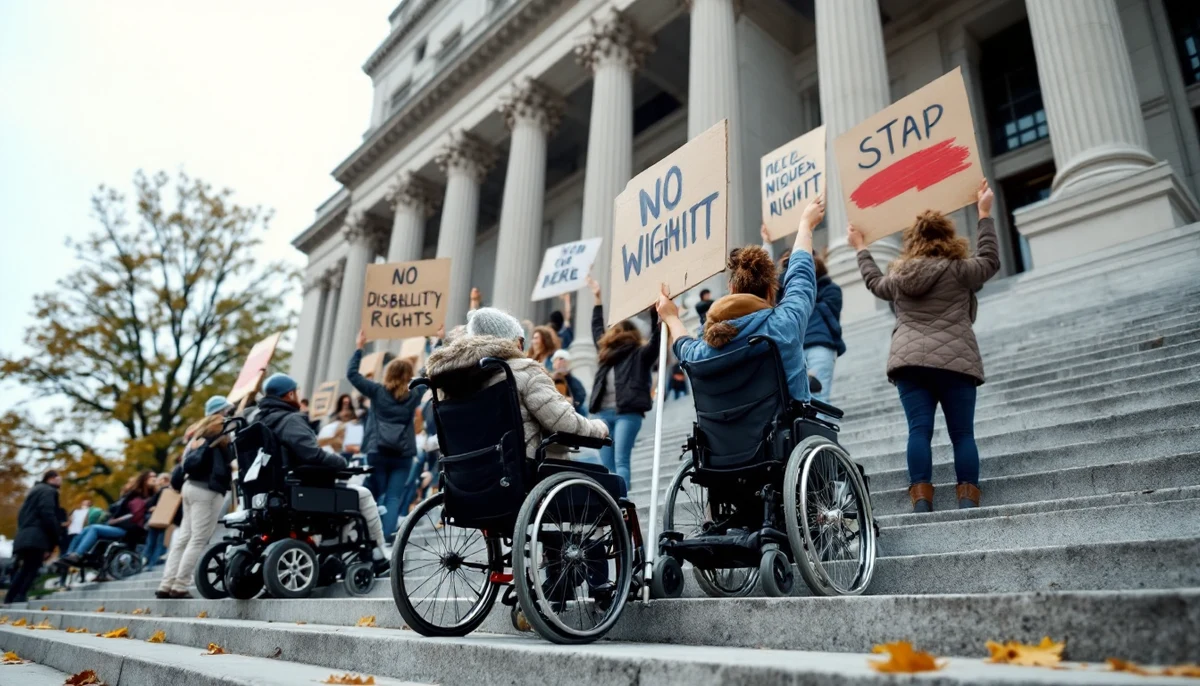
Dr. William Rowland's book Nothing About Us Without Us: Inside the Disability Rights Movement of South Africa is an inspirational work written by an authentically inspiring author. Only a person who is at the same time a leader, a disabled person and a truly committed person could have produced a work of this import. The book offers something of everything: it is an insider's tale, a human tale, a tale of triumph over adversity, a tale told by an experienced expert and a tale of the triumph of the human spirit. It is above all a readable, accessible book that should appeal to a wide variety of book-lovers.
A glance through the table of contents reveals a lively, dynamic title for every part of the book. Reading the text itself uncovers the delights that can be imparted only by that rarity an authority that can really write. There is no sentimentality here, only clarity in exposition of the world of the disabled and their struggles to be seen as ordinary, useful and, as with all human beings, sometimes exciting people.


Dr. Rowland writes of these people with deep understanding, whatever their disabilities may be, highlighting their often innovative and heroic efforts to be entirely independent and at the same time loved for their humanity. The story he tells is first and foremost a story of achievement, not achievement within the confines of the narrower rules sometimes prescribed by the unknowing for disabled people, but achievement defined by any rules. A careful reading of the book discloses that it is not that the disability movement in South Africa has nothing more to fight for, which would be too idealistic. Rather, the movement has pulled off a coup on the open playing field of life, where reality and ideals so often clash.
The book can be recommended to experts and laymen alike. No one who has read it, can fail to have their conscience pricked. No one who has read the book can ever see a disabled person in quite the same light again.
The first two chapters describe the onward rush of the disability struggle as part of the broader political movement in South Africa.
The next chapter deals with economic empowerment, as an extension of the struggle into new areas. Rowland then gives an account of the transformation of the SA National Council for the Blind, and describes three unique initiatives in South Africa around new models of service delivery and self-help.
This is followed by five interviews, each giving a personal perspective on the Disability Rights Movement, and recounting particular aspects of its history. In the last chapter, rural development and the spread of the movement throughout the Southern African region are taken up.
Dr Rowland concludes:
"So these were some of our adventures, but the point of it all was to spread the message that by organizing ourselves we could change things around us and the attitude of governments. This we have continued to do everywhere in the countries of South and Southern Africa for twenty years and more, and yet the process is far from ended."
This book is also available in braille and in audio editions from the South African Library for the Blind, Grahamstown.
For enquiries, contact
Natalia Molebatsi
Tel: (012) 429 3495
Fax: (012) 429 3449
email: molebn@unisa.ac.za
www.unisa.ac.za/press
printer-friendly format |