
![]() |
Report Card To Be
Sent To The United Nations On Violations Of Human Rights Of Australians
With A Disability
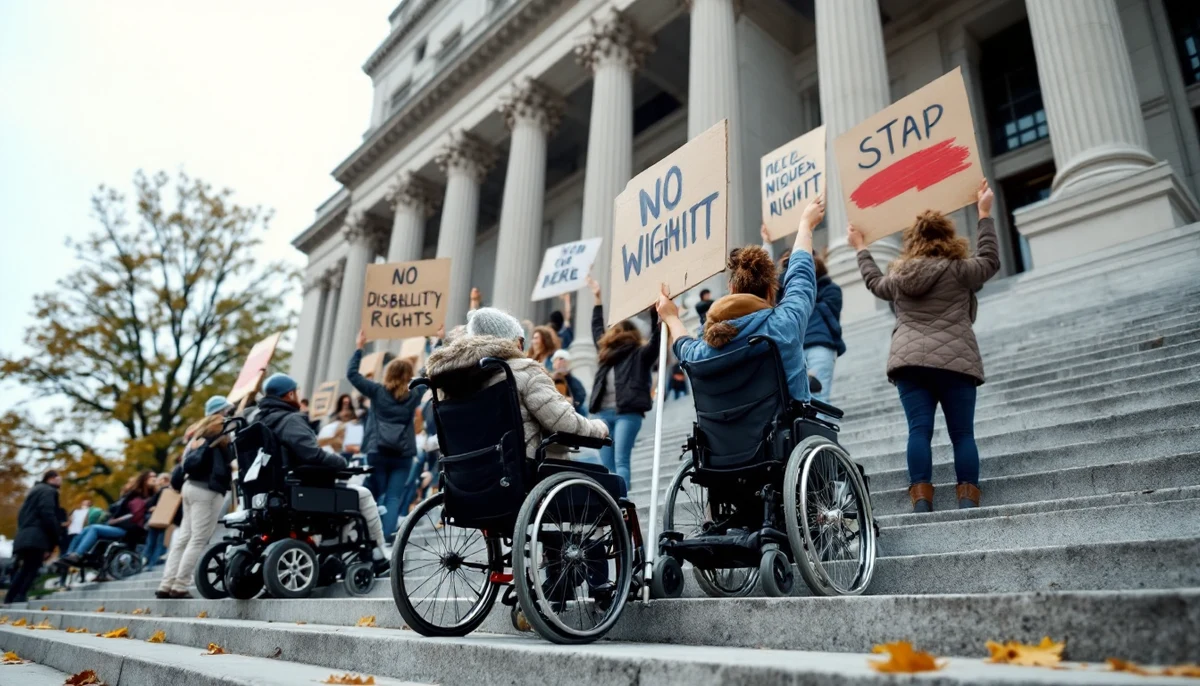
Thirty-one national and state disability organisations came together in Canberra on 23 March 2000 to a forum on Human Rights and Disability. Following is a Communique issued by the National Coalition on Disability and Human Rights.
People with disabilities in Australia continue to be denied their basic human rights. The inherent injustice and discrimination they face is part of the marginalisation of the disadvantaged which occurs in Australian society.
Significant attrition
The meeting was convened due to a recognition that in the last three years there has been a significant attrition of the rights, protection mechanisms and advocacy for people with disabilities.
The Disability Coalition carried out an analysis of draft Government documents that have been prepared for a National Action Plan on Australia's performance on human rights. Specifically, these documents set out Australia's response to United Nation's declarations and conventions, such as the Universal Declaration of Human Rights (1948) and the Declaration on the Rights of Disabled Persons (1975).
Systematic discrimination
The Disability Coalition was unanimous in the view that in Australia today, human rights violations continue to systematically discriminate against people with disabilities in a number of basic life areas.
* People with disabilities placed in institutions continue to live in appalling conditions and suffer ongoing abuse and degradation of their basic human rights.
* People with disabilities continue to be significantly over-represented in police lock ups, courts and prisons, unemployment queues, and grossly under-represented in secondary and higher education and employment.
* The Commonwealth Government's own Disability Advisory Council identified over 8000 people with disabilities nationally who are placed in large inappropriate institutional care facilities which in themselves violate human rights.
* The Government's own review of disability services by the Australian Institute of Health and Welfare 1998, identified 13,500 people with disabilities in urgent need of accommodation and support services. To date this urgent need has not received sufficient commitment by all State and Commonwealth Governments.
* These studies did not even include the fact that many hundreds of younger people with disabilities continue to be inappropriately placed in aged care nursing homes.
* We also know that hundreds of people with psychiatric disability continue to live in sub-standard boarding houses without appropriate support services. This is eight years after the Human Rights and Equal Opportunity Commission's report by Brian Burdekin into the human rights of people with mental illness which made recommendations for radical and urgent reform.
* Women with disabilities continue to be denied communication with, and access to, emergency accommodation and refuges in escaping violence and abuse.

* People with disabilities
from Indigenous and Non English Speaking Backgrounds continue to experience
double disadvantage - with Indigenous people with disabilities still without
national representation.

The National Coalition on Disability and Human Rights has agreed to:
* Develop a detailed response to the Commonwealth Department of Family and Community Services' draft submission to the National Action Plan on Human Rights, and;
* To develop a disability sector National Action Plan on Disability and Human Rights to submit to Australian Governments and the United Nations.
In doing so, disability organisations agreed to document a range of Human Rights violations that continue to occur across Australia in all aspects of life.
The Disability Coalition report will provide the United Nations with an accurate account of many real life experiences of people with disabilities in Australia today where basic rights are violated.
For more information, please
call Sue Egan 0419 659 603 or Maurice Corcoran 0419 855 735 (or e-mail
ddasp@ozemail.com.au) as spokespersons
for the Disability Coalition.
Copyright © 2000 IDEAS2000. All rights reserved.