
Disability World
A bimonthly web-zine of international disability news and views, Issue no. 7 March-April 2001


Women:

Women with Disabilities Impact UN Beijing+5 Meetings in New York

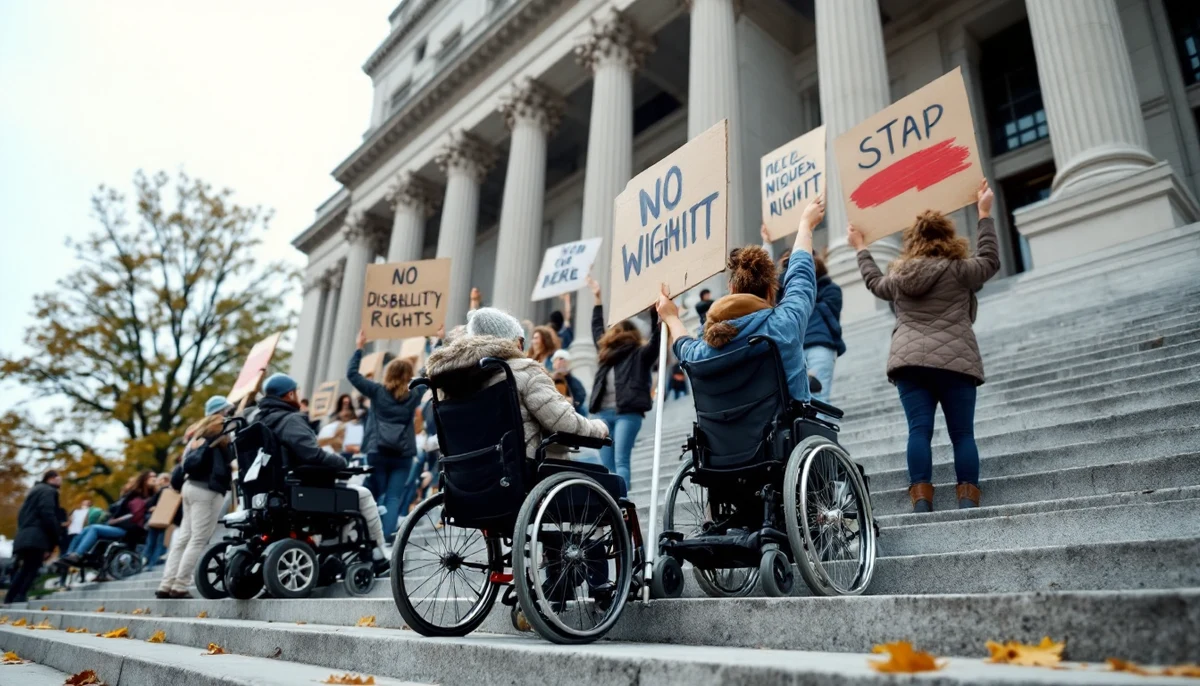
An estimated 10,000 women representing their governments or non-governmental organizations (NGOs) descended on New York City in early June to make their voices heard in the United Nations "Beijing+5"meetings. Among them was a small dedicated group of 65 women with disabilities from 31 countries around the world, participating in both the overall activities and in a unique training program.

Beijing+5 is the short name given to the UN official review process of concrete achievements on behalf of women since its 1995 World Conference on Women in Beijing.

The process included: (1) a special session of the UN General Assembly, June 5-10, where  progress reports were given by UN officials responsible for women's issues and by governmental delegates; (2) development and adoption of an outcome document on priorities  to ensure continued advances for women and girls in the 12 key areas identified by the 1995 Beijing Platform for Action; and (3) a series of NGO activities designed to exchange current information and impact the outcome document.

The 12 key areas of the Platform, which were the main focuses of group meetings during the UN review process, are: poverty, education and training, health, violence, armed conflict, the economy, power and decision making, institutional mechanisms, human rights, the media, the environment and the girl child.

Challenges & Results

One measure of the effectiveness of the disabled women's activities is the recognition given to their specific concerns in the arduously negotiated Final Outcome Document. Adopted by the June 10 UN General Assembly meeting, following several all-night re-write sessions, the document contains a political declaration and identifies further actions and initiatives to implement the Beijing Platform for Action.

It is an impressive achievement that disability concerns are mentioned at all in the outcome document, as the main energies of the meetings were directed toward problems which have worsened since 1995-such as the rise in numbers of women affected by HIV/AIDS, domestic violence, "honor killings" and trafficking in girls and women. Delegates and UN officials were also working overtime to prevent the gains made in the Beijing Platform from being watered down by the strong conservative factions, as reported widely in the mainstream press.

Overall, strong references were included in the document, identifying girls and women with disabilities as having particular concerns about violence and needing equal access to education, training, health care, rehabilitation and employment. The outcome document has been posted on the UN website as follows: www.un.org/womenwatch

The main goal of the disabled women's activities was to ensure that disabled girls and women were not just mentioned in the document as part of a "laundry list" of women facing multiple barriers, but also identified as having their own agenda, momentum and place within the women's movement.

Visibility

The presence of women with disabilities from 31 countries was perhaps most visible during UN Secretary General Kofi Annan's official welcome to Beijing+5 at a public ceremony held June 5 in Dag Hammarskjold Plaza. Thanks to the Beijing+5 host committee, a prominent space for the disability contingent was reserved in the front rows.

Somewhat less visible, but equally powerful was the disabled women's participation throughout the week, working with their national governmental delegations, their UN missions or other NGOs advocating for women's rights and services. Their job was to spread the word about resources offered by the growing number of disabled women's groups and to provide research and information articulating priorities.

The disability contingent was also well integrated into an associated high level International Women's Health Conference, held June 7 at Hunter College. Here, thanks to close collaboration with the U.S. Department of Health and Human Services, disabled women's health and equity issues were part of plenary and workshop sessions.

Another measure of results is that disabled girls and women were identified as priorities in the country reports presented to the UN General Assembly by Burkina Faso, Canada, Mexico, the Netherlands, United Arab Republic, Uganda and others.

General Assembly Participation

The only General Assembly speech focused on disabled women's needs was given by the Hon. Florence Naiga, Uganda's Minister for Disability & Aging and a strong representative of Africa's grassroots disability movement. On-going support to the disability caucus was also given by the governmental delegations with disabled members. For example, Kicki Nordstrom, First Vice President, World Blind Union, was a member of the official Swedish delegation, and Judy Heumann, Assistant Secretary for Education, was part of the U.S. delegation.

Successful Collaborative Seminar

As one of the younger participants stated at the opening of the seminar, "This is my dream: to be surrounded by and working with talented disabled women and our allies from all over the world."

The June 1-8 seminar and advocacy training brought together young deaf, blind and physically disabled women from Africa, Asia, & the Pacific, Eastern Europe, the Middle East and North & South America. An intense schedule had been planned by the organizers: Rehabilitation International (Barbara Duncan & Harilyn Rousso), World Institute on Disability (Kathy Martinez), Disabled People's International (Lucy Wong-Hernandez, World Federation of the Deaf  (Carol-Lee Aquiline) and the World Blind Union (Kicki Nordstrom).

Several of the seminar planners had represented their organizations at the original 1995 Beijing conference and at this meeting served as seminar faculty and mentors to the younger participants.

Ambitious Objectives

The ambitious objectives for the week were: 1) to provide an historical overview of the UN and its work on behalf of women and people with disabilities; 2) to introduce the international disability organizations and their work on women's issues; 3) to review the international research on girls and women with disabilities; 4) to create opportunities for the participants to mentor each other, become a cohesive group and have an impact on the outcomes of the UN Beijing+5 meetings; and 5) to learn about disabled women's activities in the countries represented by the participants.

Sponsors

The Beijing+5 Seminar was one of a 1999-2000 series of initiatives to improve employment prospects for women with disabilities sponsored by the U.S. Social Security Administration and Departments of Education and Health & Human Services. Other sponsors of the Beijing+5 seminar were: the U.S. Agency for International Development, the UN Disability Unit, UNICEF, the Women's Foundation, the Ford Foundation, the Sister Fund and the Third Wave, all of which provided scholarships for women with disabilities or in-kind services, such as sign language interpretation and meeting facilities.

The Danish Council of Organizations of Disabled Persons and the National Union of Women with Disabilities of Uganda raised funds for a group of 12 women from 10 English speaking African countries to attend Beijing+5 activities in New York.

Diverse Participants

An unusually diverse group of young participants, ages 18-36, passed the application process and flew from around the globe to reach New York City. Most had never been to the USA and many were traveling internationally for the first time. Participants came from: China, Australia, Nepal, India, the Philippines, Madagascar, Kenya, South Africa, Zambia, Malawi, Tanzania, Namibia, Uganda, Zimbabwe, Eritrea, Ghana, Brazil, Panama, Mexico, Guatemala, Chile, Colombia, Peru, Ireland, Spain, Germany, Denmark, Latvia, Sweden, Canada and from throughout the USA. (A participants list appears as an appendix to this report.)

All of the participants were involved in local or national disability groups in their home countries, many in leadership positions, while some are still working on their graduate or post-graduate degrees.

Professions represented included: biologist, ombudsman, lawyer, social worker, occupational therapist, community development worker, professor, government staff, teacher, manager or chief executive of organization, employment specialist, leadership development trainer, peer counselor and journalist.

Approximately 10 of the participants were deaf, another 5 or so were blind and the balance had a range of physical disabilities, including those caused by polio, cerebral palsy, spinal cord injury, burns, muscular dystrophy, lupus and short stature. A couple participants were disabled by war and/or landmines.
Seminar Highlights

According to the majority of the seminar evaluations received, and informal reactions conveyed to the sponsors, some of the most valuable aspects were:

Also cited as critical were the daily reports from the frontlines by representatives of governments and NGOs  who were involved in the political negotiations about the outcome document or other issues. Keeping the seminar informed and acting as advisors were: Seminar Assignments

In addition to the work described above, all participants were required to carry out individual or to take part in group assignments that would progress the status of women and girls with disabilities. Some assignments were short-term, aimed at the Beijing+5 process and completed on site, while others are long-range and will require future efforts. Examples are:
The active, "hands-on" contingent of deaf women decided to organize a network for young, deaf women under the auspices of the World Federation of the Deaf, and already outlined roles for many of the women present, such as

"Passing the Torch" to the next generation

One of the underlying goals of the seminar was that the organizing groups would be identifying and preparing young women to take on the role of leadership and training for the next generation of women activists in the worldwide disability movement.

The high caliber of the participants and the wide range of their domestic and international experience with both women's issues and disability organizations was a major contribution to the success of the initiative.
The organizers felt a genuine pride in taking part in the beginning of the "passing of the torch" to the next generation of women leaders in the worldwide movement of people with disabilities.

One example of the spirit and ingenuity of the younger participants was how two of the blind women, Sylvia Quan of Guatemala and Maria Soledad Cisternas Reyes of Chile, agilely managed to turn a stroll through a UN Exhibit of Women's Art into a meeting with UN Secretary General Kofi Annan. They took the opportunity to brief the Secretary General on women's disability issues.

Combined Seminar & Training Model

The organizations involved in planning the seminar agreed that although many aspects could have been improved with more time to coordinate and more funds for translation and interpretation, that the basic model was one that could be used effectively in the future. The model consisted of the following components:  intensive academic classes utilizing faculty and mentors with international expertise in disability, human rights and women's issues; exchange of information about the situation of women with disabilities in the countries represented; followed by "hands on" advocacy, practical assignments and participation in Beijing+5 activities.  As far as we aware, this was the first training specifically designed to provide historical background in the international disability and women's movements, combined with the opportunity for hands-on advocacy.  It was also the first instance of the international disability organizations working together to provide training, mentoring and opportunities for collaboration across disability issues.
 

Additional Results

Upon returning home, participants were also required to conduct public education or training events in their countries to ensure that the results of the Beijing+5 meetings were broadly disseminated and to encourage the participants to engage local women's groups in integrating disability issues into their efforts. The organizers have already received reports from more than 10 countries that these follow-up activities and dissemination efforts are underway.

Additionally, some participants have made contacts with their local U.S. AID and UNICEF offices to initiate further collaboration and integration of disability concerns into ongoing development programs. Five of the Latin American participants will speak to  the women's issues seminar within the Rehabilitation International World Congress in Rio in late August. Two of the U.S. participants held a report-back session at the World Institute on Disability offices in August, where they made a power point presentation and took questions from a group of 25 invited specialists in training, disability and women's issues.
 

Staff

The success of the week was due in large part to the following dedicated staff members of WID and RI: Jennifer Geagan, conference coordinator, Marylyn Thornton, financial officer, and Jeremy Thornton, photographer, all of WID; and Barbara Artusa, comptroller, Leonor Coello, Spanish language specialist, and Marie-Chantal Joseph, French language specialist, all staff or consultants of RI. The assistance and translation skills of Maribel Derjani-Bayeh of the UN Disability Unit were also greatly appreciated. Melinda Levine of the UN staff was also an outstanding volunteer.
 

Photo of Dinah Radke of Germany


Mentoring was a significant aspect of the Beijing+5 seminar for young women.


Shown next are some of the younger Beijing+5 participants, representing the following countries: USA, Egypt, Guatemala, India, Nepal, Spain, Madagascar, Kenya, Peru, Ireland, Panama, and Canada.
 
Photo of woman Photo of young woman
Photo of woman Photo of participant
Photo of a woman Photo of woman
Photo of woman Photo of woman
Photo of woman Photo of two women
Photo of woman Photo of woman

Many thanks to Jeremy Thornton for taking these wonderful photographs.
 

Beijing+5 Training Seminar Participants
 
 
Elizabeth Alarnick
City University of New York
680 Ocean Pkwy Apt 9I
Brooklyn, NY 11230
Tel: (718) 972-1676
Zealing@aol.com
 

Maria E. Antunez
Disabled Peoples International
Cda.de H.Cortes No. 86-1 Col Tlacopac
San Angel, Mexico City, 01049, Mexico
Tel: (52) 56628034
Fax: (52) 6614909
Maruantu@mail.internet.com.mx

Carol-lee Aquiline
World Federation of the Deaf
Magnus Ladulasgatan 63, 4tr 118 27
Stockholm, Sweden
Fax: 46  8  442  1499
Carol-lee.Aquiline@wfdnews.org

Roselyne Akum Ayuke
Kenya Society for Deaf Children
P.O. Box 42203
Nairobi, Kenya
Tel: 254-02-22818
Fax: 254-02-230590
Ksdc@Insightkenya.com

Vivian Berry
Sign Language Interpreter
107 Old Albany Post Road North
Cold Spring, NY 10516 USA
Fax: 914-265-7969

Nuria Carrera I Comes
Ajuntament de Barcelona
Ciutat, 4, 1r pis
08002 Barcelona, Spain
Tel: 934023278
Fax: 934027607
ncarrera@mail.bcn.es

Maria Soledad Cisternas Reyes
MIDEPLAN/COPRADEV
Eliodoro Yanez 809 oficina 13, Providencia,
Santiago, Chile
Tel: 2362901
Fax: 2363018
rrosell@entelchile.net

Ivana Cordier da Fonseca
CVI Brazil
Rua da Matiz 26/110 Botatogo
Rio de Janeiro, RJ 2260-010 Brazil
Tel: 21 354-0909
Fax: 21 534-0910
icordier@ig.com.br

Nory A. Delano
Corporacion Pro Ayuda al Debil Visual (COPRADEV)
Av.11 De Septiembre 1881 of 1006 Providencia,
Santiago, Chile
Tel: 2343505
Fax: 2335844
bmorales@entelchile.net

Rama Dhakal
National Federation of the Disabled-Nepal (NFDN)
P. O Box 9188
Bhrikuti Mandap, Kathmandu, Nepal
Tel: 977-1-231159
Nfdn@mail.com.np

Heidi M. Evans
537 Olympic Dr.,
Slinger, WI, 53086 USA
Tel: (262) 644-0389
Heidie@nconnect.net

Gertrude O.  Fefoame
Ghana Association of the Blind
AC 496
Accra, Ghana
Tel: 233-87222218
Fax: 233-21233442
gab@africaonline.com.gh

Jennifer Geagan
World Institute on Disability
510 16th Street, Suite 100
Oakland, Ca 94612 USA
Tel: (510) 251-4310
Fax: (510) 763-4109
Jennifer@wid.org

Shivani Gupta
Indian Spinal Injury Center
Sector C6/6322 Vasant Kunj
New Delhi, India 110070
Tel: 91-11-6130862
shewany@yahoo.com
shivanigupta@indiatimes.com

Judy Heumann
Assistant Secretary, US Department of Education,
OSERS, 330 C Street, SW, Room 3129
Washington, DC 20202-2500 USA
Tel: (202) 205-5465
Fax: (202) 205-9252
Judy_Heumann@ed.gov

Shannon Hy
147 East Ave #32
Los Angeles, CA 90031 USA
Tel: (323) 343-0815
Hyshannon@yahoo.com

Jennifer A. Jackson
Canadian Association of the Deaf
1291 Bayview Ave # 410
Toronto, Canada M4G2Z9
Jj_1976@hotmail.com
 

Ann Jonsson
ann.jonsson@hso.se

Marie-Chantal Joseph
JOEART ASSOCIATES INC.
54 Lyon Street
Valley Stream, NY 11580 USA
Tel: (516) 285-6758

Barbara Kolucki
UNICEF Consultant on Disabled Children
354 Stone Road
Dalton, PA 18414 USA
Tel: (570) 586-1607
Fax: (570) 586-1607
Bakoluck@aol.com

Ilze Laine
President, Latvian Association of Disabled Women
Brivabar 282-10
Riga LV-1006, Latvia
Tel: 271-947248
Aspasija@lv.apollo, Aspasia@lv.afallo

Nancy Landreville
Canadian Association for the Deaf
2380 rue Pie IX, Apt # 7
Montreal, Canada H1R 2E5
Tel: 514- 858-9431
Landrevillen@hotmail.com

Melinda Levine
Volunteer
280 Ft Washington Ave Apt 56
NY, NY 10032  USA
Tel: (914) 699-6474
MelindaLevine@hotmail.com

Kathy Martinez
World Institute on Disability (WID)
510 16 th Street, Suite 100
Oakland, CA 94612 USA
Tel: (510) 251-4326
Fax : (510) 763-4109
Kathy@wid.org

Monica Mbaru Mania
Kenya Union of the Blind
P.O. Box 870
Thika, Kenya
Tel: 0151-21634
Tcc@form-net.com

Xenia Y. Mejia
KRA 47 #81-95 Apt 212 Int 4
Entrerios, Santafe De Bogota, Colombia
Tel: 571-6405566
 

Jane Momdiwa
P/Bay 199
Blamtyre, Malawi, Southern Africa
 

Chiku Mwalutambi
Tanzania Association of the Disabled (CHAWATA),
Women Department
P.O. Box 1747
Dar es Salaam, Tanzania
Tel: 255-51-116434
Fax: 255-51-116428
fosumsyd@africaonline.co.tz

Rauha Nehale
Disabled Women's Association
P.O. Box 1584
Oshalti, Namibia
Fax: 2641065

Kicki Nordstrom
World Blind Unon
Sandsborgs V 52
S-12288 Enskede, Sweden
Tel: 468 399000
Fax: 468 7259920
kino@iris.se

Anne Buore Oginga
Kenya Society for Deaf Children
P.O. Box 42306
Nairobi, Kenya
Tel: 254-02-22818
Fax : 254-02-230590
Kdsc@Insightkenya.com

Mercedes Paniker
Femvision
E. 08017 Barcelona
Iradier, 26 Spain
Tel: 349341 70297
Fax: 349341 70297
femvision@mx3.redestb.es

Rami Rabby
US Mission to the United Nations
New York, NY 10017 USA
Tel: (212) 415-4270
Fax: (212) 415-4141
Rabbya@state.gov

Fela Razafinjato
Ikoriantsoa Foundation
Lot II E 22, Tsiazotato
Tananarive, Madagascar 101
Tel: 261-20-22-618-02

Barbara Riverdahl
US Department of Education
213 East Franklin
Chapel Hill, NC 27514 USA
Tel: (919 ) 942-6156
Lyric797@aol.com

Harilyn Rousso
Disabilities Unlimited
3 East 10th Street Apt 4b
NY, NY 10003 USA
Tel: (212) 673-4284
Harilynr@aol.com
 

Karen Saba
Domestic and International Disability Consultant
4520 Oaklyn Lane
Bowie, MD 20715 USA
Tel: (301) 464-9244
Saba@mindspring.com
 

Raquel Soto Arquero
Associacio Dones No Estandaros
Av. San Anto. M Claret, 31 entlo,
08025 Barcelona, Spain


Jeremy Thornton
Event Photographer
389 Ethel Ave
Mill Valley, CA 96730 USA
Tel: (415) 388-7240
Fax: (415) 389-6724
 

Macline Twimukye
National Union of Disabled Persons of Uganda (NUDIPU)
P.O.Box 8567
Kampala, Uganda
Tel: 256-41-540179
Fax: 256-41-540178
Nudipu@starcom.co.ug

Jon Wolfe Nelson
Sign Language Interpreter
719 West 180th Street, #63
New York, NY 10033 USA
Tel: 212-982-9517

Lucy Wong-Hernandez
Disabled Peoples International (DPI)
1160 Sunapee Rd.
West Hempstead, NY 11552 USA
Tel: (516) 593-0037
Fax: (516) 599-2571
Lucywdpiny@aol.com

Ilene R. Zeitzer
US Social Security Administration
500 E St., S.W., Suite 880
ITC Building
Washington, DC 20254 USA
Tel: (202) 358-6123
Fax: (202) 358-6103
Ilene.zeitzer@ssa.gov


Ana Malena Alvarado
Association of  Sordos De Chiriqui
P.O Box 343
David, Chiriqui, Panama
Tel: (507) 775-4162
(507) 774-4471
Anaalvao@chiriqui.com

Barbara Ann Artusa
Rehabilitation International
475 W. Merrick Rd.
Valley Stream, NY 11580, USA
Tel: (516) 825-6685
Fax: (516) 825-2661
tbatax@aol.com

Hellen Grace Asamo
National Union of Disabled Persons of Uganda
P.O. Box 8567
Kampala, Uganda
Tel: 256-41540179
Fax: 256-41540178
Nudipu@starcom.co.ug

Rosangela Berman-Bieler
Inter-American Institute On Disability
711 Brent Rd,
Rockville MD, 20850 USA
Tel: (301) 838-3031
Fax: (301) 838-3029
iidisab@aol.com

Beverly J.  Buchanan
South West Collegiate Institute for the Deaf
506 Wilbanks Rd
Big Spring, Texas 79720 USA
Tel: (915) 264-3700 x233
Fax: (915) 264-3707
Bbuchanan@hc.cc.tx.us

Susan Chitimbe
P.O. Box 2284
Blamtyre, Malawi Southern Africa
Tel: 265-620622

Leonor Coello
Rehabilitation International
25 East 21st Street
New York, NY 10010 USA
Tel: (212) 420-1500
rehabintl@aol.com

Theresia Degener
University of Applied Sciences, Germany
Evangelische Fachhochschule, Rheinland-Westfalen-Lippe,
Immanuel Kant-Str. 18-20,
44803 Bochum, Germany
Tel: 49-23436901
Fax:4923436901-100
tdegener@efh-bochum.de

Maribel Derjani-Bayeh
UN Disability Unit
United Nations
Two UN Plaza DC2 13th Floor
New York, NY USA
Derjani-bayeh@un.org

Barbara Duncan
Rehabilitation International
837 Carmel
Albany, CA 94706 USA
Tel: (510) 527-1719
Fax: (510) 526-4458
Bjdnycla@aol.com

Michelle Favis
2126 California Street Apt #2
Berkeley, CA 94703 USA
Tel: (510) 843-2928
Favis+marilou@allergan.com
ellewheels@aol.com

Stephanie Feyne
Sign Language Interpreter
P.O. Box 230582
New York, NY USA
10023-0582
SteFeyne@cs.com

Nora Groce
Yale University
Room 203 EPH Yale University 60 College Street
New Haven, CT 06520 USA
Tel: (203) 785-2866
Nora.Groce@yale.edu

Gulbadan Habibi
Disability Focal Point
Child Protection Section, UNICEF
UNICEF House, 3 UN Plaza
New York, NY 10017 USA
Tel: (212) 824-6638
Fax: (212) 824-6483
ghabibi@unicef.org


Sherry Hicks
Sign Language Interpreter
107 Old Albany Post Road North
Cold Spring, NY 10516 USA
Fax: 914-265-796

Akiko Ikeda
Disability Unit, Department of Policy Coordination
and Sustainable Development, United Nations
New York, NY 10017, USA
Tel: (212) 963-1996
Fax: (212) 963-3062
Ikeda@un.org

Anneli Joneken
Swedish Disabled Persons International Aid Association
and European Disability Forum
Box 4060
S-102 61 Stockholm, Sweden
Tel: 46-08-462 33 65
Fax: 714-59-22
anneli@joneken.se

Florance Kabayadondo
P.O. Box 2980
Kampala, Uganda
 

Tarsha R. Lagrone
Working Women with Disabilities
6113 Saint Marie St.
Pittsburgh, PA 15206 USA
Tel: (412) 362-6440
Tenay25@yahoo.com

Linda A Lamitola
Sign Language Interpreter
29 Bowling Green Ave
Morrisville, PA 19067  USA
Tel: (215) 428-0511
lclamitola@aol.com

Noelle Lee
Irish Deaf Society
30 Blessington Street
Dublin 7 Ireland
Fax: 353-1-860-1960
Ids@indigo.ie

Kabelo Makgata
Deaf South Africa
Aslam Centre 82 Mint Str Fordsberg
Johannesburg 2092, South Africa
Kabelo.Makgta@w3ebmail.co.za

Olga Martinez
Associacio Dones No Estandaros
Av. San Anto. M Claret, 31 entlo
08025 Barcelona, Spain

Peggy McLeod
US Department of Education, OSERS
330 C Street, SW Room 3129
Washington, DC 20202-2500 USA
Tel: (202) 260-9163
Fax: (202) 205-9252
Margaret_Mcleod@ed.gov

Dr. Sruti Mohapatra
Disabled Peoples International (DPI), India
A/99 Budhanagar
Bhubaneswar, Pin- 751006, India
Tel: 91-671-40-6725
Srutim@dte.vsnl.net.in

Bill Moody
Sign Language Interpreter
250 Cabrini Blvd., Apt. #5H
New York, NY 10033 USA
Tel: (212) 927-2525
Fax: (212) 927-6713
moodyterp@aol.com

Safia Nalule
Disabled Women Network
and Resource Organisation in Uganda (DWNRO)
Box 3454
Kampala, Uganda
Tel: 256-41-268295
Fax: c/o 256-41-250-445

Kirsten Nielsen
Danish Council of Organizations of Disabled Persons
NUDIPU
P.O. Box 8567
Kampala, Uganda
Tel: 256-41-272-204
Fax: 256-41-540-179
benkir@starcom.co.ug

Francisca Numba
BOX 36450
Lusaka, Zambia
Znahi@zamnet.zm

Liz Olsen
Carenera, 6
08338 Premia de Dalt
Barcelona, Spain
Tel: 34937524379
dricart@dbod.es

Silvia Quan
CONADI
8 Calle 7-52, Zona 1
Guatemala City, Guatemala
Tel: 502-2324207
Silviaq@intelnet.net.gt

Dinah Radtke
Disabled Peoples International (DPI), Europe,
DPI Women's Committee
Luitpold-strasse 42
91052 Erlangen, Germany
Tel: (09131) 205022
Fax: (09131) 207351

Carmen Reyes-Zubiaga
11 Magndang Lahi Street,
Taytay, Rizal Philippines 1901
Tel: 632-660-3221/632-917-9605902/632-674-5538
Fax: 632-656-5543
Czubiagia@i-next.net

Gretty R. Rivero Alcocer
Club Rotary International
Calle Pargo, No. 47 Esq., Bonampak
Cancun, Quintana Roo, Mexico
Tel: (0198) 845889
Fax: (0198) 845919
inconture@mail.caribe.net.mx

Carmen Rui Pascal
Associacio Dones No Estandaros
Av. San Anto. M Claret, 31 entlo,
08025 Barcelona, Spain

Rosa Ana Sanchez Nunez
Disabled Federation in Albacete Spain
C/Feria 73 2 B
Albacete, Spain 2005
Tel: 967-504397
Fax: 967-246652
fama@netvision.es

Susana Stiglich
Defensoria del Pueblo Ombudsman & Aproddis
Calle Choquehuanca 830
San Isidro, Lima 27 Peru
Tel: (511) 4410691
Fax: (511) 422-5135
sstiglish@ombudsman.gob.pe

Marylyn Thornton
World Institute on Disability (WID)
389 Ethel Ave
Mill Valley, CA 96730 USA
Tel: (510) 251-4332
Fax: (510) 763-4109
Marylyn@wid.org

Victoria Wardlaw
Wardlaw Support Services
9B Judge Ave, Claremont,
Perth, Western Australia, 6010
Tel: (618) 92844220
vwardlaw@hotmail.com

Daniel W. Wong
Observer
1160 Sunapee Rd.
West Hempstead, NY 11552 USA
Tel: (516) 593-0037

Jia Yang
World Blind Union
and China Disabled Persons Federation
P.O Box 753
Beijing 100011 China
Tel: (86-10) 84275522-2101
Fax : (86-10) 84273389
Yangrui@public2.bta.net.cn


Return to Table of Contents

Return to disabilityworld home page

Copyright © 2000 IDEAS2000. All rights reserved.