US elections still fail disabled voters — what two decades of the public record show
This is not a new audit. It is a reading of the audits that already exist — the Government Accountability Office’s polling-place surveys, the Rutgers turnout studies commissioned by the Election Assistance Commission, the peer-reviewed research on ballot-marking-device verification, and the academic scans of state voter-registration websites. Read together, they describe a system that made a specific legal promise in 2002 and has never fully kept it. The Help America Vote Act guaranteed every polling place at least one voting system accessible to disabled voters “in a manner that provides the same opportunity for access and participation, including privacy and independence.” Twenty-four years later, the GAO found that 60 percent of a sampled 178 polling places had an accessibility barrier before a voter even reached the booth, and that 65 percent of the accessible voting stations it could fully examine were set up in a way that “could impede the casting of a private and independent vote.” The machines are almost always present. The access is not. This dossier assembles what the record says — and flags, honestly, what it does not yet say.
What the record reveals
- 0160%
Three in five sampled polling places had a physical accessibility barrier in the most recent GAO field survey
In its 2017 report on the 2016 general election, the GAO examined 178 polling places and found 107 of them — 60 percent — had one or more potential impediments from the parking lot to the entrance to the voting room: steep ramps, missing accessible-route signage, gravel surfaces, propped doors. This was the sample the GAO could reach; it is not a national projection, but it is the most rigorous field data that exists.
- 0265%
Of the accessible voting stations the GAO could fully examine, most were set up in a way that could defeat a private, independent vote
The machine mandated by federal law was almost always in the room. But in 89 of the 137 stations the GAO fully examined — 65 percent — it was positioned so a wheelchair user could not reach it, angled toward a line of sight, or left powered down, in ways the GAO said “could impede the casting of a private and independent vote.” Presence is not access. (The denominator here is examined stations, not all polling places.)
- 037.1 pts
Disabled Americans voted at a rate 7 points below their non-disabled peers in 2020, adjusting for age
The Rutgers team of Lisa Schur and Douglas Kruse, in the study series the EAC commissions, found 17.7 million people with disabilities voted in 2020 — a real gain — yet still an age-adjusted turnout gap of 7.1 percentage points. The gap narrowed to roughly 1.5 points in the 2022 midterms on the headline measure, but it has never closed, and accessibility barriers are among the reasons voters themselves name.
- 041 in 9
About one in nine disabled voters reported difficulty voting in 2020 — roughly double the non-disabled rate
The same EAC-commissioned survey found about 11 percent of voters with disabilities encountered difficulties casting a ballot in 2020, against a non-disabled rate roughly half that. In the 2022 midterms, 14 percent of disabled voters reported some difficulty — an estimated 2.2 million people — with in-person difficulty running at 20 percent. The difficulty rate is a separate instrument from the turnout count; both point the same direction.
- 0540%
Only 40 percent of voters reviewed the printout their ballot-marking device produced — and they missed over 93 percent of introduced errors
In a University of Michigan study led by Matthew Bernhard (IEEE Symposium on Security and Privacy, 2020), 241 mock voters used a BMD with one deliberate error planted on each printout. Only 40 percent looked at the printed ballot at all; just 6.6 percent told a poll worker something was wrong; voters missed more than 93 percent of the planted errors. The paper trail only works if voters read it — and mostly they do not.
- 068 of 43
Only eight of 43 state online voter-registration sites passed an automated accessibility scan with no major errors
A 2021 Harvard Technology Science study (Zang, van der Vorm and Guzman) ran automated and screen-reader testing across 43 state registration sites: 79 percent of testable registration pages failed, and eight states’ sites were completely inaccessible under VoiceOver. A 2024 manual re-test found 42 of 43 sites still carried HTML errors and only about a third rated “high” accessibility. Registration is the first step, and the web half of it fails too.
01 · Methodology and scope
This dossier is a synthesis of the public record, not a first-hand audit. Disability World did not scan polling places, operate ballot-marking devices, or test registration portals for this piece. Every figure below is attributed to the body that produced it — the Government Accountability Office, the Election Assistance Commission and its commissioned Rutgers researchers, peer-reviewed security and usability studies, and the National Federation of the Blind’s post-election surveys. Where the record is silent or unpublished, we say so rather than fill the gap. The purpose is to put figures that normally live in separate reports into one frame, so the pattern across two decades is legible.
A deliberate omission. There is, as of mid-2026, no published turnout or difficulty study for the 2024 general election from the Rutgers/EAC series. A widely-cited “40.2 million” figure for 2024 is a pre-election projection of eligible disabled voters — not a count of votes cast, and not a difficulty rate. We do not report a 2024 turnout gap because the primary source does not yet exist. When it publishes, this dossier will be updated.
02 · The turnout gap — how many, and how far behind
The disability vote is large and growing. In 2020, 17.7 million people with disabilities cast a ballot, at a turnout of roughly 62 percent — both records for the series. That is the encouraging half. The discouraging half is that the same study measured an age-adjusted turnout gap of 7.1 percentage points between disabled and non-disabled voters: even after accounting for the fact that the disabled population skews older (and older people vote more), disabled Americans voted meaningfully less. In the 2022 midterms the headline gap narrowed to about 1.5 points, and 15.8 million disabled people reported voting — but “narrowed” is not “closed,” and the midterm and presidential electorates are not directly comparable.
The turnout number and the difficulty number are different instruments measuring different things, and it is worth keeping them apart. Turnout asks: did you vote? Difficulty asks: how hard was it? In 2020, about one in nine disabled voters — roughly 11 percent — reported difficulty, against a non-disabled rate around half that. In 2022, 14 percent of disabled voters reported some difficulty, an estimated 2.2 million people, with in-person difficulty at 20 percent and mail difficulty at 6 percent. The difficulty rate had fallen sharply from the 30 percent recorded in 2012 — real progress — but it plateaued well above the non-disabled baseline. Two decades of federal law and hundreds of millions of dollars in equipment have moved the numbers, and then stopped moving them.
03 · The polling place — HAVA’s promise against GAO’s findings
The Help America Vote Act of 2002 is unambiguous. Section 301(a)(3), codified at 52 U.S.C. § 21081, requires that a voting system “be accessible for individuals with disabilities, including nonvisual accessibility for the blind and visually impaired, in a manner that provides the same opportunity for access and participation (including privacy and independence) as for other voters,” and that this be satisfied “through the use of at least one direct recording electronic voting system or other voting system equipped for individuals with disabilities at each polling place.” Every polling place. At least one machine. Private and independent.
The GAO has field-tested that promise three times. In 2000, only 16 percent of surveyed polling places were free of potential impediments. By 2008 that had improved to 27 percent — which is to say 73 percent still had at least one barrier. And in the most recent survey, of the 2016 election, 60 percent of 178 examined polling places had an impediment somewhere on the path to the vote. The trend line is real improvement that never reaches the destination the statute names.
The subtler finding is the more damning one. The accessible machine HAVA mandates is, by 2016, almost universally present — the GAO noted “virtually all” polling places had one. The failure has migrated from absence to setup. In 65 percent of the voting stations the GAO could fully examine, the machine was there but placed where a wheelchair could not pull up to it, oriented so the screen faced a queue, or switched off with no poll worker who knew how to wake it. A machine that exists but cannot be reached, or cannot be used privately, satisfies the letter of “at least one at each polling place” while defeating the “privacy and independence” the same sentence demands.
The poll-worker gap. The National Federation of the Blind has found, across post-presidential-election surveys since 2008, that roughly one-third of poll workers do not know how to operate the accessible voting machine at their own site. A device that is present, powered, and correctly placed still fails if the person staffing it cannot start the audio ballot. This is the least expensive barrier in the entire system to fix, and the most persistent.
04 · Ballot-marking devices and the verification problem
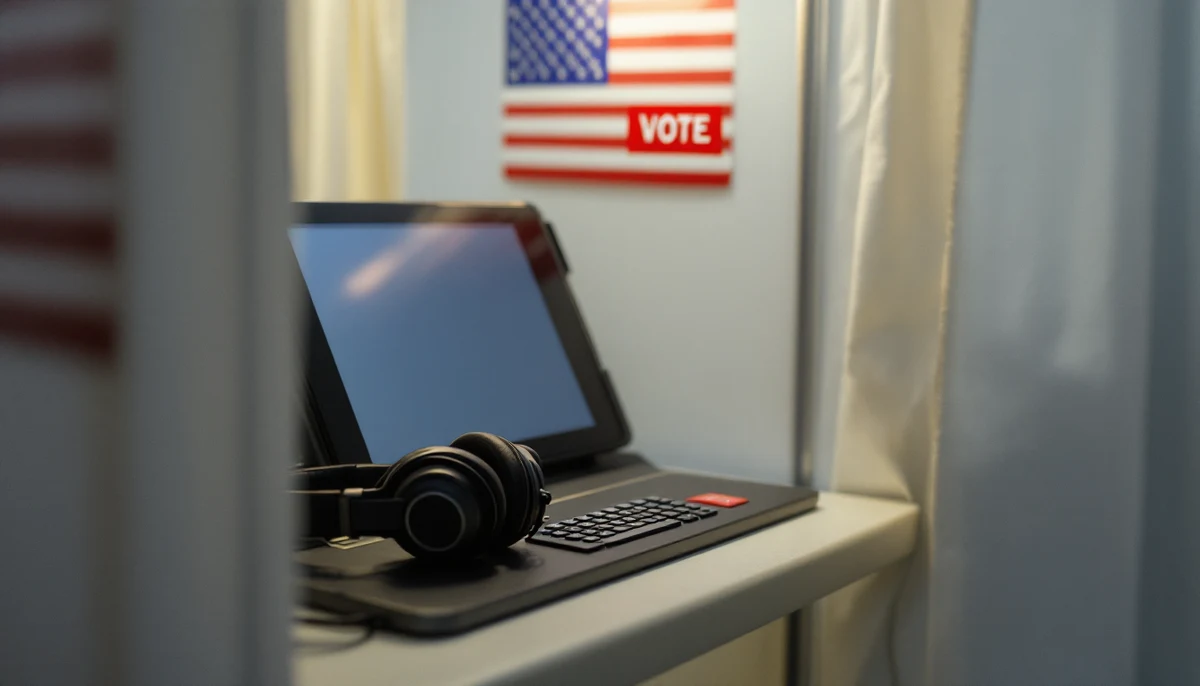
The machine most disabled voters now use to vote independently is a ballot-marking device (BMD): a touchscreen with an audio-tactile interface — headphones, a tactile keypad, sip-and-puff and rocker-switch inputs — that lets a voter who cannot read or mark a paper ballot make selections, then prints a marked ballot to be counted. The three that dominate US precincts are the ES&S ExpressVote, the Dominion ImageCast X, and the Hart InterCivic Verity Touch Writer and Duo. For a blind voter, a well-run BMD is the difference between voting alone and dictating choices to a stranger. The National Federation of the Blind’s 2024 survey found 84.6 percent of blind and low-vision voters who used an accessible machine voted privately and independently — up from 68 percent in 2018. When these devices work, they deliver exactly what HAVA promised.
But the BMD carries a verification problem that sits at the intersection of accessibility and election security, and it is worth stating precisely because it is easy to overstate. Most BMDs print a summary the voter is meant to check before casting. Research shows they mostly do not. In the Bernhard-led Michigan study, only 40 percent of voters reviewed the printout at all, and voters missed over 93 percent of deliberately introduced errors; a companion Rice University study by Kortum and Byrne found that voters who did examine the printout caught 76 percent of anomalies. The gap between “can verify” and “do verify” is the whole problem. For a blind voter the problem compounds: verifying a printed summary non-visually requires the machine to read the printout back, a capability not every deployment implements, and a barcode-only summary card cannot be independently verified by a human at all — which is why the move toward human-readable, non-barcode records matters for disabled and non-disabled voters alike.
The following is an illustrative walkthrough — not a specific audited incident — of how the failure presents in practice: a blind voter completes an audio ballot, the machine prints a summary card encoded as a barcode with small human-readable text, and there is no audio read-back of the printed card. The voter has voted independently up to the moment of verification, and then, at the one step where sighted voters get a final check, the independence quietly ends. That is the design gap the security and accessibility communities are, for once, aligned on closing.
05 · Online voter registration — the web half fails too
Before anyone reaches a polling place they usually have to register, and registration has moved online. That migration inherited every web-accessibility failure mode this publication documents elsewhere. The 2021 Harvard Technology Science study by Zang, van der Vorm and Guzman tested 43 state online voter-registration systems: only eight passed an automated scan with no major errors, 79 percent of testable registration pages failed, and eight states’ registration sites were completely unusable with the VoiceOver screen reader. A 2024 manual re-test against WCAG 2.2 found little had structurally changed — 42 of 43 sites still carried HTML validity errors, 77 percent were missing form-input labels (the single failure most likely to strand a screen-reader user mid-form), and only about a third earned a “high” accessibility rating.
These are the same defects — unlabelled inputs, low-contrast text, keyboard traps — that a routine automated accessibility scan surfaces on any government form, checked against the WCAG success criteria. What makes them consequential here is the stakes attached to the form: a registration page that a blind citizen cannot complete independently is a barrier to the franchise itself, not merely an inconvenience. Litigation has followed. In a case brought by the National Federation of the Blind and disability-rights groups, New York’s Board of Elections and DMV settled in 2019 and agreed to make the state’s online registration screen-reader accessible.
06 · Accessible vote-by-mail and the litigation record
For voters who cannot get to a polling place, the paper absentee ballot has always been the least accessible option in the system: a blind voter cannot mark a printed ballot privately, and for years the only remedy was to have someone else fill it in. Remote accessible vote-by-mail (RAVBM) closes that gap — the ballot is delivered electronically, marked on the voter’s own device with their own assistive technology, then printed and mailed back, with no vote transmitted over the internet. California has required RAVBM in every county since 2020; adoption elsewhere has been driven substantially by litigation.
The disability-rights case record over inaccessible mail ballots is one of the clearer accountability stories in this dossier, because it produced concrete remedies:
- NFB of Michigan v. Benson (E.D. Mich., 2020) — a consent decree requiring accessible absentee ballots in all future elections; over four thousand voters used the resulting system.
- NFB / CIDNY / DRNY v. New York State Board of Elections (settlement approved April 2022) — a statewide RAVBM program plus 400,000 US dollars in fees and costs.
- Drenth v. Boockvar (M.D. Pa., 2020) — a preliminary injunction requiring Pennsylvania to provide an accessible remote ballot for the general election.
- Hindel v. Husted (Ohio; Sixth Circuit reversal 2017, settled 2018) — Ohio required to offer accessible remote ballot-marking.
The pattern is telling: the accessible-mail-ballot right has largely been won ballot by ballot, state by state, in court — not delivered proactively by administrators. That is expensive, slow, and dependent on advocacy capacity that not every state’s voters have.
07 · The legal stack — HAVA, ADA Title II, and the 2024 web rule
Three federal layers govern this terrain. HAVA §301 sets the polling-place machine requirement described above. The Americans with Disabilities Act — Title II, which binds state and local governments — reaches the whole apparatus of an election as a government program, and the Department of Justice has used it: the DOJ’s 2016 ADA Checklist for Polling Places, its standing voting-rights guidance, and a string of settlements including a 2024 agreement with Los Angeles County over inaccessible vote centers and a 2019 agreement with Harris County, Texas, covering 750-plus polling places.
The newest and most consequential layer is the DOJ’s April 2024 Title II web rule (89 FR 31320), which for the first time sets a hard technical standard — WCAG 2.1 Level AA — for state and local government web content and mobile apps. Election and voter-registration websites are squarely within its scope. This is the mechanism that could finally force the OVR failures in section 05 to be fixed on a schedule rather than one lawsuit at a time.
The deadlines moved — get this right. The 2024 rule originally set compliance for April 2026 (jurisdictions of 50,000-plus) and April 2027 (smaller). A DOJ interim final rule effective in April 2026 extended both by a year. As of mid-2026 the operative deadlines are 26 April 2027 for larger jurisdictions and 26 April 2028 for populations under 50,000 and special districts. Any guidance still citing the 2026/2027 pair is out of date. The extension buys administrators time; it does not change the destination.
How these compare with the EU’s approach is instructive: where the US stacks HAVA plus ADA Title II plus the new web rule, Europe routes government-facing digital accessibility through the Web Accessibility Directive and EN 301 549. The mechanisms differ; the WCAG core is shared. Readers tracking the transatlantic picture can compare our ADA web-accessibility guide with the European Accessibility Act primer.
08 · What 2026 asks of election administrators
An accessible election is not a single fix; it is a chain, and the chain is only as strong as its weakest link. A voter with a disability must be able to register (the web layer), get to and into the polling place (the building layer), operate the machine privately and verify the result (the device and poll-worker layers), or mark a ballot at home (the mail layer). This dossier’s sources show every link failing somewhere. The building has improved but not enough. The machine is present but often mis-set-up and under-staffed. The website mostly fails outright. The mail ballot is being fixed in court rather than by design.
The concrete asks for 2026 are unglamorous and mostly cheap. Train poll workers to start the audio ballot — the single highest-leverage, lowest-cost fix in the system. Include a physical setup check in the polling-place opening procedure, not just a “machine present” checkbox. Bring registration websites to WCAG 2.1 AA ahead of the 2027 deadline rather than at it, using the same monitoring and remediation cadence any organisation would apply to a compliance obligation. And move toward human-readable, independently-verifiable ballot records so that verification — the one step where disabled independence currently breaks — becomes possible for everyone.
The machine is in the room
The recurring image across twenty years of this record is a voting machine that is technically present and functionally out of reach — in the room, as the law requires, but angled wrong, powered down, un-staffed, or fronted by a website the voter could never get past to reach it. HAVA promised “the same opportunity for access and participation, including privacy and independence.” The audits that already exist show how far “present” still is from “accessible.” No new scan is needed to see it; the public record has been saying it, clearly and repeatedly, since before some of today’s voters were born.
Figures in this dossier are attributed to their originating sources: the US Government Accountability Office (GAO-02-107, GAO-09-685, GAO-18-4); the Rutgers/EAC disability-turnout series (Schur and Kruse); the National Federation of the Blind post-election surveys; Bernhard et al. (IEEE Symposium on Security and Privacy, 2020) and Kortum and Byrne (Rice, 2021) on BMD verification; and Zang, van der Vorm and Guzman (Harvard Technology Science, 2021) on registration-site accessibility. The 2024 general-election turnout study in this series had not been published as of July 2026. Legal provisions cited are HAVA §301 (52 U.S.C. § 21081) and the DOJ Title II web rule (89 FR 31320), as amended by the 2026 compliance-date extension.